

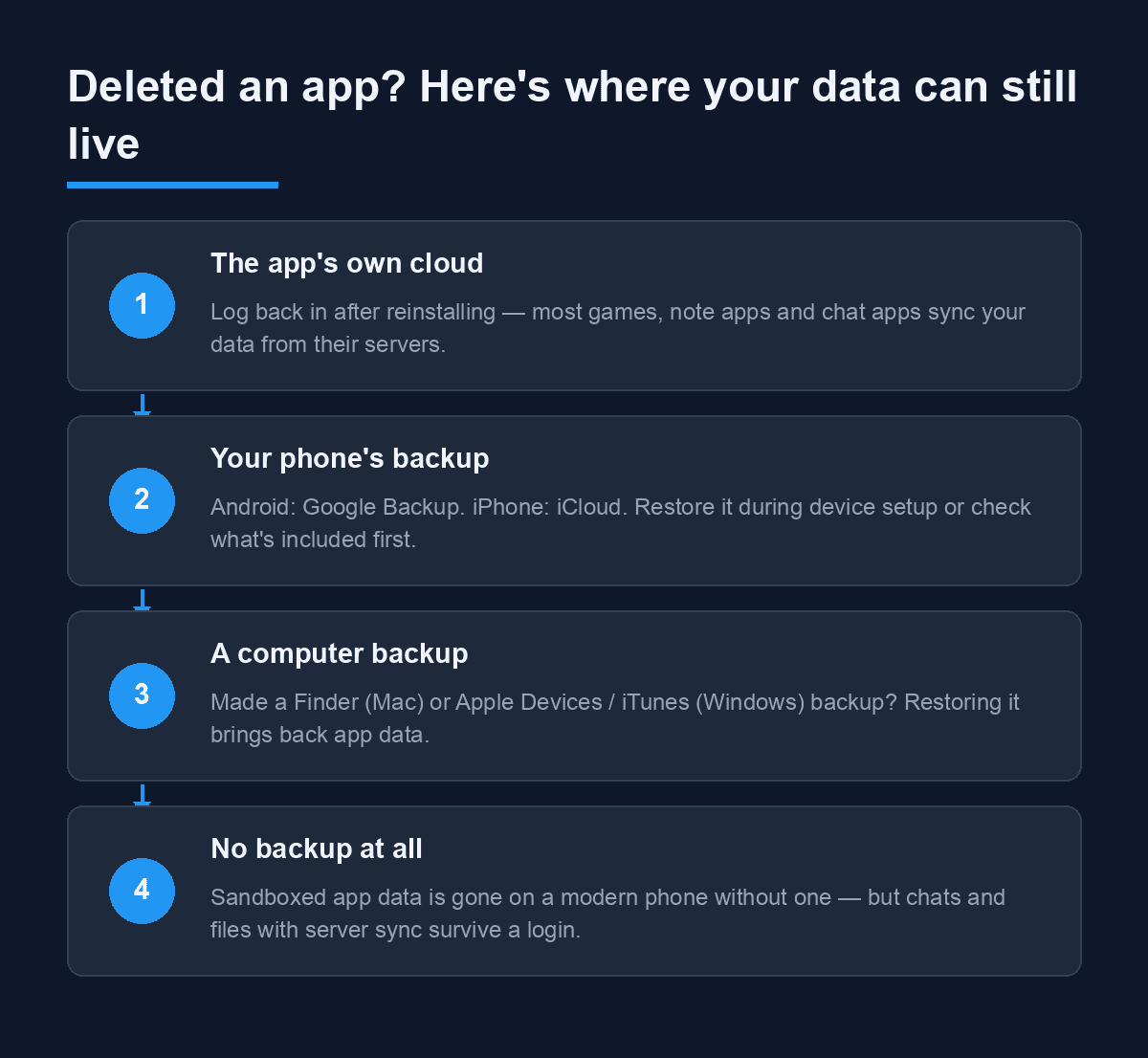
Deleted an app in a rush and only realised later it took your notes, chats, or game progress with it? Don't panic-install random "recovery" tools yet. On both Android and iPhone, deleted app data usually survives in one of three places: the app's own cloud, your phone's automatic backup, or a computer backup. This guide walks through each route in order — and is honest about the one situation where the data is genuinely gone.
Quick answer: Reinstall the app and log in first — most apps restore your data from their own servers. If that comes back empty, restore from Google Backup (Android) or iCloud (iPhone), or from a Finder/Apple Devices computer backup. Without any backup, sandboxed app data can't be recovered on a modern phone — but anything the app synced server-side is still safe.
First, understand where app data actually lives
Every app keeps data in two places: on your phone (settings, offline files, databases in the app's private storage) and on the developer's servers (account-linked data: messages, game saves, synced documents). Deleting the app only removes the phone-side half. The server half stays put until you delete your account — which is why the first fix below works so often.
There's also a third copy in play more often than people realise: your phone's automatic backup. Both Android and iPhone have backed up app data by default for years, so a delete-and-restore can bring back settings, chat histories, and documents — if you know where to look.
Fix 1: Reinstall and log in (works more often than anything else)
Before touching any backup, do the simplest thing:
1. Reinstall the app from the Play Store or App Store.
2. Open it and sign in with the same account you used before — Google, Apple, Facebook, or whatever the app offered.
3. Give it a minute on Wi-Fi. Apps with cloud sync (WhatsApp with a linked account, games signed into a game service, note apps, photo editors with accounts) pull your data back down.
This one login step recovers more "lost" app data than every recovery tool combined, because most developers moved data storage to their own servers years ago. Only if the app comes back genuinely empty — no account, or a purely local app — do you move on to backups.
Fix 2: Restore from your phone's backup
On Android (Google Backup)
If your phone had Backup by Google One enabled — it's on by default on most recent phones — your apps and (for participating apps) their data were being backed up. The catch: Google restores app data during device setup, not on a running phone.
- Check what you have: Settings → Google (search "Backup") → confirm a recent backup exists and that it includes apps.
- To restore: the practical route is Settings → System → Reset, then during setup sign into the same Google account and choose Restore from backup when offered, picking the most recent one. Apps reinstall and their backed-up data returns.
- Softer option first: some apps re-download their own data when you reinstall them on the same account — try Fix 1 before considering a reset.
A reset is a big step. If the missing data matters less than the hassle of setting the phone up again, weigh it honestly.
On iPhone (iCloud)
1. Check the backup exists: Settings → [your name] → iCloud → iCloud Backup (or Manage Account Storage → Backups) and look for a backup dated before you deleted the app.
2. If it exists, the restore happens during device setup: Settings → General → Transfer or Reset iPhone → Erase All Content and Settings, then during setup choose Restore from iCloud Backup and sign in with your Apple ID.
3. Apps reinstall from the App Store automatically with their backed-up data. Anything you've added to the phone since that backup is overwritten, so save recent photos and files elsewhere first.
iCloud's web interface at icloud.com is also worth checking for synced app content (notes, contacts, photos, files) that may already be safe there.
Fix 3: Restore from a computer backup
If you ever synced your iPhone to a computer, you have a second chance:
- Mac: a Finder backup (made by connecting the phone and syncing) includes app data.
- Windows: the Apple Devices app (or iTunes, if you still have it) makes the same local backups.
Connect the phone, choose Restore Backup, and pick the most recent backup from before the deletion. Same caveat as iCloud: restoring overwrites the phone's current state with the backup's state.
If there's no backup: what's actually possible
Here's where this guide differs from the older recovery-software roundups: on a modern, unrooted phone, third-party recovery tools cannot pull deleted app-private data out of thin air. Android has sandboxed app storage since its 4.x days — other apps (and desktop scanners) simply don't have access — and iOS similarly sandboxes app data. Any tool advertising full "deleted app data recovery without backup" on a current phone is overselling.
What genuinely still works without a backup:
- Server-side data — log into the app's account on any device (Fix 1).
- App-linked media — photos and videos the app saved to your gallery are recovered like any other deleted files; see how to recover deleted photos from an Android gallery.
- WhatsApp chats — if WhatsApp's own Google Drive/iCloud backup was on, reinstalling WhatsApp and verifying the same number restores your history.
- Transferred copies — data you ever exported to an SD card or computer may still be there; desktop recovery tools like those in our Stellar Data Recovery for Android review can scan SD cards and, for iPhone, existing computer backups — tools such as 4Easysoft iPhone Data Recovery work by reading iTunes/iCloud backups or scanning what's still on the device, not by performing magic on wiped storage.
How to never lose app data again (5-minute setup)
- Android: Settings → Google → Backup → turn on Backup by Google One. Check it says apps are included and a recent backup time.
- iPhone: Settings → [your name] → iCloud → iCloud Backup → Back Up Now, and leave the automatic overnight backups on.
- In-app: sign into the app's own account/cloud sync where offered — it's the most portable copy of all.
- Big apps, manual backup: WhatsApp (chats → chat backup), game accounts (link to Google/Apple/Game Center), note apps (enable sync).
FAQ
Can I recover app data without a backup?
Only what the app stored on its own servers. Log back into the app after reinstalling — messages, game progress and synced documents come back with your account. Data that lived only in the app's private on-phone storage is not recoverable on a modern unrooted phone without a backup, despite what some recovery tools advertise.
Does uninstalling an app delete my data on iPhone?
It deletes the app and its local data. Anything in iCloud, in a computer backup, or on the developer's servers survives. Note the separate Offload App option (Settings → General → iPhone Storage): offloading keeps documents and data on the phone and only removes the app itself.
Where is Android's app backup stored?
In your Google account's backup — encrypted on Google's servers, not on the device. Check it under Settings → Google → Backup. Restores happen during device setup, so recovering data onto your current install usually means a factory reset and restore-from-backup.
How do I restore an app I deleted on iPhone if I forgot its name?
Open the App Store, tap your profile picture, then Purchased → Not on this iPhone (or the My Purchases list). Every app your Apple ID ever downloaded is there in chronological order — reinstall from that list and sign back in.
Does Google Backup restore my game progress?
It restores the game app itself and any data the game opted into Android's Auto Backup. Progress tied to a game account (Google Play Games, Facebook, or a game-specific login) returns when you sign in — progress stored only in local files returns only if the developer enabled backup for them.
Is it safe to use "recover app data" apps from the Play Store?
Be sceptical. Tools that scan your gallery or SD card for deleted files are legitimate; tools promising to resurrect deleted app-private data with no backup are not — modern Android doesn't grant them access to other apps' storage. Stick to backups and account logins for app data itself.
Related reading
- How to Recover Data from Damaged iOS Devices — when the phone itself, not just the app, is the problem
- How to Recover Deleted Photos from Android Gallery — the media half of app-data loss
- Stellar Data Recovery for Android: a hands-on review — what desktop recovery can and can't do
- Recover Lost Data on Windows and Mac with AnyRecover — computer-side file recovery
Lost something to an app delete recently — and did it come back? Tell us which route saved it in the comments.