

Search "Enware Aurora 2019" today and you'll find dozens of blog posts describing it as an Alienware PC case — this article once did too. Here's the correction up front: no such product exists. The name is a mislabel of the Alienware Aurora 2019 gaming desktop (model R8) that spread across copycat blogs around 2022-23, and Enware — the company behind the "enware" half — is an Australian plumbing and industrial-safety manufacturer founded in 1937, with no connection to Dell, Alienware, or computers of any kind.
Quick answer: The "Enware Aurora 2019" is the Alienware Aurora R8 mislabeled by content farms. The real machine is a solid 2019-era gaming desktop — 9th-gen Intel, RTX 20-series graphics, great port selection — let down by hot-running internals and proprietary parts. In 2026 it's a secondhand curiosity only; buy the Aurora R16, the Area-51, or a standard-parts prebuilt instead.
Where the "Enware" name came from
The story is a small case study in how content farms launder names. Enware Australia makes emergency showers, taps and safety fittings for hospitals and industry — check their site and you'll find nothing that plugs into a monitor. Drop the "Ali" from Alienware, spin up a plausible-sounding review around the phrase, and the term gathers its own search volume, which then gets "reviewed" by the next blog in the chain. The old version of this very post claimed the Enware Aurora was an aluminum mid-tower case with a tempered-glass panel that accepted E-ATX motherboards. None of that describes the Alienware Aurora R8, which is a prebuilt desktop with a proprietary motherboard and power supply — you can't build into it at all.
If you arrived here genuinely hunting for a PC case, our teardown of what goes into a gaming PC cabinet covers the real thing — cases and the machines they house are separate purchases.
The real machine: Alienware Aurora R8 (2019)
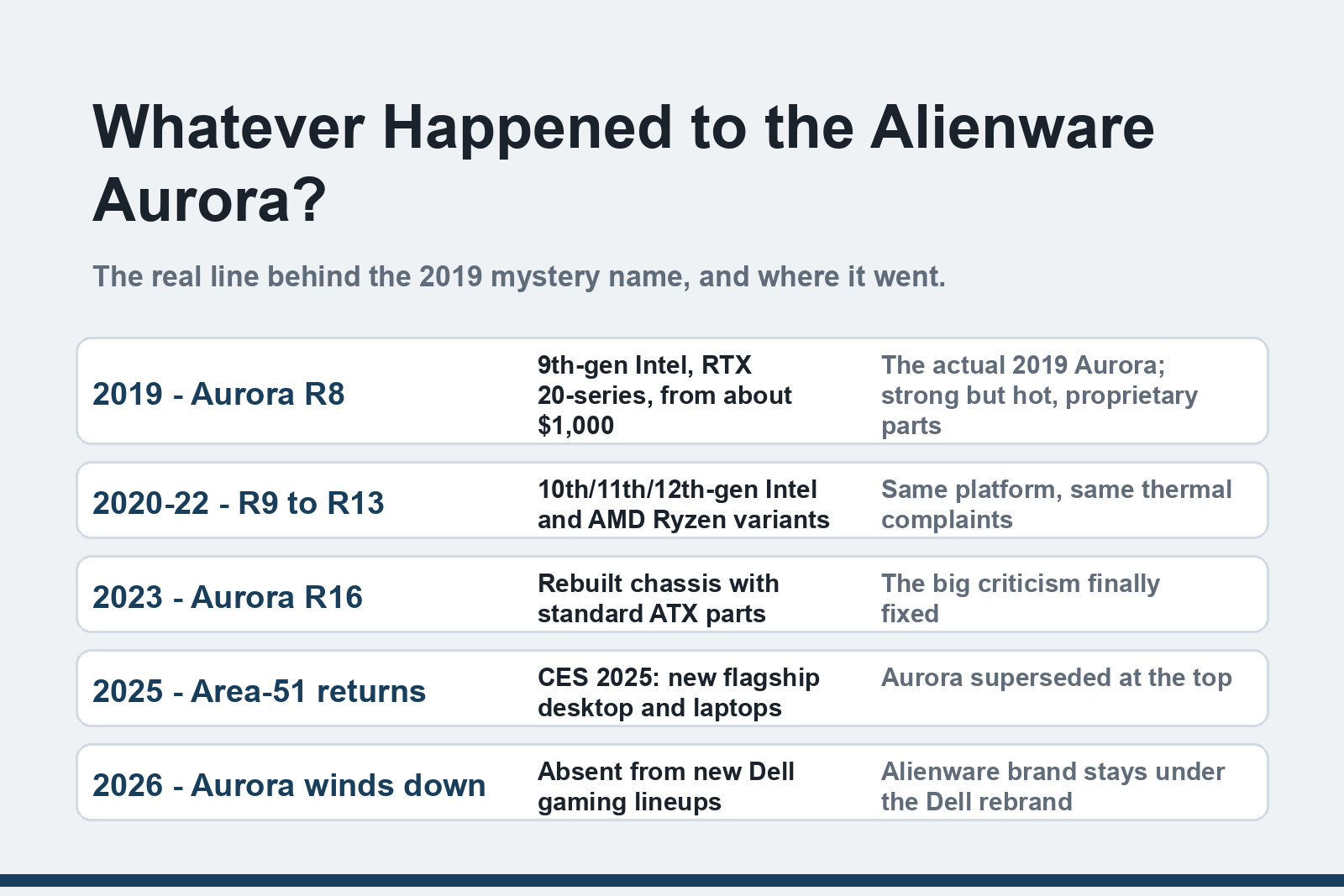
The Aurora R8 is what everyone writing about the "Enware Aurora" was actually describing. Launched mid-2019, it carried Intel's 9th-generation CPUs — Core i5-9400 up to the i9-9900K — with Nvidia GeForce RTX 20-series graphics from the RTX 2060 up to the 2080 Super, up to 64GB of DDR4, and storage combos of NVMe SSD plus hard drive. Configurations started around the $1,000 mark with mainstream specs, while loaded builds like Tom's Hardware's i9-9900K and RTX 2080 review unit ran to $2,625.
What reviewers liked: the Legend industrial design — the loop handle, the rear halo lighting — was genuinely distinctive, the port selection was generous for the class, and Alienware's tool-free interior made RAM and drive swaps easy. Performance in games was everything you'd expect from that hardware at the time.
What nobody liked, and what matters most in hindsight, were the two catches below.
Pros and cons as they stood in 2019
| Pros | Cons |
|---|---|
| Distinctive, compact chassis with a carry handle | Ran hot — sustained CPU loads throttled performance |
| Strong 9th-gen CPU + RTX 20-series configurations | Proprietary motherboard and PSU block normal upgrades |
| Easy tool-free access to RAM and drives | Premium price over equivalently specced standard builds |
| Wide port selection, including USB-C | Integrated graphics options were weak for the price |
Catch one: the thermals
The R8's compact chassis squeezed a 9th-gen i9 and an RTX card into a case with limited airflow, and sustained loads pushed CPU temperatures to the point of throttling — a criticism that followed the Aurora platform through the R9, R10 and beyond, and one that owners worked around with repastes, fan tweaks and aftermarket cooling. If you buy one used in 2026, assume the seven-year-old thermal paste has long since dried out; a repaste and dust-out is the first job, not an upgrade.
Catch two: the proprietary insides
Aurora desktops of this era used Alienware-specific motherboards and power supplies. That's why a machine that looks upgrade-friendly isn't: a GPU swap usually fits, but a serious CPU or PSU upgrade means replacing the board and power supply with standard parts — at which point you've rebuilt the PC around its case. This single design choice did more than thermals to earn the Aurora its reputation, and it's the reason used Auroras are priced as complete machines rather than platforms.
What happened to the Aurora line
Alienware kept the Aurora platform alive through the R9-R15 generations — same basic layout, same complaints — until the R16 in 2023 finally moved to a rebuilt chassis with standard ATX parts, fixing both catches at once. At CES 2025 Dell resurrected the Area-51 name as Alienware's new flagship desktop (and laptop) line, and under Dell's 2025 brand simplification Alienware remains the gaming brand while the Aurora has quietly wound out of the lineup. The irony is that the R16 and Area-51 are the machines the Aurora's buyers always asked for: standard parts, sane thermals, less LED tax.
The TechBii verdict
As a 2019 release: 7/10. For a style-first buyer who wanted a working RTX gaming desktop out of the box and never planned to upgrade the core, the R8 was a fair purchase — distinctive, quick, well-connected.
As a 2026 purchase: 3/10. Everything the R8 offered is now available used for a fraction of the price with standard parts, and its thermal and upgrade baggage is only seven years more stale.
The original verdict below this article's old version praised the "Enware Aurora" as an extraordinary addition if budget wasn't a constraint — for a product that never existed. The direction we'll keep is the honest version: the real Aurora R8 was a good machine for its moment, and that moment has passed. If you're shopping in 2026, a used R16 or any standard-parts prebuilt beats it, and if you're building instead, start with the components that actually matter — our first gaming PC buying guide and the five mistakes first-time builders make cover both routes. Pair any new machine with a monitoring habit; checking GPU performance on Windows takes minutes and catches thermal trouble early.
FAQ
Is Enware a real computer brand?
No. Enware Australia manufactures commercial plumbing and safety products — emergency showers, taps, healthcare fittings — and has no relation to Dell or Alienware. No company has ever sold a PC called the "Enware Aurora." The phrase is a content-farm corruption of "Alienware Aurora 2019" that spread across dozens of low-effort blogs, including an older version of this one.
What PC is the "Enware Aurora 2019" actually about?
The Alienware Aurora R8, Dell's 2019 mid-tower gaming desktop: 9th-generation Intel processors, Nvidia RTX 20-series graphics, from roughly $1,000 in base configurations. It shipped as a complete prebuilt — not a case — with a proprietary motherboard and power supply that limited later upgrades.
Is the Alienware Aurora R8 still worth buying in 2026?
Only cheaply, secondhand, with its age in mind. The 9th-gen CPU and RTX 20-series hardware still handle esports and older titles, but expect dried thermal paste, and remember the proprietary board and PSU cap your upgrade path. For most buyers, a used Aurora R16 (2023) with standard ATX parts or a self-built machine is the better spend.
Why did the Alienware Aurora get such bad reviews?
Two design decisions. The compact chassis restricted airflow, so i9-class CPUs throttled under sustained load, and reviewers measured the slowdown. The proprietary motherboard and power supply then blocked the standard fixes — you couldn't drop in better cooling hardware or a normal PSU. The 2023 R16 addressed both by moving to standard components.
What replaced the Alienware Aurora?
The Area-51, revived at CES 2025 as Alienware's flagship desktop line, now sits above where the Aurora was; the Aurora R16 (2023) with its standard-parts chassis remains the last and best-regarded Aurora generation. Under Dell's 2025 rebrand, Alienware continues as the dedicated gaming brand, with new Aurora models no longer part of the push.
That's the full correction: the machine was real, the name never was — and knowing which parts of a seven-year-old prebuilt age badly is the difference between a bargain and a paperweight.