

Native app to Flutter migration makes sense when separate iOS and Android roadmaps start slowing releases, increasing maintenance costs, and creating inconsistent user experiences. This blog explains the key business and technical scenarios where Flutter can support faster experimentation, phased modernization, and better cost control without forcing a complete app rewrite.
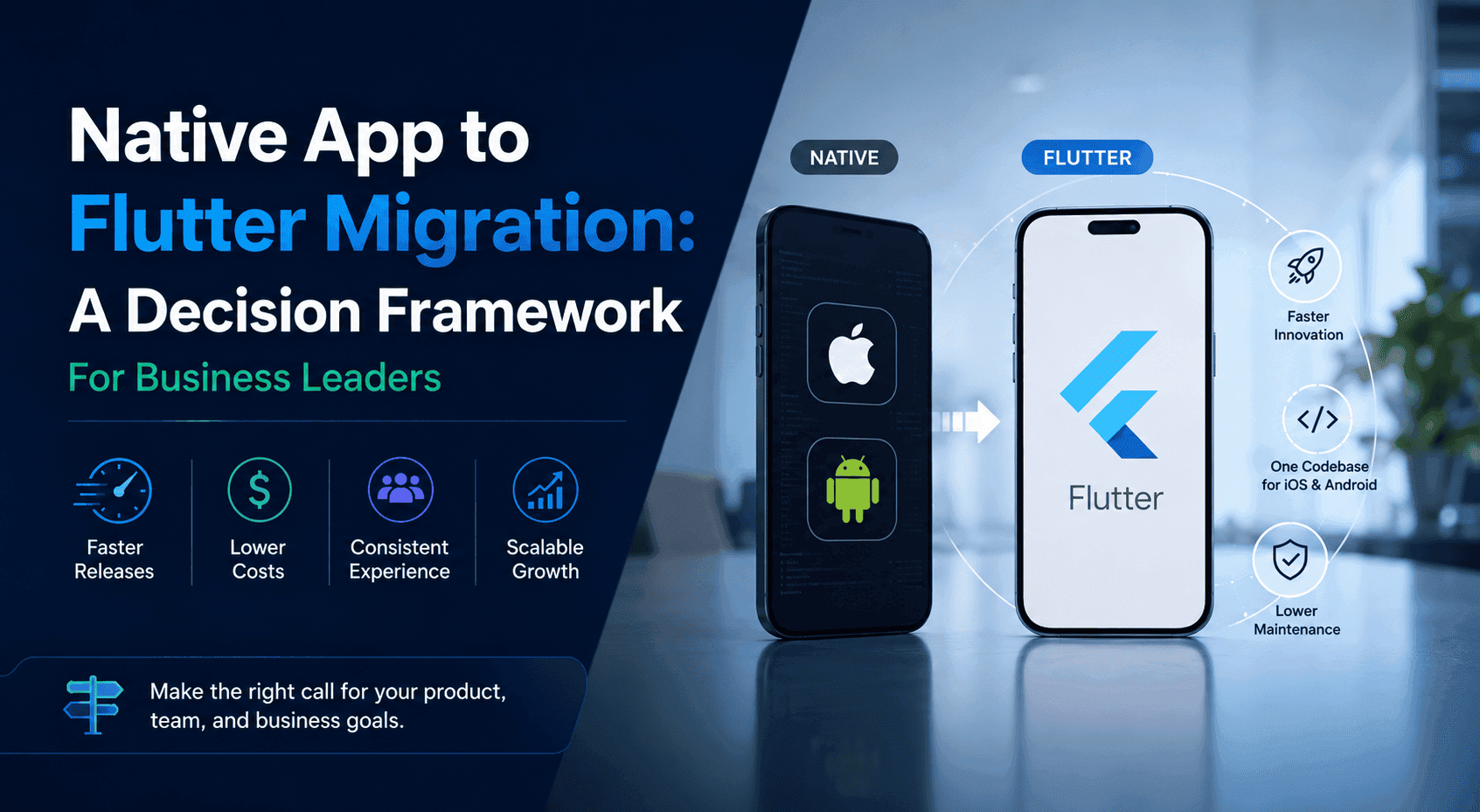
For the longest time, native apps began as the safest route for a mobile product. Performance, platform-specific behavior, and long-term stability all matter, and native development delivers on those fronts. But over time, maintaining separate iOS and Android teams, feature roadmaps, release cycles, QA processes, and design systems can increase cost and slow delivery. At that point, decision makers start looking for a way to reduce duplication without compromising the app experience. This is where a Flutter migration strategy often enters the discussion.
The core message for business leaders is simple: native is not the problem. The problem starts when the native setup becomes too expensive, too slow, or too fragmented for the company’s product roadmap.
Native-to-Flutter migration makes the most sense when separate app roadmaps, rising maintenance costs, inconsistent UX, or slower experimentation begin affecting business growth. The six scenarios below outline when Flutter migration becomes a strategic decision.
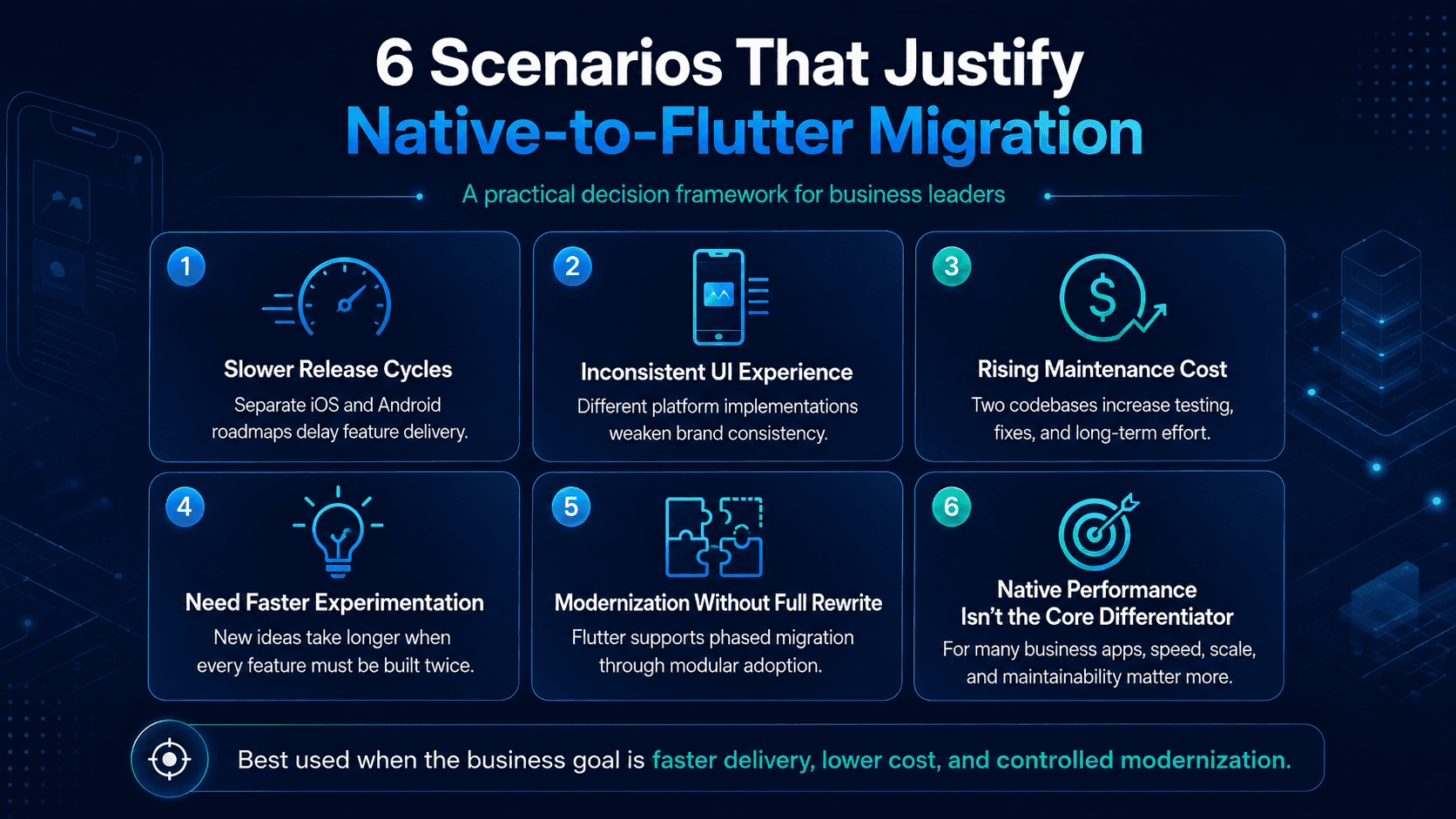
Native-to-Flutter migration makes the most sense when separate app roadmaps, rising maintenance costs, inconsistent UX, or slower experimentation begin affecting business growth.
Scenario 1: When Separate iOS and Android Roadmaps are Slowing Product Releases
Many enterprises maintain two native codebases: Swift or Objective-C for iOS and Kotlin or Java for Android. Every feature needs separate development, testing, bug fixing, and release coordination, which creates delays when business teams expect frequent feature updates.
Why Flutter Makes Sense?
For release builds, Flutter compiles directly to native machine code on iOS and Android, avoiding an interpreted bridge layer at runtime. A single CI/CD workflow can orchestrate builds, tests, and releases for both platforms. That said, though platform-specific signing, store submission, and build tooling still need to be managed separately. A large share of the business logic, UI flows, and non-platform-specific features can also be written once instead of being maintained separately across two native codebases.
Business Value
Faster releases, lower coordination overhead, better roadmap alignment, and improved engineering productivity.
Scenario 2: When UI and Brand Experience are Inconsistent Across Platforms
Native apps often drift apart visually because iOS and Android teams implement the same design differently, which becomes a real problem where mobile experience directly affects customer trust or conversion. The divergence happens because both platforms work on separate UI frameworks (like SwiftUI on iOS versus Jetpack Compose on Android) and rely on different layout constraints and text-rendering engines.
Why Flutter Makes Sense?
Flutter gives teams greater control over UI consistency because the interface is rendered through Flutter’s own engine. With Impeller as the default renderer on iOS and supported Android versions, teams can deliver a more consistent interface across platforms instead of relying entirely on native UI toolkits. Design tokens such as spacing, color, and typography can be centralized in a single configuration, so brand guidelines are implemented once instead of interpreted separately by two teams.
Business Value
A more consistent customer experience, stronger brand control, fewer design QA cycles, and reduced rework between product, design, and engineering teams.
Scenario 3: When Maintenance Cost is Rising Faster Than Product Value
A native app may be stable, but stability alone does not justify rising maintenance costs. If every small change requires two teams, two test cycles, and two platform-specific fixes, the business ends up paying twice for incremental improvements.
Why Flutter Makes Sense?
This is often the point where companies decide to migrate their native apps to Flutter, at least for shared business logic and non-platform-specific modules. A shared state management approach keeps business logic separate from the UI, so it stays consistent and reusable across screens. Shared Dart logic and Flutter UI flows can be tested through a unified test suite, while native modules and platform-specific integrations may still require targeted native testing. This consolidation halves synchronization friction for product managers and shrinks the surface area for platform-specific regressions.
Business Value
Lower long-term maintenance effort, better resource utilization, and reduced dependency on separate platform teams for every feature enhancement.
Scenario 4: When the App Needs Faster Experimentation and Feature Validation
CXOs increasingly expect mobile app development teams to test and release new business ideas quickly: subscription flows, checkout experiences, loyalty features, or AI-powered interfaces. Native development can slow experimentation when every idea must be built twice before it can be validated.
Why Flutter Makes Sense?
Flutter app migration works well when businesses need to prototype, test, and scale new cross-platform features quickly. Hot reload lets engineers push code changes into a running app in seconds, shortening the iteration loop compared to native rebuild-and-redeploy cycles. Companies can also add Flutter modules inside an existing native app (using Flutter’s Add-to-App capability) so new features ship without disturbing the surrounding app. Furthermore, it ensures absolute feature and analytics parity, allowing Flutter developers to collect clean, unified user data across both platforms simultaneously.
Business Value
Faster MVPs, shorter feedback loops, quicker market testing, and reduced cost of experimentation.
Scenario 5: When You Want to Modernize Without Rebuilding the Entire App
A complete rewrite sounds appealing, but it often becomes an operational bottleneck that traps engineering teams in a multi-year cycle of chasing a moving target.
Why Flutter Makes Sense?
A Flutter migration does not have to be a big bang replacement. Enterprises can start with a module-by-module migration strategy, rebuilding new screens in Flutter while keeping existing native modules for payments, Bluetooth, camera, or other platform-sensitive capabilities. Flutter supports this through platform channels, which let Flutter screens communicate with existing native SDKs without forcing a full rewrite, and the same approach extends to desktop platforms for future rollouts.
Business Value
Lower migration risk, continued product releases, better control over technical debt, and gradual modernization on the company’s own timeline.
Scenario 6: When Native Performance is Not the Main Competitive Advantage
Some apps genuinely need deep native performance: advanced gaming, real-time augmented reality (AR), low-latency video processing, or highly specialized OS-level behavior. Most business apps do not fall into this category.
Why Flutter Makes Sense?
For apps focused on commerce, bookings, dashboards, self-service, content, or SaaS access, Flutter can often provide the right balance of performance, speed, and maintainability without the overhead of two native codebases. Its Impeller engine draws directly to an OS-level canvas and comfortably maintains a smooth, jitter-free 60Hz to 120Hz refresh rate. Moreover, with Dart’s event-loop architecture, the app easily handles REST API orchestration, JSON parsing, and local caching to prevent itself from freezing under data-heavy transfers.
Business Value
The company avoids over-investing in native complexity where the business does not truly need it.
For many businesses, the right time to consider Flutter migration is when separate native codebases begin slowing the product roadmap. This is also where the role of experienced Flutter developers becomes important, because the decision depends on understanding what can be shared, what should remain native, and where migration will create real delivery value. Flutter becomes relevant when the app needs faster cross-platform delivery, stronger UI consistency, and a more scalable mobile architecture without removing native control where platform-specific functionality is still required.
Ending Note: Treat Flutter Migration as a Business and Architecture Decision
A native app to Flutter migration should be considered when the existing mobile setup no longer supports the speed, consistency, or flexibility the business needs. The decision is not about replacing native development for the sake of change. But about identifying where separate iOS and Android codebases are creating avoidable delays, duplicated engineering effort, inconsistent user journeys, or rising maintenance pressure.
Flutter becomes a strong option when shared product logic, reusable UI, and future platform expansion can create measurable value without weakening the app’s core performance or native capabilities. A clear evaluation should consider the current architecture, dependency depth, release workflow, team capabilities, and long-term product direction together. When those signals align, migrating from native to Flutter becomes a practical step toward building a more efficient mobile product.
Author Bio :
Murli Pawar is the Vice President of the Digital Engineering Division at SunTec India, leading enterprise-wide technology innovation and solution delivery. With over 20 years of experience, he specializes in software architecture, automation, AI integration, and digital modernization, helping global enterprises enhance agility, scalability, and business value through advanced technology solutions.