

Industrial cooling rarely gets attention until it fails. Yet in pharmaceutical plants, dairies, food-processing lines and cold stores, the cooling system is quietly doing safety work: keeping machines inside their thermal limits, keeping sensitive products inside spec, and keeping the working environment humane. This guide explains those roles and the practices that keep a cooling system safe to run.
Quick Answer: Industrial cooling systems improve safety in four ways: they prevent equipment overheating and fire risk, protect temperature-sensitive products from spoilage, reduce heat stress for workers, and add automated controls (sensors, alarms, redundancy) that catch failures before they become accidents.
Why overheating is a safety problem, not just a maintenance one
Production machinery converts most of its wasted energy into heat. Run a chiller line, compressor bank or packaging hall for long shifts without adequate heat rejection and three things happen in order: electronics drift out of spec, lubricants and seals degrade faster, and surfaces reach temperatures that ignite dust or foam near them. Overheating is behind a meaningful share of industrial equipment fires — which is why thermal management belongs in the safety plan next to guarding and lockout procedures, not just in the maintenance budget.
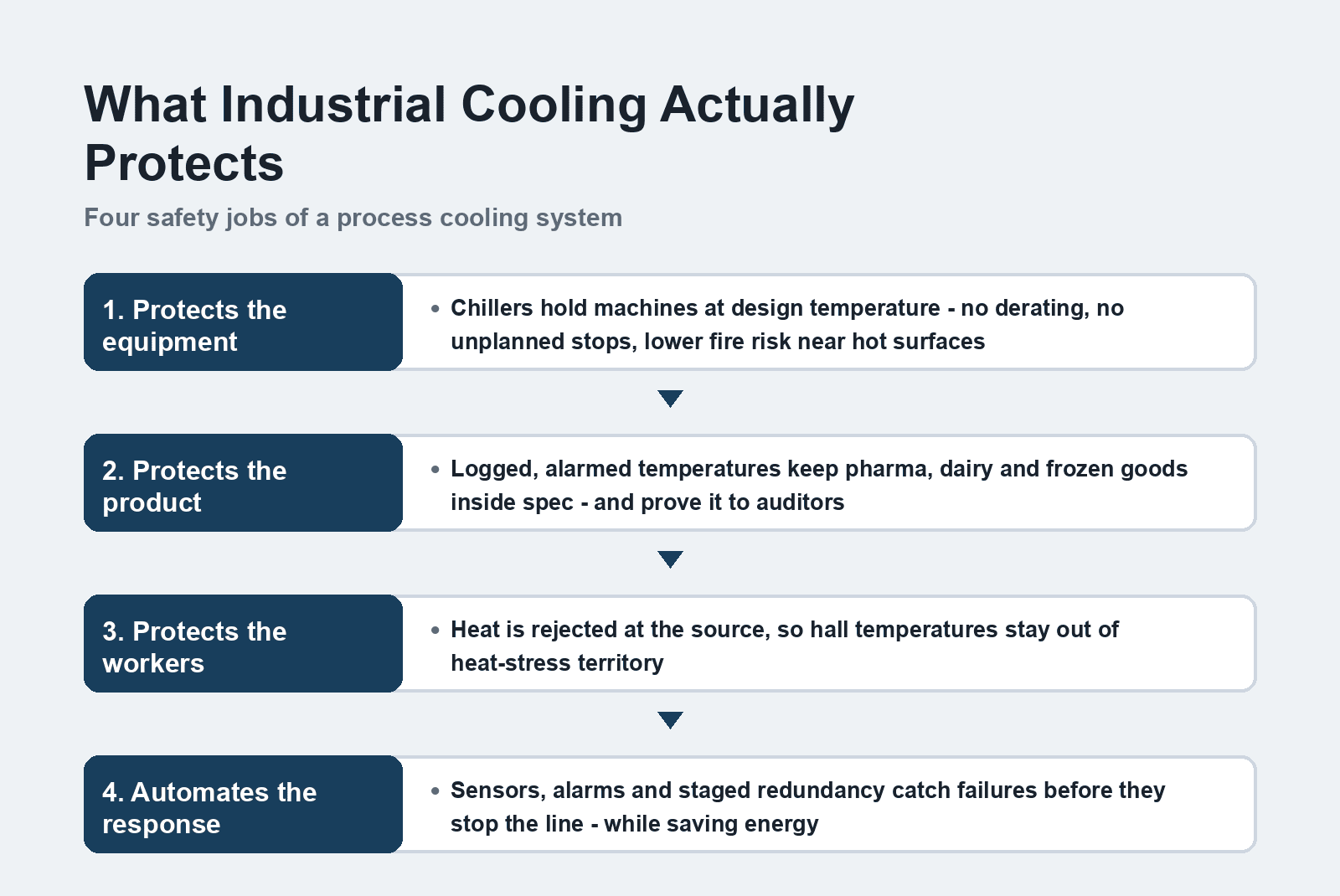
The four safety jobs of an industrial cooling system
1. Protecting the equipment
Chillers hold process equipment at design temperature so machines can run long production campaigns without derating or unplanned stops. Modern ranges — from compact C-class units to high-capacity HCP-class industrial chillers — pair compressors with electronic controls that modulate capacity instead of cycling hard on and off, which reduces thermal stress on the machines they serve. Vendors such as Fenagy publish their ranges' monitoring and alarm features openly, which makes comparing safety instrumentation across suppliers straightforward.
2. Protecting the product
Vaccines, dairy, ready meals and frozen goods tolerate narrow temperature windows. A failing cooling loop doesn't just risk quality — a broken cold chain can turn an entire batch into regulated waste, and in pharma, an undocumented temperature excursion can invalidate the batch's release. Reliable cooling with logged, alarmed temperatures is therefore part of the product-safety system: it provides the evidence trail auditors ask for, not just the cooling itself.
3. Protecting the workers
Machines dump their heat into the hall. Without effective heat rejection, workplace temperatures climb into heat-stress territory — fatigue, slower reaction times and more mistakes, especially around hot surfaces and moving machinery. Moving the heat out at the source (process cooling) rather than relying on ventilation to dilute it keeps the working environment safer and cheaper to condition.
4. Automating the response
Modern chillers carry the safety instrumentation a plant's own staff can't watch around the clock: temperature and pressure sensors, flow monitoring, alarm relays into the SCADA or BMS, and staged redundancy so a single component failure degrades capacity instead of stopping the line. Integrated controls also save energy — variable-speed compressors and fans match output to load — which matters because an over-worked cooling system is both an operating-cost problem and a reliability problem.
Keeping the system itself safe: a working checklist
1. Size for the real thermal load, including summer peaks — an undersized chiller runs flat-out and fails on the hottest day.
2. Wire the alarms somewhere people actually see them — SCADA, SMS or BMS, not a local panel in an empty room.
3. Service on schedule: clean condensers, check refrigerant charge, test safety cutouts. Quarterly is a common baseline for process cooling; follow the manufacturer's interval.
4. Build in redundancy for critical loads: N+1 compressors, dual pumps, or at minimum a documented fallback for the most sensitive product areas.
5. Handle refrigerants compliantly — leak checks and records are legal obligations in most jurisdictions, and leaks are both an environmental and a safety event.
6. Log temperatures continuously. The record protects the product claim, directs maintenance, and turns "the cooler felt warm" into a precise event with a time stamp.
Red flags that call for a service visit
Rising discharge temperatures, short cycling, unusual compressor noise, ice forming where it shouldn't, or alarms that are frequently silenced — any of these means the system is working harder than it should. Investigating early costs a service visit; ignoring them risks the batch, the machine or the fire-safety margin.
FAQ
What temperatures do pharmaceutical cold rooms need?
Typical cold-chain ranges are 2-8°C for chilled vaccine and biologic storage and around -20°C or below for frozen material, with the exact window set by the product license. What regulators care about as much as the setpoint is the monitored record — continuous logging with alarms on excursions.
How often should industrial chillers be serviced?
Most manufacturers specify service intervals of three to six months depending on load and environment: condenser cleaning, refrigerant and oil checks, sensor calibration and safety-cutout tests. Heavy-duty or dusty environments shorten the interval. Missed service shows up first as rising energy use, then as failures.
What's the difference between air-cooled and water-cooled chillers?
Air-cooled units reject heat to outdoor air and are simpler to install; water-cooled units use a cooling tower circuit, reach better efficiency at large loads, and need water treatment. The safety angle: water-cooled plants carry legionella-management duties for their towers, so the choice affects your compliance workload, not just your energy bill.
Do modern chillers really save energy?
Yes — variable-speed compressors and EC fans that track the actual load typically cut cooling energy substantially versus fixed-speed units that cycle on and off, with payback periods that vary by duty cycle. The efficiency also reduces thermal stress, which is why energy upgrades and safety upgrades are usually the same upgrade.