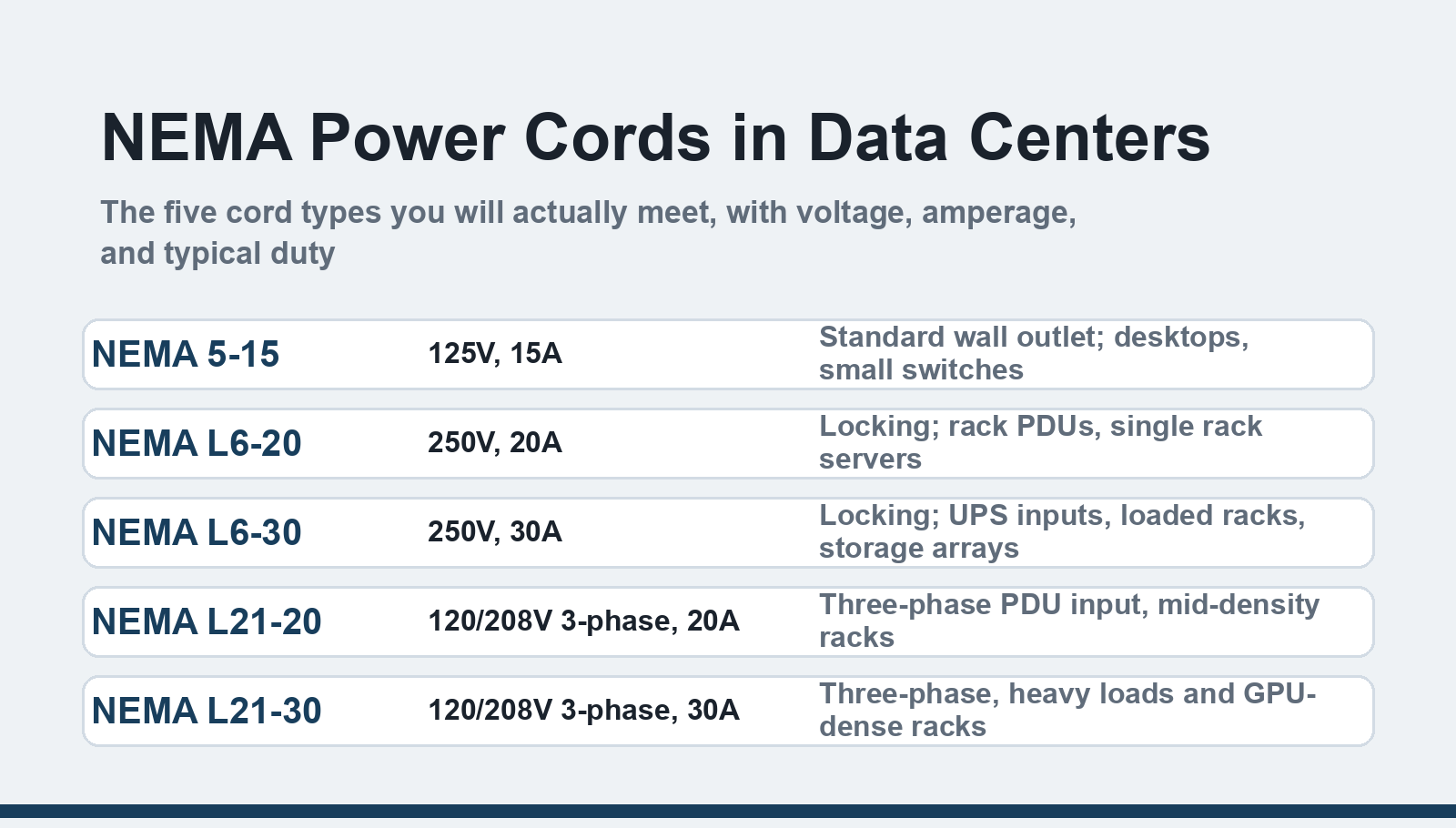
Data center power fails at the most boring component first: the cord. A rack that draws 8,000 watts through an underrated or unlocked connector doesn't warn you — it trips a circuit at 2 a.m. or melts a plug. This guide covers the five NEMA connector types that carry most server-room power in 2026, the amp math behind them, and what's replacing them in the highest-density aisles.
Quick Answer: The workhorse NEMA cords in data centers are the locking L6-20 (250V/20A) and L6-30 (250V/30A) for single-phase rack power, plus the three-phase L21-20 and L21-30 (120/208V, 20A or 30A per phase) feeding rack PDUs. Standard 5-15 wall plugs only handle desktop gear. Above ~10 kW per rack, plugs give way to hardwired and busway distribution.
Why server rooms can't use ordinary wall plugs
A residential outlet delivers 15 amps at 120 volts — about 1,800 watts. A single modern rack can hold forty servers, and even modest 1U machines add up fast. Data centers solve this with two upgrades:
Three-phase power. Commercial buildings receive three-phase supply; data centers distribute it to the rack because three conductors carry far more power for the copper they use. The L21 family of connectors exists specifically to deliver all three phases plus neutral and ground through one plug.
Redundancy. Every serious facility runs A+B power feeds from separate UPS systems, so each server has two power supplies on two independent paths. The connectors on those paths must be locking — a plug that vibrates loose takes down a server with redundant power still technically flowing.
Locking connectors use a twist ring that seats the plug into the receptacle. Once twisted, they cannot be pulled out by cable weight, maintenance bumps, or gravity — the single biggest reason L-series connectors dominate over straight-blade plugs in racks.
The five NEMA cords you'll actually meet
NEMA 5-15 — the baseline. 125 volts, 15 amps, the ordinary grounded plug. In a server room it belongs at the edge: management workstations, KVM consoles, small network closets. Any rack that matters has outgrown it.
NEMA L6-20 — the rack workhorse. 250 volts, 20 amps, locking. Most single-phase rack PDUs terminate in an L6-20 plug, giving a rack about 3.8 kW of usable power (80% of 4.8 kVA, the continuous-load derating rule). Rack servers, switches, and storage drawers all live here. It is the single most common server-room cord.
NEMA L6-30 — more of the same, bigger. 250 volts, 30 amps, locking — about 5.7 kW usable. Used for fuller racks, larger UPS input connections, and blade chassis in single-phase buildings.
NEMA L21-20 — three-phase entry. Carries 120/208-volt three-phase power at 20 amps per phase (roughly 6 kW usable through a matching PDU). The five-wire configuration lets one feed supply a PDU with mixed 120V and 208V outlets, which is why it's the standard input cord for mid-density three-phase racks.
NEMA L21-30 — the heavy plug. Same 120/208V three-phase at 30 amps per phase — around 9 kW usable. This is the practical ceiling of plug-based power delivery in most North American racks, and the feed you'll find on high-performance and GPU-dense racks.
One labeling note: NEMA 250-volt-class connectors (L6, and 6-series generally) are rated 250V, though the facility typically supplies 240V — you'll see both numbers on spec sheets, and they refer to the same hardware.
Matching cords to equipment
| Equipment | Typical draw | Cord / feed |
|---|---|---|
| 1U rack server | 300–500W | L6-20 fed PDU |
| Fully loaded 42U rack (classic) | 4–8 kW | L6-30 or L21-20 |
| Storage array | 1–3 kW | L6-30 fed PDU |
| Blade chassis | 4–10 kW | L21-20/L21-30 |
| 8-GPU AI server | 10–14 kW | L21-30, or dual feeds |
| AI rack (NVL72-class) | 100+ kW | Beyond plugs — busway/415V |
That last row is the 2026 change: AI accelerated racks past anything a single connector carries. An eight-GPU server can pull as much power as a 2015-era rack by itself, and modern AI racks measure in the tens of kilowatts per cabinet — hyperscale operators feed them with 415V three-phase Wye distribution, overhead busway, and hardwired PDUs using IEC C-connector outlets rather than any NEMA locking plug. NEMA cords remain the language of enterprise server rooms; the AI aisle has moved past them.
Special-case cords
High-temperature ratings. Cable jackets carry a temperature rating — 75°C for controlled spaces, 90°C typical, 105°C for hot aisles where cables run near exhaust. Underrated jackets stiffen and crack fastest in contained hot aisles.
Plenum-rated (CMP). Any cord routed through ceiling plenums or raised-floor air spaces must use low-smoke, fire-retardant jacketing that meets plenum code. It's a code requirement, not a preference — inspectors fail installations for it.
Hospital-grade and shielded variants exist for facilities with power-quality monitoring requirements, though data centers more commonly solve this at the PDU level.
Safety and installation practice
- Locking connectors everywhere a plug can be bumped. Straight-blade 5-15/5-20 only for fixed, out-of-path equipment.
- Separate power and data pathways. Power cords and Ethernet runs in their own trays or ladders — crossing at right angles if they must meet. Our Ethernet cable comparison covers the data side of that separation.
- Spread loads across circuits. Two PDUs per rack, each on its own feed, and balance server power supplies across both. A rack drawing full power from one feed has no redundancy.
- Certifications: UL or CSA listing, ETL verification, RoHS compliance. Counterfeit cords with fake UL marks are common enough in the discount market that certification marks deserve a second look on unfamiliar brands.
- Buy from cable specialists. Data-center-grade suppliers — SF Cable's NEMA cord catalog is one example of a specialist power cord source — spec jacket gauge, temperature rating, and certified connectors, which is what separates a rack cord from an appliance cord that happens to fit.
Maintenance: the checklist that prevents outages
On a schedule: visual inspection monthly (jacket cracks, connector heat discoloration, plug wobble), thermal-camera scan of PDUs and connections quarterly, full power-path test annually.
Replace immediately on any of these: cracked or stiffened jacket, melted or discolored connector, loose locking ring, hot spots on a thermal scan, or unexplained resets traced to a cord. Power cords are commodity parts — there is no economy in nursing a failing one on production hardware.
Facility monitoring closes the loop: rack-level power telemetry catches a drifting PDU load long before a breaker does, and server and network monitoring platforms increasingly include environmental sensors for exactly this. When racks get decommissioned, much of this cabling gets resold — see what happens to enterprise hardware after data center upgrades for that afterlife.
FAQ
What's the difference between an L6-20 and a 6-20?
The L means locking. Both are 250V/20A electrically, but the L6-20 twists into its receptacle and can't be pulled loose, while the straight-blade 6-20 can. Data centers standardize on locking connectors because a dislodged plug is an outage.
How many watts can an L21-30 actually deliver?
On paper, 30 amps at 208 volts three-phase is about 10.8 kVA. Continuous-load practice derates to 80%, so plan around 9 kW of sustained draw per cord. Feeding a PDU that splits it into 120V and 208V branch outlets, that's a well-loaded rack on one connector.
Are C13/C19 cords replacing NEMA in data centers?
They coexist by level. C13/C19 are the device-end connectors on server power supplies; NEMA connectors are typically the facility-end feed into the PDU. The move "past NEMA" at high density is about the feed level — 415V Wye, busway, and hardwired PDUs — not about the C-connectors on each server.
Why 80% derating for continuous loads?
Electrical code treats loads running three or more hours as continuous, requiring sizing at 125% of the load — equivalently, 80% of the circuit rating. A 20A circuit is planned for 16A sustained. It's the margin that keeps connectors and breakers from cooking under steady data center loads.
Related reading
- What happens to enterprise hardware after data center upgrades
- Cat5e vs Cat6 vs Cat7 vs Cat8: which Ethernet cable
- OpManager Plus for network and server monitoring
Before buying anything, do the amp math for the rack you actually have — the right cord is the one rated for your worst-case sustained draw plus 25%, not the biggest plug that fits.