


In contemporary interior design, the role of lighting has experienced a profound shift. It is no longer viewed merely as a functional necessity—a fixture hung from the ceiling to dispel darkness. Today, architects and interior designers treat light as a foundational building material. The prevailing trend leans heavily into minimalism: defining spatial flow, highlighting architectural geometries, and creating infinite visual depth through clean, continuous lines of light.
The ultimate goal for many modern commercial and high-end residential spaces is the seamless aesthetic. Designers want the light to appear as though it is naturally glowing from within the architecture itself, completely devoid of visible hardware, joints, or LED pixelation. However, translating this sweeping, monolithic vision from a beautiful architectural rendering into a physical, manufactured product presents a significant engineering hurdle.

The Luminaire Design Challenge: Breaking Physical Boundaries
When a designer specifies a flawless, 10-meter continuous ribbon of light traversing a corporate lobby ceiling, luminaire manufacturers face a harsh reality check. Traditional optical manufacturing methods, while excellent for certain applications, physically clash with the concept of infinity.
For instance, plastic injection molding is the undisputed gold standard for creating precise, targeted optics (like tight 15-degree spotlights). However, injection molds are strictly constrained by the physical size of the steel tooling and the pressing machine. Because of this, an injection-molded linear cover typically maxes out at about 1.2 to 1.5 meters in length.
To create that 10-meter line of light using molded parts, a manufacturer must connect multiple segments end-to-end. This creates the enemy of modern lighting design: the visible seam. Every connection point introduces the risk of a dark zone (a shadow where the plastic segments meet) or a light leak (where harsh, uncontrolled glare escapes through a microscopic gap). These visual interruptions instantly shatter the illusion of a continuous architectural element.
The Extrusion Paradigm: Engineering the Infinite Line
To eliminate these seams and achieve true architectural integration, the manufacturing approach must shift from a batch process to a continuous one. This is where extrusion technology steps in to solve the design bottleneck.
Instead of injecting polymer into a closed, finite mold, the extrusion process involves melting optical-grade materials—like Polycarbonate (PC) or PMMA (Acrylic) —and pushing them continuously through a custom-shaped steel die. This process creates an Extrusion Lens that can be manufactured to virtually any length required by the project. Whether it is a rigid 3-meter section for a suspended pendant or a continuous 50-meter flexible roll for curved cove lighting, extrusion delivers an entirely uninterrupted optical surface.
Beyond length, the continuous extrusion process allows for flawless diffusion. By perfectly blending high-quality diffusing agents into the raw polymer before it is shaped, the resulting extruded lens completely masks the individual LED diodes, providing the uniform, glowing surface that modern interior designers demand, while maintaining excellent visual comfort and low glare.
Beyond the Diffuser: The Need for a Complete Linear System
However, industrial designers know that a successful luminaire requires more than just a beautiful strip of plastic. Lighting is a system, and every component must interact perfectly.
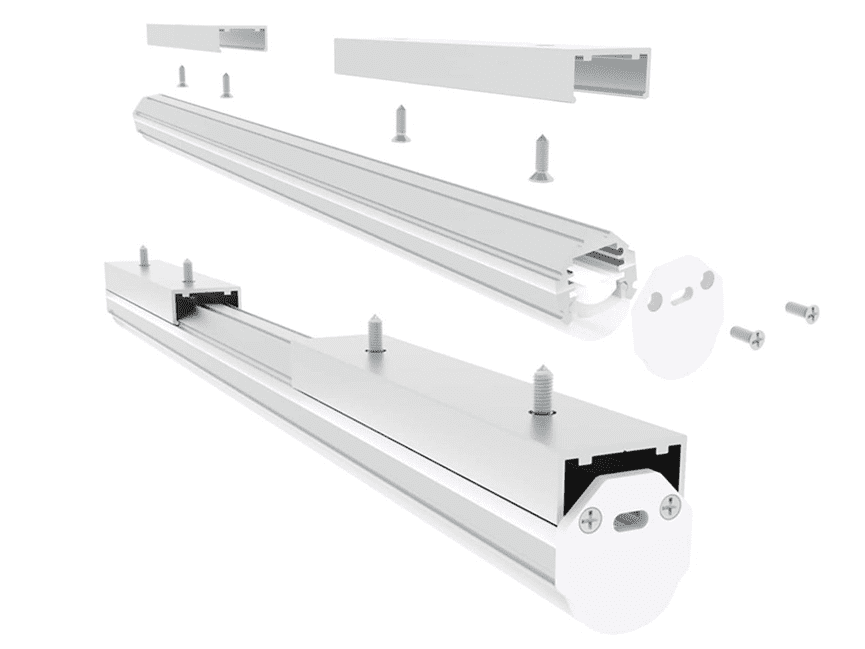
If an optical cover does not precisely match the aluminum housing, the fixture may suffer from thermal expansion warping, or it may fail its IP rating, allowing dust and moisture to ingress. Therefore, when developing linear lighting, manufacturers cannot look at the optics in isolation.
Achieving the perfect fixture requires a holistic approach. It involves pairing the optics with precisely engineered aluminum profiles that manage heat dissipation, alongside perfectly matched end caps and mounting accessories. A poorly fitted end cap can cause as much light leakage as a seam in the middle of the lens.
Sourcing the Right Manufacturing Partner
For luminaire brands and lighting designers looking to bring high-end linear concepts to life, the key to success lies in the supply chain. Sourcing the aluminum profile from one vendor, the plastic cover from another, and the end caps from a third is a recipe for tolerance mismatches and assembly nightmares.
The most efficient route is partnering with an optical manufacturer capable of delivering a comprehensive solution. Industry leaders like Asahi Optics do not just supply raw plastic; they engineer the entire ecosystem. Whether a project requires a standard geometric profile or a highly complex custom extruded lens tailored to a unique architectural contour, having a single-source manufacturer ensures that the optical cover, the aluminum profile, and the end caps fit together with microscopic precision.
By utilizing a complete Extrusion Linear Lens system from a dedicated partner, lighting manufacturers can confidently deliver the pristine, unbroken lines of light that define the future of architectural design, ensuring that the final installation looks exactly as flawless as the original blueprint.