


Amazon's search bar is still where product discovery starts — most shoppers never scroll past the first page of results — which makes keyword research the cheapest ranking lever a seller controls. The tooling has changed since this list was first drawn up: Helium 10 and Jungle Scout have become the mainstream all-in-one choices, Sellics' free Sonar tool now lives under the Perpetua brand, and several 2021-era prices are history. Here's the updated 2026 shortlist, what each tool actually does best, and what it costs.
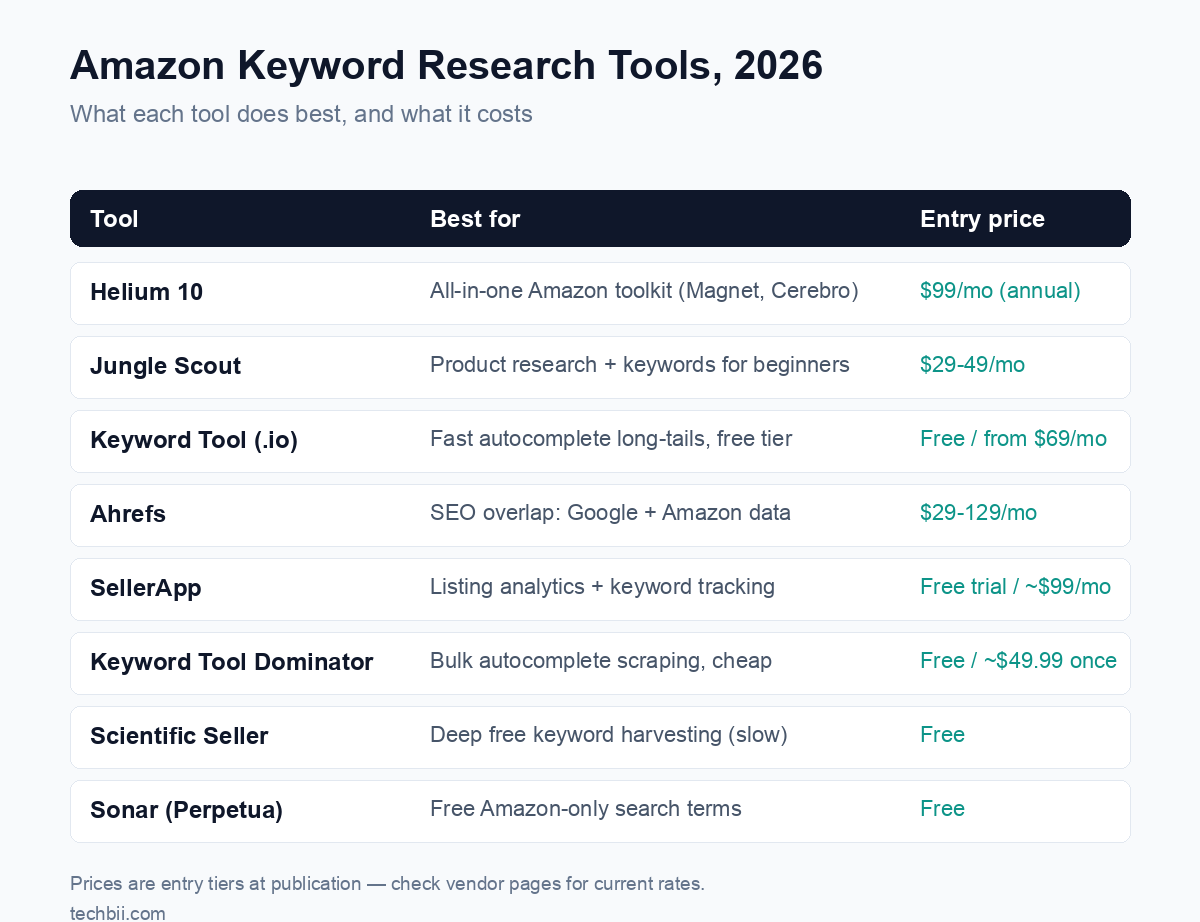
Quick Answer: The best Amazon keyword research tools in 2026: Helium 10 (from ~$99/mo annual) for the deepest all-in-one toolkit, Jungle Scout (from ~$29/mo) for beginners, Keyword Tool .io for fast free long-tails, Ahrefs for SEO-overlap research, and Scientific Seller or Sonar for genuinely free options. Start free, upgrade when your listings volume justifies it.
1. Helium 10
Best for: serious sellers who want one subscription to cover research, listing optimization and tracking.
Helium 10 is the industry heavyweight, and its keyword tools justify the reputation: Magnet mines Amazon autocomplete for long-tail suggestions with search-volume estimates, while Cerebro reverse-engineers any ASIN — including competitors' — to show every keyword it ranks for. Listing Builder then turns that research into optimized titles, bullets and backend terms, and the index checker confirms Amazon actually indexed you for a term. Pricing runs about $99/month for Platinum on annual billing (~$129 monthly), with Diamond and Enterprise above it; the free plan offers limited daily searches, enough to taste the workflow. If keyword research on Amazon is a weekly job rather than a setup task, this is the tool most professionals land on.
2. Jungle Scout
Best for: beginners and product researchers who want keywords in the context of product opportunity.
Jungle Scout approaches keywords from the product-research side: its Keyword Scout shows search volume, trend graphs, and — usefully — related terms organized by what buyers actually type, alongside its product/opportunity databases. Entry pricing undercuts Helium 10 (Starter around $49/month monthly, $29 on annual, with Growth Accelerator tiers above), making it the friendly on-ramp for new sellers. The trade-off: keyword tooling is a feature of a broader suite rather than the deepest standalone research engine. For a solo seller validating a first product and its keywords in the same afternoon, that bundling is exactly the point.
3. Keyword Tool .io
Best for: fast, no-login autocomplete harvesting of long-tail phrases.
Keyword Tool remains the quickest way to pull hundreds of Amazon autocomplete suggestions for a seed term — type "yoga mat", get the long-tail phrases real shoppers append, in seconds and without an account. The free tier shows the keywords; paid plans (from roughly $69/month, with Pro Plus and Business tiers up to ~$159) unlock search-volume and competition estimates. It doesn't know Amazon-specific metrics like Cerebro does, but as a cheap idea generator — especially for backend search terms where you just need coverage — it punches far above its price. I still run seed terms through it before touching anything paid, because autocomplete data is raw demand, unfiltered by any vendor's model.
4. Ahrefs
Best for: sellers whose buyers also search Google — the SEO overlap play.
Ahrefs is an SEO suite first, but it earns its slot here: Amazon product and category pages rank in Google, and Ahrefs' data reveals which keywords send organic traffic to Amazon listings — intelligence you can use to pick product names and listing phrases that win on both engines. Pricing changed since 2021: plans now start at a $29/month Starter tier, with Lite at $129/month as the real working plan. If your marketing strategy treats Amazon listings and your own storefront/website as one organic-search system, this perspective is unique on this list. If you only ever sell inside Amazon, Helium 10's Amazon-native data serves you better for the money.
5. SellerApp
Best for: mid-size sellers who want keyword tracking fused with listing analytics.
SellerApp combines keyword research with product analytics — search volumes, estimated orders, CPC ranges, listing-quality scores — and tracks your keyword ranks over time so you can see whether a listing change actually moved the needle. A free tier/trial covers the basics; paid plans have historically run from around $99/month upward, with 25% off annual billing — check the current pricing page, as tiers have shifted more than once. It sits sensibly between the free tools and Helium 10's full suite: more Amazon-native depth than Keyword Tool, less cost than the heavyweights.
6. Keyword Tool Dominator
Best for: bulk autocomplete scraping on a budget — one-time purchase.
Keyword Tool Dominator automates what manual autocomplete mining looks like: it crawls Amazon's suggest phrases for your seed terms in bulk and exports lists in real time. The free version handles limited daily searches; the paid edition has historically been a one-time ~$49.99 license rather than a subscription — a pricing model that's nearly extinct in this market, which alone keeps it worth mentioning. It's a pure autocomplete harvester: no volumes, no competition scores. Use it to build raw keyword pools, then validate elsewhere.
7. Scientific Seller
Best for: patient, genuinely free deep keyword expansion.
Scientific Seller is the odd one: deliberately slow, because it runs what it calls "apparent seller keywords" — terms it believes actually drive sales — rather than instant autocomplete dumps. The free tier is a real tool, not a trial (paid plans add volume data and speed). Sellers have relied on it for years precisely because it's free and disciplined; the cost is your patience — harvesting a full keyword space can take hours.
8. Sonar (by Perpetua)
Best for: a free Amazon-only search-term lookup with no install.
Sonar started life under Sellics, which merged into the ad-platform Perpetua — the free tool survived the merger and still returns Amazon customer search terms with relative popularity, straight from real shopper data, no Chrome extension needed. It won't replace a paid suite for tracking or optimization, but as a zero-cost reality check on a keyword's actual Amazon presence, it's the quickest lookup on this list.
Comparison Table
| Tool | Entry price (2026) | Amazon-native data | Best for |
|---|---|---|---|
| Helium 10 | ~$99/mo annual | Volumes, indexing, ASIN reverse-lookup | Professional sellers, full workflow |
| Jungle Scout | ~$29–49/mo | Volumes + product databases | Beginners, product validation |
| Keyword Tool .io | Free / ~$69/mo | Autocomplete only | Fast long-tail harvesting |
| Ahrefs | $29–129/mo | Indirect (Google-side) | SEO-overlap strategy |
| SellerApp | Trial / ~$99/mo | Volumes, rank tracking | Mid-size sellers tracking listings |
| Keyword Tool Dominator | Free / ~$49.99 one-time | Autocomplete only | Bulk scraping on a budget |
| Scientific Seller | Free | Curated "seller keywords" | Patient free research |
| Sonar (Perpetua) | Free | Search terms, relative popularity | Quick free lookups |
How to Choose
Match the tool to your stage. Validating a first product: Jungle Scout or Sonar. Writing and optimizing listings weekly: Helium 10. Building raw keyword pools cheaply: Keyword Tool .io or Dominator, validated by Scientific Seller. Running a brand where Google and Amazon both matter: add Ahrefs. And whatever you pick, the workflow matters more than the tool — harvest broadly, filter by relevance and competition, put the winners in title/bullets/backend, and re-check ranks after 30 days.
FAQ
What is the best Amazon keyword research tool in 2026?
For professional sellers, Helium 10 (Magnet + Cerebro) is the most complete, from roughly $99/month on annual billing. Jungle Scout is the friendlier, cheaper entry point at ~$29–49/month. For free options, Keyword Tool .io, Scientific Seller and Sonar all work — they trade depth and speed for zero cost. Most sellers do fine starting free and upgrading once listing volume justifies it.
Are free Amazon keyword tools good enough?
For getting started, yes. Sonar and Keyword Tool .io surface real customer search terms for free, and Scientific Seller's free tier produces curated keyword lists. What free tools don't give you: search-volume estimates, competitor ASIN reverse-lookup, rank tracking, and indexing checks — the features that turn a keyword list into an optimization strategy. Plan to upgrade when you're managing more than a handful of listings.
What happened to Sellics Sonar?
Sellics' Sonar tool survived the company's transition into Perpetua (the two brands merged; Perpetua focuses on Amazon advertising). The free Sonar keyword tool remains accessible under the Perpetua umbrella and still returns Amazon customer search terms. It's one of the few genuinely free Amazon-native keyword lookups left, though it lacks volume tracking and optimization features.
Is Amazon keyword research different from Google SEO keyword research?
Yes, meaningfully. Amazon searchers are buyers with purchase intent — keywords skew toward product types, features and use cases rather than information-seeking phrases ("how to…" barely exists on Amazon). Volume data is Amazon-specific, conversion matters more than traffic, and placement within Amazon's own system (title, bullets, backend terms, indexing) drives ranking. Google keyword tools help with the SEO overlap, but they don't see what happens inside Amazon's search.
Where do I put keywords in an Amazon listing?
Title (most weight — brand, main keyword, key attributes), bullet points (natural phrases covering secondary keywords and benefits), backend search terms (the hidden field — no repetition, no quotes, no competitor brands, use all 249 bytes), and A+ content where applicable. Then verify indexing with a tool's index checker, because being written down doesn't mean being indexed.
How often should I redo Amazon keyword research?
Full pass quarterly for most sellers; more often for launch-phase products or volatile categories. Between passes, watch your keyword ranks (SellerApp or Helium 10 track these) and Amazon's Search Query Performance dashboard, which shows impressions and click share per query. Seasonal terms deserve their own pre-season research about two months ahead.
Related Reading
- 10 Best eCommerce Platforms — if you're deciding where to sell beyond Amazon.
- Long-Tail Pro: How to Research and Locate Long-Tail Keywords — the long-tail method these tools automate.
- How to Find and Analyze Your Competitor's Website — competitive research beyond Amazon.
- 3 Ways to Keep Your Amazon Business on Strategy — the operational side of selling.
Which tool is doing the heavy lifting in your Amazon stack right now? Tell us in the comments.