

A dream computer setup is two projects stacked on top of each other: a machine with the right parts for your workload, and a room arranged so you actually enjoy using it. Get both right and the thing runs happily for five years with only small upgrades. Get either wrong — the classic mistake is a flagship GPU in a stuffy room with a wobbly desk — and even a monster PC feels bad to sit at.
Quick answer: Define your purpose first (gaming, creating, or hybrid work), then spend in this order: GPU for gaming, CPU and RAM for creating, fast NVMe storage for everyone, a PSU with headroom, then monitor and chair — the two things you actually touch all day.
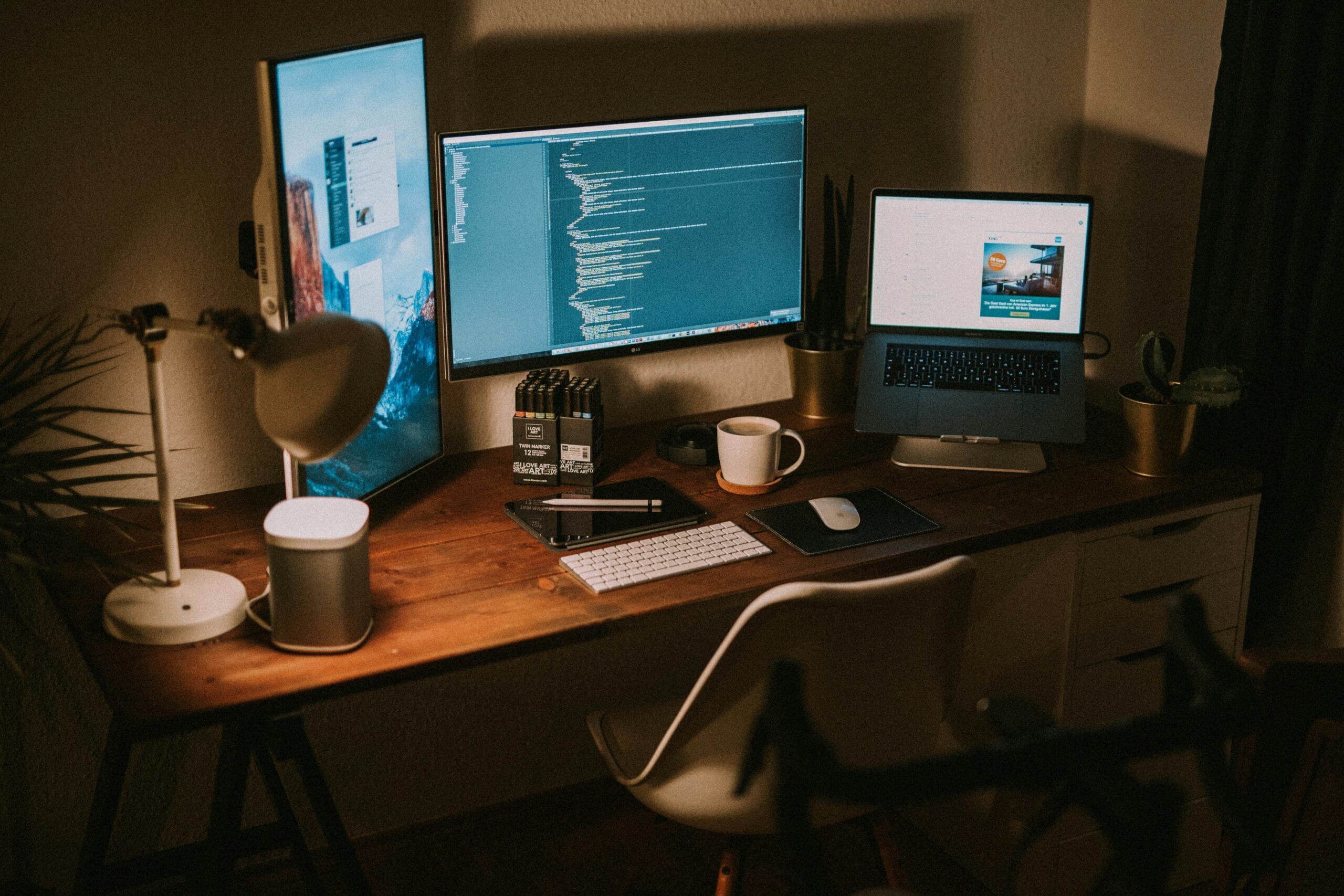
Photo by Jannis Brandt on Unsplash
Step 1: Define the purpose, honestly
Three archetypes cover most builds, and 2026 pricing differs sharply between them:
- The gaming rig. The GPU dominates the budget and the experience. Every game you play is rendered by it; everything else just needs to not get in the way.
- The creator workstation. Video editing, 3D, music production, code. Here the CPU, RAM and storage do the lifting; the GPU matters for specific apps (Premiere, Blender, DaVinci) more than for the desktop itself.
- The hybrid office. Meetings, documents, browsing, a little of everything. This build is about silence, reliability and screen real estate — not benchmarks.
Write down your three most-used programs and your resolution target before shopping. A build plan that starts with parts usually ends with the wrong parts.
Step 2: The components, as they stand in 2026
CPU. Intel's current mobile-and-desktop wave is Core Ultra Series 3 (Panther Lake, launched through early 2026, built on the 18A process); AMD's answer on the mobile side is Ryzen AI 400, with Ryzen 9000 chips covering desktop gaming and the Ryzen AI Max line pushing huge unified memory into mini-PCs. For a gaming rig, mid-tier chips in either family are enough — GPUs bottleneck games, not CPUs. Creators should buy more cores: rendering compresses video and compiles code in proportion to CPU muscle.
GPU. NVIDIA's RTX 50 series (Blackwell — 5090 down to 5060) brought DLSS 4 frame generation and GDDR7 memory; AMD's RX 9000 series (RDNA 4 — 9070 XT, 9070, 9060 XT) competes hardest in the value tiers. Pick by your monitor, not by reviews of cards you can't afford: 1440p high-refresh is the sweet spot for most gamers, and the mid-range cards of 2026 handle it comfortably.
RAM. 32GB is the 2026 baseline for anything serious; 16GB now feels tight the moment a browser and a game share the stage. Video editors and 3D artists should look at 64GB. Buy DDR5, two matched sticks (not four) for cleaner memory control.
Storage. One fast NVMe SSD (1-2TB, PCIe 4.0 — Gen 5 drives run hotter for gains most people won't feel) plus a second larger drive for archives if you shoot video. SSDs are cheap enough now that nobody should boot from a hard drive.
PSU and case. A quality 80+ Gold unit sized with ~30% headroom, ideally ATX 3.x-rated for modern GPU power spikes. Spend real thought on airflow: a mesh-front case with two or three quiet fans beats a glass showcase with none, every single summer.
Step 3: The room around the PC
Desk and chair. An adjustable chair and a desk at the right height do more for long-session comfort than any component. If you sit more than four hours a day, this is the budget line that pays back daily.
Monitors. One large high-resolution panel beats two small mismatched ones; two identical 27-inch 1440p displays remain the productivity standard. Gamers chasing high refresh rates should match the monitor to the GPU chosen above. A monitor arm frees desk depth and lets you set the top of the screen at eye level — the single best ergonomics upgrade available.
Lighting. A bias light (a soft source behind the monitor) cuts eye strain in dark rooms better than any overhead fixture. LED strips are the aesthetic layer; the bias light is the functional one.
Cables. Route power and data before the desk gets crowded: Velcro ties, an under-desk tray, and one power strip mounted out of sight. Do it during assembly, not after — it takes twenty minutes on day one and an afternoon in year two.
Step 4: Assemble, boot, test
Take your time on the build itself: motherboard manual open, standoffs checked, CPU cooler seated properly, all power cables fully clicked. First boot into the BIOS to confirm temperatures and RAM running at its rated speed (enable the memory profile — the default is slower). Then install Windows 11 — Windows 10 support ended in October 2025, so there's no reason to build on the old OS — update drivers, and stress-test: a gaming rig gets a couple of hours of the most demanding game you own plus a temperature watch; a workstation gets a render or export you know the duration of. Thermal throttling found today is a warranty case; found next year, it's your weekend.
Step 5: Leave yourself an upgrade path
The dream setup is a platform, not a purchase. Choose a motherboard with room — spare M.2 slots, free RAM slots, a current socket generation — and a case with clearance for a longer, thicker GPU than you bought. Two or three years from now, a GPU or RAM drop-in should be a thirty-minute job, not a rebuild. That's the difference between a setup that ages and one that compounds.
I've built my own desk machines this way for years, and the pattern that holds: overbuy the case, monitor and chair; buy the silicon that's fast enough today — it'll be cheap enough to swap later.
Related reading
- How Much Memory Do You Need for Gaming?
- 10 Must-Try Optimization Tricks for PC Gaming
- How to Clone a Hard Drive to SSD in Windows
Frequently asked questions
How much should a dream PC setup cost in 2026?
A strong gaming build lands around $1,200-2,000 with a 1440p monitor; a serious creator workstation runs $2,000-3,500 with RAM and storage doing the spending. Add $300-600 for the chair, desk and lighting — the parts of the setup you'll still be using when the GPU is two generations old.
Is it still cheaper to build a PC than buy one?
For gaming, building usually wins on price-per-performance and wins clearly on upgrade freedom and part quality. Prebuilts close the gap during sales and suit buyers who want one warranty to call. The build-it-yourself premium you pay is an afternoon and some reading — worth it for most people who care about their setup.
What's the most common first-build mistake?
Thermals from bad airflow — GPU hot, fans loud, performance throttled — followed by forgetting to enable the RAM's rated speed in BIOS. Both are free to avoid at planning time and annoying to fix after.
Do I need liquid cooling?
No. A good air cooler handles every current mainstream CPU quietly and never leaks. All-in-one liquid cooling earns its keep on top-tier CPUs in hot rooms and on the aesthetics of a clean build — it's a preference, not a requirement.
Which part of your setup needs the most love right now — the box under the desk or the room around it? Tell us in the comments.