

I've been writing about retail technology long enough to remember when "AI in stores" meant a clunky recommendation widget on a product page. That era is over. In 2026, artificial intelligence decides what you see when you open a shopping app, rings up your basket without a checkout lane, and tells the warehouse what to ship before the shelf is empty. Industry analysts put the AI-in-retail market at roughly $19 billion in 2026, growing around 35% a year, and NVIDIA's retail survey found about 80% of retailers already using or piloting generative AI. This isn't a future trend — it's how retail works now.
Quick Answer: The 10 AI solutions transforming retail in 2026 are personalization engines, checkout-free autonomous stores, blockchain supply-chain traceability, AR shopping, AI chatbots and assistants like Amazon's Rufus and Walmart's Sparky, demand forecasting, IoT smart shelves, facial-recognition security, carbon tracking, and AI-driven fashion trend prediction. Most retailers see the fastest return from forecasting and personalization — start there.
What Are AI Retail Solutions?
An AI retail solution is any software that uses machine learning or generative AI to run part of the retail operation: pricing, stock levels, recommendations, support, security, or logistics. The practical version looks like this — AI reads your sales history, foot traffic, weather, and local events, then makes a call a human would make slower: reorder this, discount that, show this customer these products.
That last part matters more than people realize. Retailers that adopt retail solutions built around predictive analytics consistently report the same two wins: fewer stockouts and less money tied up in dead inventory. Shoppers just experience it as "the store had what I wanted."
The 10 AI Retail Solutions Transforming the Industry
Some of these are mature technology you can buy off the shelf today; others are still settling into their final shape. Here's the full list, with what's actually working in 2026.
1. Generative AI Personalization
Every major shopping platform now builds a per-shopper experience: recommendations, emails, homepage order, even generated product descriptions matched to how you browse. The difference from five years ago is that large language models can reason over messy signals — purchase history, browsing, reviews you wrote — instead of just "customers like you bought X."
Amazon has said shoppers who use its AI features are measurably more likely to complete a purchase, and that pattern holds across the industry. The near future is predictive: your shopping app suggesting the winter jacket before you've checked the weather, because it knows your travel patterns. Done well, personalization feels like service. Done badly, it feels like surveillance — the line is consent and obvious value.
2. Autonomous Stores and Smart Carts
This category got a reality check, and the survivor is more interesting. In 2024 Amazon pulled its Just Walk Out cameras out of its larger Amazon Fresh grocery stores — not because the tech failed, but because retrofitting every shelf of a big grocery was too expensive — and bet on Dash Carts, smart carts that scan items as you drop them in. Amazon says Dash Carts will reach dozens of Whole Foods locations by the end of 2026.
Just Walk Out didn't die: it lives on through AWS as a licensed service in stadiums, airports, and smaller convenience formats where the economics work. My take: the lesson for any retailer is that checkout-free tech is a format decision, not a bolt-on. Small footprint, high traffic, single-category — great. 40,000-square-foot supermarket — think twice.
3. Blockchain in the Retail Supply Chain
Pairing blockchain with AI gives you two things retailers have wanted for decades: proof and prediction. The blockchain part creates a tamper-proof record from raw material to shelf — scan a QR code and see where the coffee was grown and when the shirt was stitched. The AI part forecasts disruptions before they hit: port delays, demand spikes, a supplier slipping.
Smart contracts close the loop by releasing payment automatically once sensors verify a delivery arrived and passed inspection. Counterfeiting drops, disputes resolve faster, and nobody argues about whose spreadsheet is right.
4. Augmented Reality Shopping
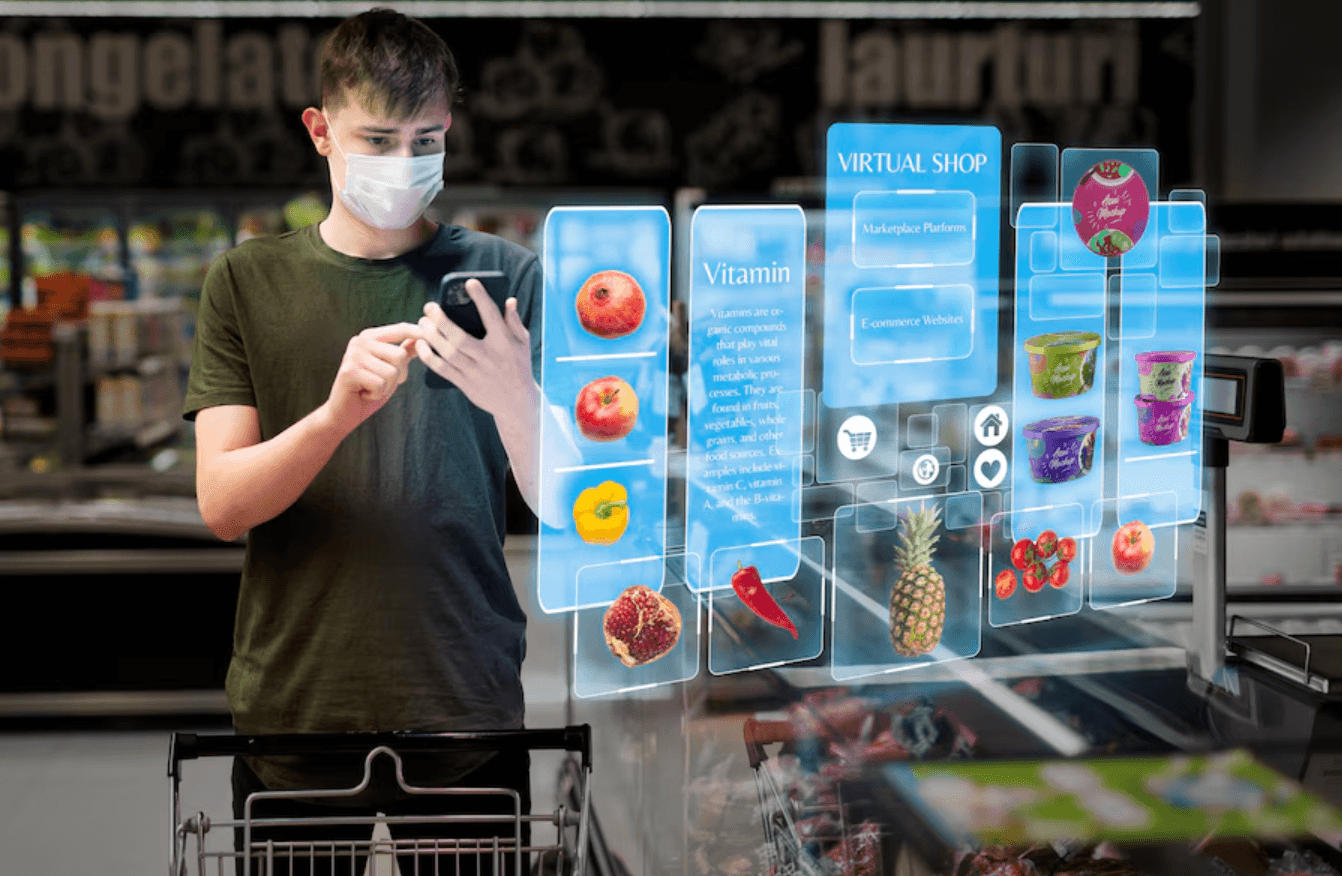
AR try-on finally crossed from gimmick to expected feature. Shoppers place furniture in their actual living room at true scale, try glasses on their own face, and preview paint colors on their own walls — all from the phone camera. AI does the matching: it recommends items based on your taste, past purchases, and what's actually trending, then renders them in your space.
The business case is returns. Apparel and furniture returns are brutally expensive, and AR previews cut the "looked different online" return reason dramatically. Brands that treat AR as a returns-reduction tool, not a toy, get the ROI. We cover where this is heading in our piece on AR shopping.
5. AI Chatbots and Shopping Assistants
This is the loudest change of the past 18 months. The new wave of retail assistants — Amazon's Rufus, Walmart's Sparky (launched June 2025) — are generative AI, not decision-tree bots. They answer "which of these treadmills fits under a low ceiling?" with actual product knowledge, compare options, and handle order issues without a human agent.
Walmart went further and partnered with OpenAI to let people shop inside ChatGPT itself. The next step everyone is building toward is agentic shopping: an assistant that doesn't just advise but completes the purchase for you. Retailers using AI chatbots for customer experience typically start with support and returns, then expand into guided selling once the bot earns trust.
6. AI Demand Forecasting and Inventory Management
Overstock ties up cash; stockouts lose the sale; perishables do both at once. AI forecasting eats this problem by combining historical sales with weather, local events, and market signals to predict demand store by store, SKU by SKU.
In the warehouse, AI routes picking robots, rebalances stock between locations, and reroutes deliveries when a storm closes a corridor. The version most mid-size retailers actually run in 2026 is less dramatic and more profitable: reorder points that adapt themselves, markdowns triggered by predicted slow-moving stock, and shrinkage reports that flag problems before month-end. If you've never formalized the process, our demand forecasting overview is the plain-English starting point.
7. IoT and Smart Store Integration
Smart shelves, electronic shelf labels (ESLs), interactive displays, and weight sensors turn a physical store into a data source. AI reads that stream and acts: a shelf running low triggers a reorder automatically, a display notices a shopper lingering and surfaces a relevant offer, ESLs reprice slow-moving stock in minutes instead of the next print cycle.
The same sensors watch the cold chain — temperature and humidity logs from the logistics provider tell you whether perishables were handled properly in transit. One honest warning from watching implementations: every connected shelf and camera is also attack surface, so IoT rollout needs a security plan on day one, not after the first incident.
8. Facial Recognition: Security and Privacy
Facial recognition in retail can identify known shoplifters, control access to stockrooms, verify age for restricted purchases, and let a loyal customer skip a loyalty card. The technology works. The problem is everything around it: regulators are tightening fast, shoppers are increasingly uncomfortable, and a privacy misstep costs more brand damage than shrinkage ever did.
Several jurisdictions now restrict or ban the practice in retail settings, and enforcement is getting sharper every year. My honest advice for 2026: if you're considering it, get legal counsel for your specific markets first, prefer opt-in programs over covert scanning, and read up on data privacy basics before the lawyers make you. Most retailers get 80% of the security benefit from plain computer vision (counting, heat-mapping, anomaly alerts) with none of the biometric legal exposure.
9. Smart Carbon Tracking
Sustainability moved from marketing to reporting obligation, and AI is how retailers actually measure it. AI models track emissions across the full chain — sourcing, manufacturing, shipping routes, store energy use — by analyzing route data, traffic, weather, and logistics records. Generative AI then compresses what used to be weeks of cross-system data gathering into a report you can actually act on.
The operational payoff: AI predicts the carbon cost of a planned promotion or a new delivery route before you commit, and trims energy use in stores and warehouses by forecasting demand for heating, cooling, and refrigeration. Retailers selling to enterprise buyers increasingly need these numbers just to keep the contract.
10. AI in Fashion: Trend Prediction and Virtual Try-On
Fashion runs on guessing right, and AI turns the guess into a forecast. Models scan social media, search trends, and sell-through data to spot what's about to be big while there's still time to design and stock it — which also means producing less of what won't sell, cutting the industry's chronic waste problem.
In-store, smart mirrors suggest sizes and complementary items; in-app, AI try-on matches makeup and clothing to your skin tone and body from a phone camera. The fast-fashion leaders built their entire restock loops around this: sell a week, predict the next ten, produce only what the model confirms.
Where Should a Retailer Actually Start?
Ten categories is a lot, so here's the sequence I'd recommend after watching this market for years:
1. Demand forecasting first — it pays for itself fastest and feeds every other system clean data.
2. Personalization second — most e-commerce platforms already bundle usable AI features; turn them on before buying anything new.
3. A support chatbot third — cheap to pilot, immediate cost visibility.
4. AR and smart-store tech once the basics earn money.
5. Facial recognition last, if ever — and only after a legal review of your markets.
Frequently Asked Questions
What is AI in retail?
AI in retail is the use of machine learning and generative AI to run retail operations: predicting demand, personalizing recommendations, powering shopping assistants, automating checkout, setting prices, and tracking supply chains. In practice it spans everything from Amazon's Rufus answering product questions to a smart shelf that reorders stock automatically. Most retailers adopt it one function at a time, starting with forecasting or personalization.
How big is the AI-in-retail market in 2026?
Analyst estimates vary by methodology, but most put AI in retail at roughly $19–31 billion in 2026, growing at 30–35% annually toward $80–160 billion by the early 2030s. The generative AI slice is smaller but exploding — retail-specific GenAI spending was around $1 billion in 2025 and is forecast to grow twentyfold over the next decade. Treat all figures as directional; check current analyst reports before quoting them in a business plan.
Which big retailers use AI right now?
Amazon uses AI across recommendations (Rufus), fulfillment, and checkout-free stores; Walmart runs the Sparky assistant in its app and partnered with OpenAI for in-ChatGPT shopping; and most large grocers use some form of AI forecasting and electronic shelf labels. Beyond the giants, AI features are increasingly bundled into standard retail SaaS — Shopify, POS systems, and email platforms — so even small stores use AI without branding it that way.
Will AI replace retail workers?
It replaces tasks more than jobs. Self-checkout, smart carts, and chatbots absorb repetitive work — scanning, order-status questions, shelf counting — while human staff shift toward fulfillment, exception handling, and in-person service where people still prefer a person. Most retailers redeploy rather than cut: fewer registers staffed, more pickers, personal shoppers, and floor staff with better tools. The honest answer is that roles change faster than headcount.
Is facial recognition in stores legal?
It depends entirely on where you operate. Several US states and cities restrict biometric scanning in commercial spaces, the EU's AI Act imposes strict conditions on biometric identification, and some jurisdictions require explicit consent and posted notices. Rules have tightened every year since 2023. Any retailer considering it needs jurisdiction-specific legal advice, and many are choosing plain computer-vision analytics instead — similar loss-prevention value, far less legal exposure.
How much does it cost to add AI to a retail business?
Far less than it did two years ago if you use bundled features: AI forecasting, recommendations, and chatbots are now included in most mainstream retail platforms at no extra cost. Adding a specialized tool typically runs on monthly SaaS pricing scaled to store count. A custom build — autonomous checkout, proprietary models, full smart-store retrofits — is a serious capital project with six-to-seven-figure budgets. Start with what your current stack already includes before shopping for anything new.
Related Reading
- AR/VR in E-Commerce: The Future of Online Shopping
- The Impact of Generative AI on Customer Engagement and Marketing Performance
- Data Privacy in the Digital Age: Protecting Your Information Online
- How Is Facial Recognition Being Used in Mobile Phones?
The ten solutions above are reshaping retail right now — I've watched these go from conference demos to default features in just a few years. If you're weighing any of them for your store, ask me in the comments and I'll share what the implementations I've tracked actually cost and returned.