Quick answer
A website is the only online presence your business owns outright. Social profiles are rented land (algorithm changes, account bans, platform decay), marketplaces take fees and data, and AI search results cite sites with substance. In 2026 a simple site costs roughly the price of a phone contract monthly, and it is where customers verify you are real before spending money.
Every few years someone declares the website dead — social platforms will do the job, or marketplaces, or just a Google Business Profile. The lesson of the last five years is the opposite: every business that depends entirely on rented channels eventually learns what rented means. Algorithm changes have gutted organic reach on the big social platforms, accounts get locked with no appeal process, and platform demographics drift.
This piece covers the four reasons a website still earns its keep in 2026, what it costs now, and where social profiles and marketplaces fit — because the honest answer is that you need both, with the website as the ground they stand on.
1. You own the relationship (everything else is rented)
A follower is a lease; an email list and a site are property. When a platform changes its feed algorithm, a business with 40,000 followers can see its reach drop 90% overnight and have nobody to call. When Instagram or TikTok bans an account by mistake — and it happens — the business that built there exclusively starts over from zero. The website, the domain, the mailing list: those survive every platform decision, and they compound. Every year of blogging, product pages and customer emails accumulates on ground you control.
This is also a data story. Platforms hold the audience data and share what suits them. Your own site tells you exactly what people searched to find you, which pages they read before buying, and where they hesitated — data you can act on, and data no platform hands over completely.
2. Customers verify you before they trust you
Before a first purchase, most people check whether a business exists in a way they can scrutinize: a site with a real address, named people, photos of actual work, and a returns or contact policy in plain language. A social profile alone raises questions a website answers — Is this a real business? What are the prices? Where are they? What happens if something goes wrong?
The verification habit runs deeper in 2026 because AI search assistants now mediate discovery. When someone asks an AI tool or Google for "a wedding photographer in Jaipur," the answers cite and link websites with substance; businesses with no site are simply not in the pool. Google Business Profile matters enormously for local discovery (set it up if you have a physical presence), but the profile links to a site, and the credibility transfer works in that direction.
3. It is the one place that sells on your terms
Marketplaces take commissions, control the checkout, own the customer data, and can delist you. A website lets you tell the full story of what you sell, price it without platform math, bundle services with products, take bookings, publish policies, and answer objections at length. For services especially, the site is where a complicated offer gets explained properly — something no social bio can do.
Search traffic still flows to sites that answer real questions. Local search — "plumber near me", "best physio for runners" — sends calls and bookings to businesses whose sites answer those queries with substance. Our guide to ways to increase website traffic covers the mechanics, and for shops specifically, our fast eCommerce site guide covers speed and conversion basics.
4. It anchors every other channel
Social posts link somewhere — the site. Ads need a landing page — the site. Google Business Profile wants hours, services and updates — the site is the source of truth. Email campaigns link to — the site. The website is not one channel among many; it is the destination all the others point at, which is why its pages (home, about, services/pricing, contact) need to answer questions clearly rather than merely look decorative.
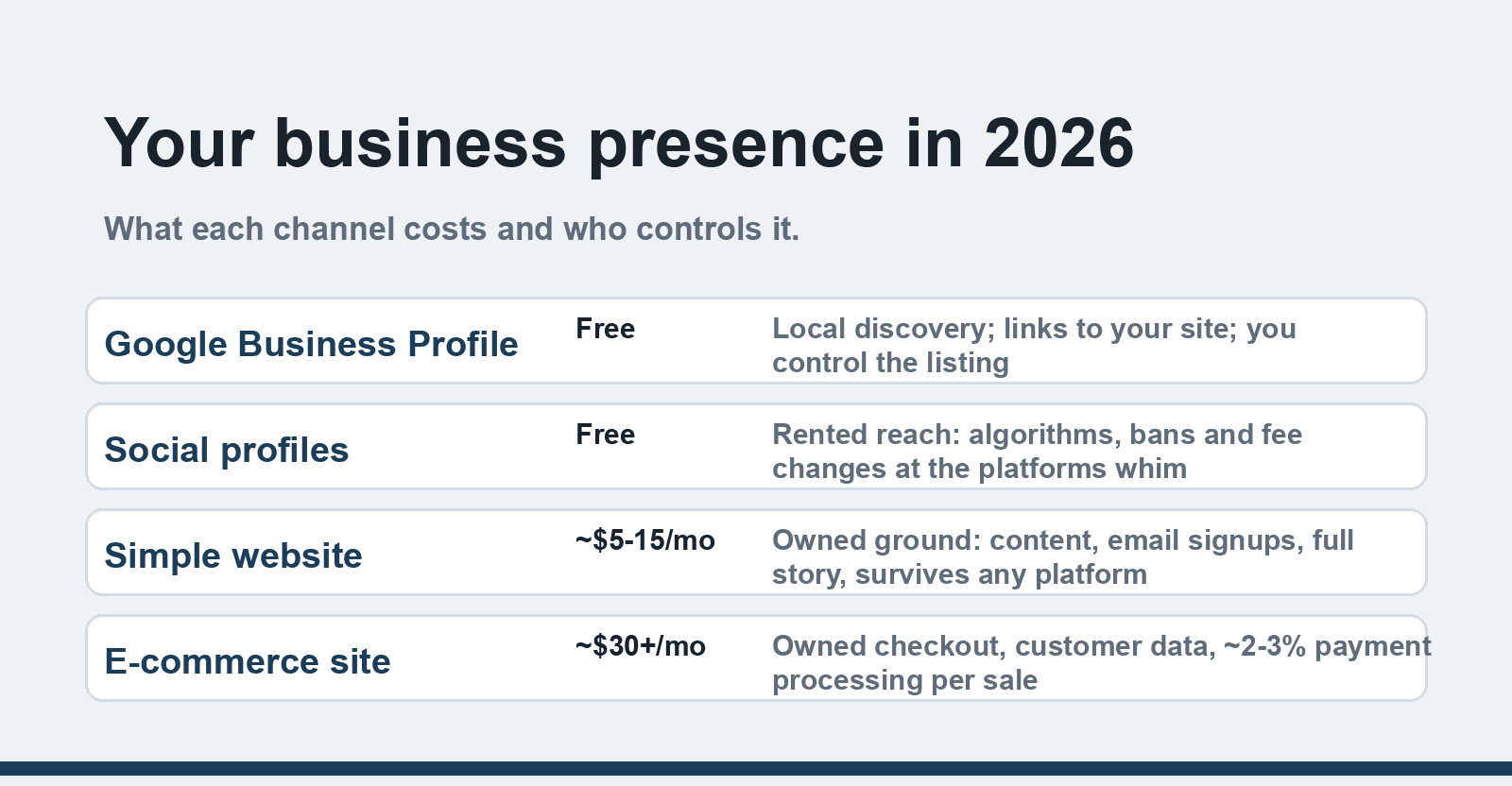
What it costs in 2026
The DIY route prices like this: domain around $10-15 a year, shared hosting from roughly $5-10 a month (WordPress included or one-click), a theme either free or a one-time license, and your time to build four or five honest pages. Website builders charge $10-25 monthly with hosting bundled. E-commerce with payments runs higher — platform fees plus payment processing around 2-3% per sale. An agency build for a small business starts around a few hundred dollars and scales with complexity. Choose the shape by what the site must do: our Shopify vs WordPress comparison breaks the biggest fork in that decision.
The comparison that matters is not website versus nothing; it is a modest monthly cost against the cost of being unfindable and unverifiable to everyone who searches before buying — which is nearly everyone.
FAQ
Is a website still necessary if my business does well on Instagram?
Yes, and the strongest evidence is platform risk: reach can drop overnight on a rented feed, and accounts get suspended by mistake with limited recourse. Treat social as discovery and relationship, and the website as the place followers can always find you, buy from you, and sign up for updates you own.
Can't I just use a Google Business Profile?
For a purely local, walk-in business, a complete Google Business Profile with photos and reviews does a lot of work — set one up regardless. But the profile is shallow: no room for pricing, policies, service detail or content. It also links out, and customers who click expect a real site on the other end.
How much does a small business website cost in 2026?
DIY WordPress: about $70-140 a year (domain plus basic hosting). Builders: $10-25 a month. E-commerce: platform fees plus roughly 2-3% payment processing per sale. Custom agency builds start around a few hundred dollars for a simple four-to-five-page site. The recurring cost is comparable to a phone contract; the difference is in your time.
Do I need to know how to code?
No. Modern builders and WordPress handle everything visually. What matters is the same skill a good brochure always needed: clear writing about what you do, for whom, at what price, and how to reach you. Most small business sites fail on vague copy, not technology.
What pages does a small business website actually need?
Five, usually: Home (what you do, for whom, proof), About (real names and faces), Services or Products with prices or ranges, Contact with a real address and response promise, and a Reviews or Work page. Start there, then add pages when customers keep asking the same question.
Will AI search replace small business websites?
AI answers sit on top of search, but they cite and link to sources — and local, transactional intent still ends in a call, a booking or a cart on a real site. Businesses with substantive websites get cited; businesses without a site are invisible to those answers. The website is how you remain in the pool AI draws from.