


As US businesses continue to scale digital operations, CRM performance plays a direct role in revenue efficiency, customer experience, and operational speed. Salesforce remains the preferred CRM platform for organizations that want reliable automation, accurate data, and unified workflows. But the real advantage comes when companies decide to hire Salesforce developers who can tailor the system to match how their business works, not the other way around.
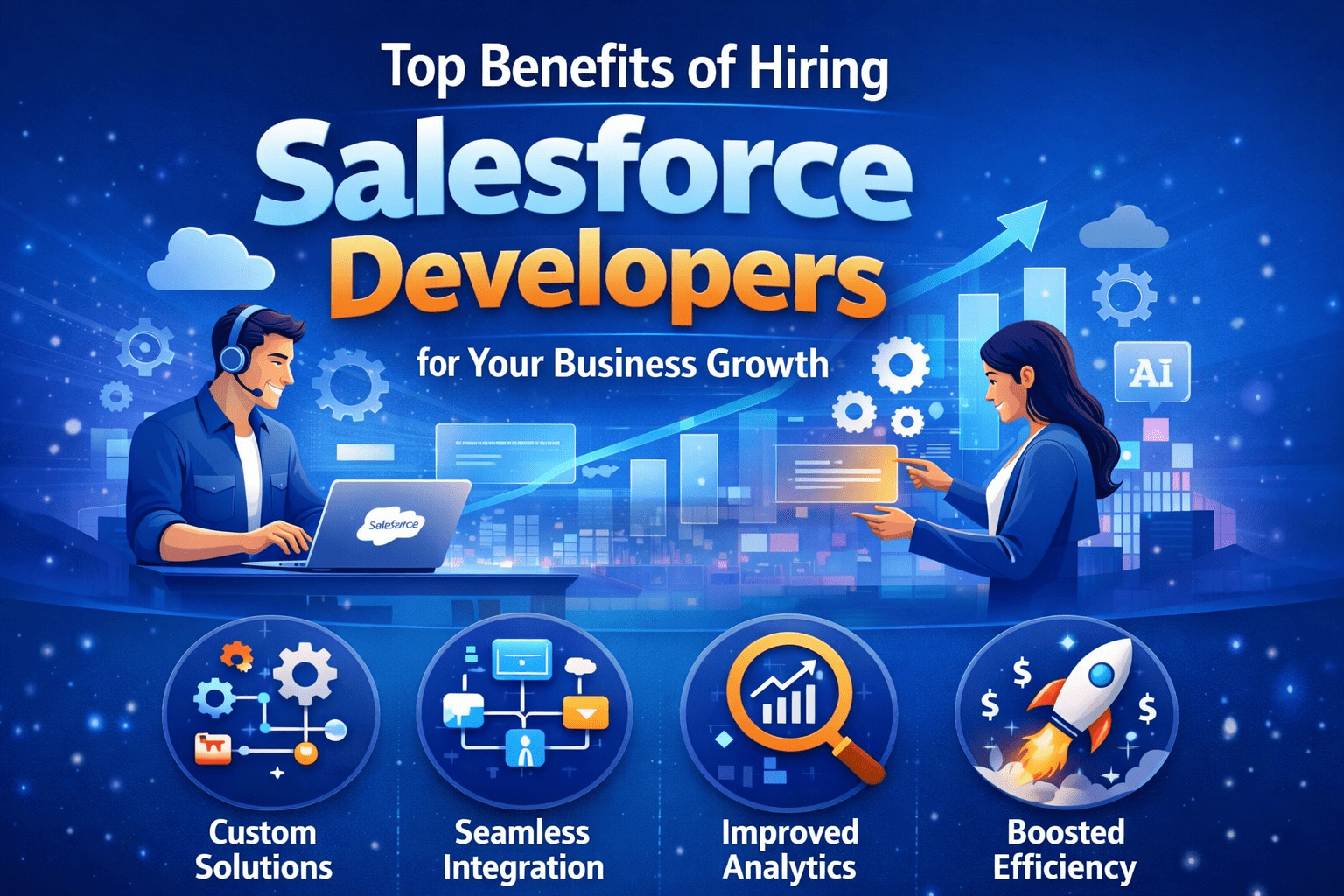
A specialized Salesforce development company brings both technical depth and operational understanding, helping enterprises maximize every feature of the platform. With AI in Salesforce, US organizations move beyond basic setups and gain highly personalized workflows, better integration capabilities, and a more predictable CRM environment.
Why US businesses need to hire Salesforce developers
Today’s customer expectations require fast responses, consistent communication, and error-free processes. Salesforce is capable of delivering all of this, but only when configured correctly. That’s why many companies choose to hire Salesforce developers, professionals who can convert business logic into automated workflows, scalable architectures, and frictionless user experiences.
Developers also optimize how departments exchange information. Sales, support, finance, marketing, and operations often use separate tools; without proper integration, data gaps and delays occur. Salesforce engineers unify these systems, giving decision-makers real-time visibility.
1. Custom workflows built for precision and efficiency
Every organization has unique processes, lead qualification steps, quote approvals, service escalations, renewal cycles, and onboarding flows. Developers translate these steps into automated Salesforce processes using:
- Flow automation
- Approval routing
- Trigger-based actions
- Custom business rules
- Lightning Web Components for added functionalities
With these upgrades Salesforce development company removes delays and reduces repetitive work. Teams no longer rely on manual checks or emails to complete tasks.
What this means for US businesses:
- Consistent customer experience
- Fewer operational mistakes
- Faster sales cycles
- Increased accountability across teams
2. Seamless integration with business-critical tools
Most US companies rely on multiple platforms: finance software, ERP systems, marketing automation, communication tools, support applications, and custom-built internal systems. Without structured integration, these tools create data silos.
Salesforce developers integrate platforms using:
- APIs
- Middleware solutions
- Webhooks
- Event-driven architectures
This ensures customer records, invoices, inventory updates, service logs, and engagement history move smoothly across systems. The result is a unified CRM environment where data stays accurate and up to date.
3. Improved data quality and reporting accuracy
Reliable analytics depend on clean, structured data. Developers enhance data models, validation rules, and field-level automation to maintain accuracy. They also build dashboards for:
- Sales forecasting
- Pipeline health
- Revenue projections
- Customer behavior analytics
With strong reporting, executives get a clearer picture of performance and can plan with confidence.
4. Enhanced performance through custom Salesforce applications
Standard Salesforce features work well for general processes, but many companies have niche requirements. Developers build custom applications using Apex, Lightning Web Components, and the Salesforce Platform.
Examples include:
- Custom quoting engines
- Field service management apps
- Partner or dealer portals
- Inventory tracking tools
- Subscription management modules
These tailored solutions offer a competitive advantage because they align perfectly with internal workflows.
5. Advanced automation for faster operations
Automation is one of Salesforce’s strongest capabilities. Developers take automation further by designing systems that handle tasks without human intervention. This includes:
- Auto-generated tasks and reminders
- Intelligent lead assignment
- Renewal management automation
- Automated SLA-based case handling
- Document generation workflows
Such automation minimizes human effort and speeds up response times across departments.
6. Stronger security and compliance for US regulations
Industries like healthcare, finance, insurance, logistics, and government require strict data governance. Developers implement:
- Role-based access models
- Field-level protections
- Audit trails
- Encryption settings
- Compliance-friendly architectures
This ensures the CRM supports US regulatory standards while maintaining operational flexibility.
7. Long-term scalability and system stability
As businesses expand, CRM workloads increase—more users, more data, more processes, and more integration points. Salesforce developers design systems that support:
- Growth in users
- More complex workflows
- Multi-department adoption
- Process-level upgrades
- Higher automation levels
These enhancements prevent performance slowdowns and reduce future development costs. By using professional Salesforce development services, organizations gain structured maintenance, version control, and predictable release cycles.
Industry-specific advantages across
- Technology & SaaS
Automated renewals, subscription billing, and detailed user activity insights help SaaS teams improve retention, track product usage, and optimize customer lifecycles. - Healthcare
HIPAA-ready patient workflows, appointment scheduling, and care cycle routing streamline operations while maintaining data security and compliance across care teams. - Finance & Insurance
Advanced risk models, underwriting automation, and secure approval workflows support faster decision-making while meeting strict regulatory and security requirements. - Manufacturing & Logistics
Real-time inventory synchronization, dealer and partner network management, and field service automation improve supply chain visibility and operational efficiency. - Retail & E-commerce
Omnichannel integrations, returns and order management, and personalized merchandising workflows enhance customer experience and drive repeat purchases.
Each industry benefits from a custom CRM solution designed to match its unique processes, compliance needs, and growth goals.
Conclusion
US businesses aiming for growth require hiring Salesforce developers and systems that run with efficiency and consistency. Salesforce delivers that foundation, but only when configured with precision. Hiring skilled developers ensures your CRM becomes a powerful operational asset, fast, scalable, secure, and aligned with every team. With the right expertise, businesses can focus on expansion while Salesforce drives productivity at every level.

Prathik, a senior content writer at Agile Infoways LLC and a former English literature student, seamlessly blends his passion for writing with trending technologies and crafts engaging content. He explores the intersection of innovation and human experience through his writing. His greatest dream is to make the target audience pause, smile & click!