


The last time this list was written, it counted a real-money fantasy-cricket app and a rummy portal among "games for all ages" — a stretch even then, and one that India's Online Gaming Act has since turned into a legal question, not just a taste question. This version keeps the spirit of the original (games a household can share across generations) and rebuilds the list around five games that are genuinely all-ages, all still actively updated in 2026, and fun without a credit card requirement.
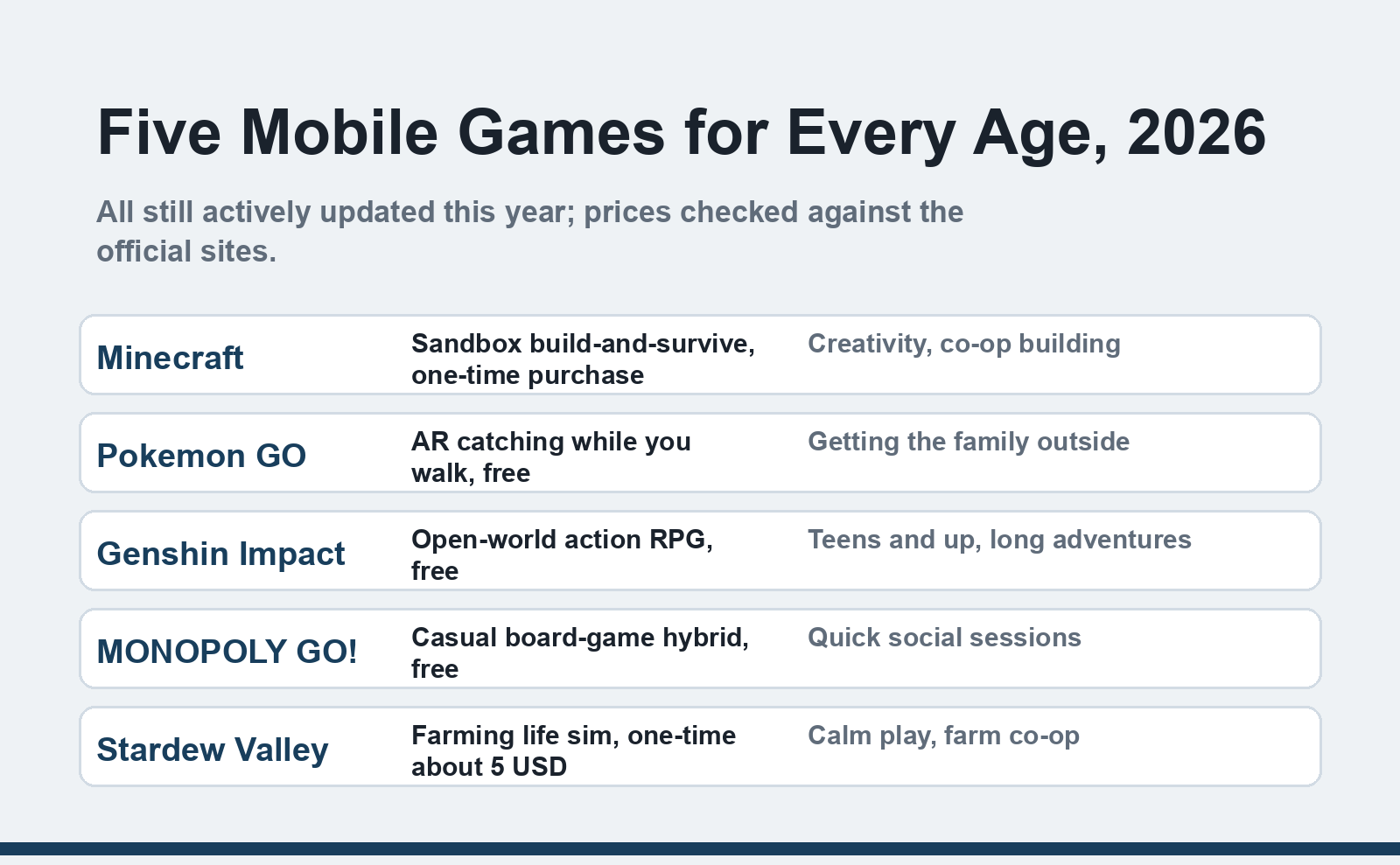
Quick answer: In 2026, the best mobile games that genuinely work for all ages are Minecraft (creative sandbox), Pokémon GO (outdoor AR), Genshin Impact (open-world adventure, best for teens up), MONOPOLY GO! (quick casual sessions) and Stardew Valley (calm farming sim). All five are actively updated; two are paid once, three are free.
What changed since the original list
Two of the original five picks were removed, and one stayed with a warning label:
| Original pick | Status in 2026 |
|---|---|
| Fantasy cricket (MPL link in the old version) | Removed. India's Online Gaming Act, 2025 bans online money games — MPL, Dream11 and rivals suspended their paid contests in August 2025, and the ban remains in force while a Supreme Court challenge proceeds. Free-to-play fantasy exists, but the old link pointed at the cash format. |
| Rummy | Removed for the same reason — the money-game versions were the draw, and they're no longer a legal or family-appropriate recommendation. |
| Call of Duty Mobile | Kept, but flagged: it's a well-run, hugely popular shooter, and it is rated 17+/Teen — not an all-ages game. It appears below as a pick for households with older teens. |
The pandemic framing of the old intro is gone too — mobile gaming stuck around after lockdowns did not because they isolate, but because a good game is the cheapest shared activity a family owns.
1. Minecraft — the sandbox every generation shares
Fifteen years on, Minecraft is still the default answer to "what can my kids and my parents both play?" The mobile version is the full sandbox — build, survive, explore — with cross-play so a phone player can join a PC or console world. It's a one-time purchase, updated constantly, and it teaches more spatial reasoning and resource planning than most "educational" apps ever manage. Buy it once from Minecraft's official site or the app store and it belongs to the household. Best for: creativity and co-op building across every age.
2. Pokémon GO — the game that gets people outside
A decade old and still a phenomenon: Pokémon GO turned 2026 events into city-filling gatherings, and its lifetime revenue past $9 billion says the daily catch loop still works. The magic for families is what it does to a walk — the neighborhood errand becomes a PokéStop crawl, and grandparents, kids and parents end up on the same sidewalk comparing catches. Free with optional item purchases, and playable without spending sensibly. Track events and community days on Pokémon GO's official site. Best for: getting everyone outdoors together.
3. Genshin Impact — the adventure for teens and up
The open-world RPG that defined a genre on mobile is still going strong in 2026, with new regions, characters and seasonal events. The combat has real depth, the world is gorgeous, and the free tier is generous — you can put in a hundred hours without paying. Two honest caveats for the "all ages" framing: the gacha monetization is designed to tempt, so it suits players old enough to understand that, and the adventure demands longer sessions than a five-minute wait in a queue. Play with a parent's account first for younger kids. Best for: teens and up who want a real, long-form adventure.
4. MONOPOLY GO! — the quick-session crowd-pleaser
Scopely's board-game hybrid is one of the top-grossing mobile games of 2026 for a simple reason: sessions take minutes, the rolls-and-raids loop is easy to grasp, and the social features let family members trade stickers and nudge each other's boards. It's the modern version of the board game your family already argues over — including the argument part, which some will consider a feature. Free with in-app purchases that are easy to decline. Best for: quick, social sessions with casual players.
5. Stardew Valley — the calm one
Fifty million copies sold as of early 2026, and the farming sim keeps growing because it does one thing perfectly: it's gentle. Grow crops, raise animals, befriend the town, restore your grandfather's farm — alone or in co-op. The mobile version costs a few dollars once (about $5), has no ads or in-app purchases at all, and runs on nearly any phone. When the household needs a game that lowers the pulse instead of spiking it, this is the pick. Best for: calm, screen-time-friendly play at any age.
The one that stayed: Call of Duty Mobile, with an age flag
The original list's other survivor remains excellent in 2026 — polished controls, constant seasonal updates, and a massive player base. But "all ages" it is not: the shooter content earns it a 17+ App Store rating (Teen on Google Play). For households with older teens it's a legitimate pick, and among the best-executed mobile shooters available; just don't hand it to the ten-year-old.
How to pick one game and stop there
Match the game to the youngest player in the house — Minecraft and Stardew Valley for under-tens, Genshin and CoD Mobile for teens — and the rest will follow. Watch the payment model more than the genre: one-time purchases like Minecraft and Stardew cost less per hour of play than almost anything else in the house, while free-to-play games are designed to nibble at wallets and, for that matter, at bedtime — our notes on screen light and sleep apply double to late-night gaming sessions. Round the setup out with the right mobile gaming accessories if gaming gets serious, check how much memory a phone needs for gaming before upgrading hardware, and if you're curious how deeply online play has rewired the hobby itself, our piece on the evolution of online gaming covers the arc from dial-up lobbies to these five.
FAQ
Are these games actually free, and what do they cost in 2026?
Pokémon GO, Genshin Impact and MONOPOLY GO! are free to download and playable without spending; Minecraft and Stardew Valley are one-time purchases (Minecraft around $7 on mobile, Stardew about $5) with no ads or subscriptions. Every one of the five can be enjoyed without in-app purchases — the free-to-play three will gently offer them anyway.
Which of these is safest for a seven-year-old?
Minecraft and Stardew Valley, in single-player or with family co-op, with Stardew the calmest of the entire list. Turn on Microsoft account parental controls for Minecraft multiplayer, and note that open multiplayer servers of any game put strangers in the chat — offline or family-only play is the safe default at that age.
Is Genshin Impact okay for kids?
It's rated for teens, and that's about right: the fantasy combat is mild by shooter standards, but the gacha system encourages spending, and progress demands longer sessions. If a younger child loves the look of it, co-op together with a parent account, and decide your wallet rules before they fall for a limited-time character banner.
Do any of these work without internet?
Stardew Valley and Minecraft's single-player mode work fully offline once downloaded — the two best travel companions on the list. Pokémon GO needs GPS and data by design, and Genshin and MONOPOLY GO! require a connection for their core loops. For flights and road trips, the two paid games are the reliable picks.
What happened to the real-money games in the old list?
India's Promotion and Regulation of Online Gaming Act, 2025 — in force since August 2025 — banned online games played for money, taking in fantasy sports, rummy and poker apps; MPL, Dream11 and their rivals suspended paid contests, and free-to-play versions are what remain while a Supreme Court challenge proceeds. This list sticks to games where the only thing at stake is the high score.
If your household could only keep one of the five, which would earn the space — the builder, the walker, the adventurer, the roller, or the farmer?