


This review originally ran in 2017, when Serpstat was the scrappy budget alternative to Moz and Semrush. Nearly a decade later the tool has grown up — and so has its pricing. Here is what Serpstat actually delivers in 2026, and who it still makes sense for.
Quick answer: Serpstat is a budget-friendly all-in-one SEO platform covering keyword research, rank tracking, backlink analysis, and site audits. Plans start at $50/month, and a 7-day free trial covers the paid features. It suits freelancers and small teams that want Semrush-style data without Semrush pricing.
What Is Serpstat?
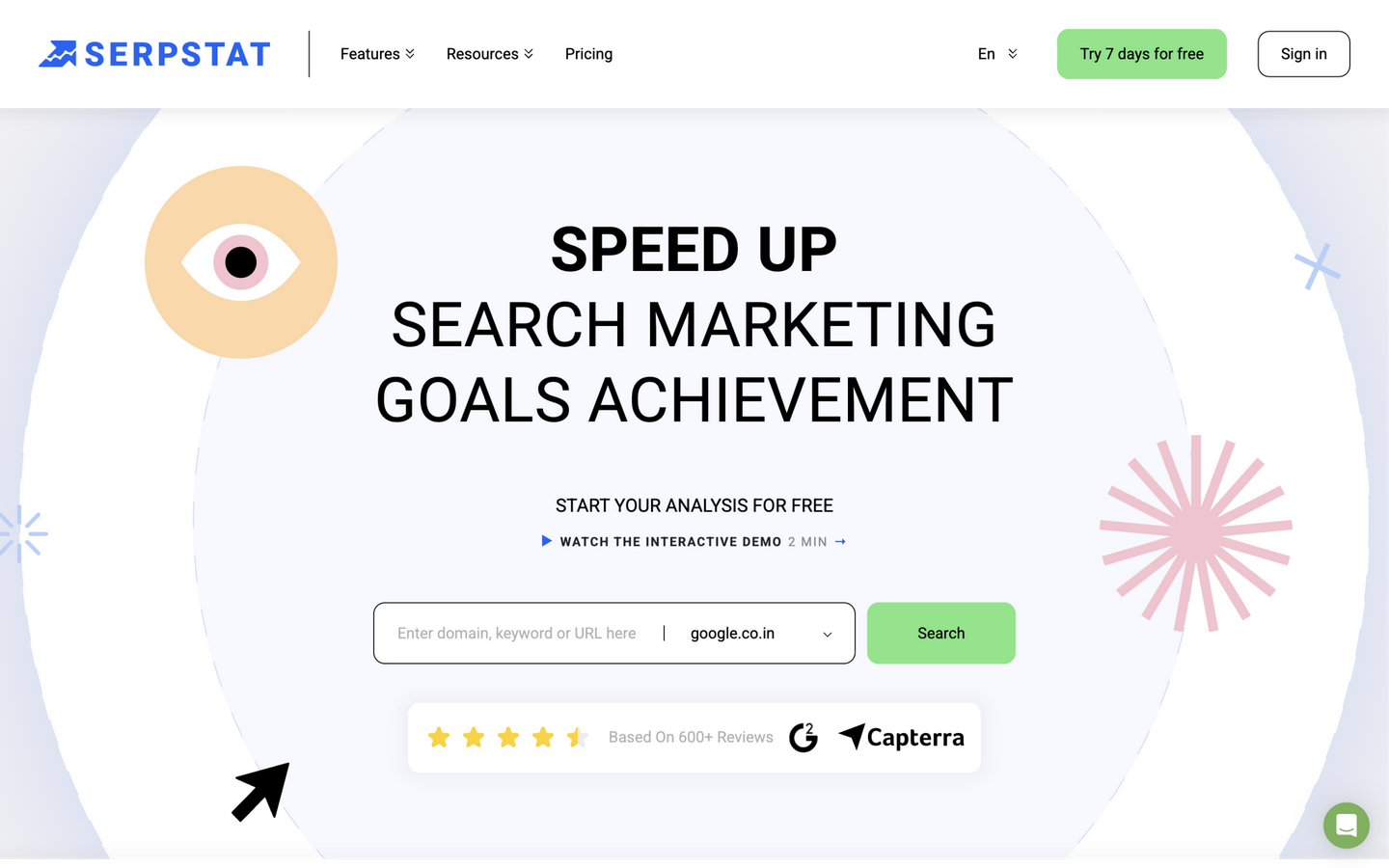
Serpstat launched in 2013 as a rank tracker and gradually expanded into a full suite: keyword research, backlink analysis, site audits, rank tracking, and competitor research. Its 2026 positioning is "one subscription instead of five tools" — the homepage now bills it as a marketing tool for SEO and content tasks rather than a pure SEO platform.
The consistent theme in user reviews (Capterra sits around 4.5 stars from 600+ ratings) is that Serpstat covers most of what Semrush does at roughly a third of the price, with the gaps showing up in database size and data freshness rather than missing features.
What Serpstat Does in 2026
Keyword research
Type a seed keyword and Serpstat returns search volume, estimated competition, cost-per-click, and a "keyword clustering" view that groups related terms into topics. The cluster report is the standout: instead of a flat list of 5,000 variations, you get terms grouped by the pages that rank for them, which maps directly onto how you would actually structure content. For a deeper dive on turning those clusters into articles, see our guide to the power of long-tail keywords in modern SEO.
Site audit
The site audit crawler checks a site against meta tags, headings, redirects, indexing directives, and page-weight issues, then produces a prioritized list of errors with a general optimization score. Scheduling is built in, so the audit re-runs on its own and tracks whether fixes actually landed between crawls. Of all the modules, this is the one existing users tend to praise most consistently in reviews.
Rank tracking
The rank tracker monitors daily positions for your keyword set across desktop and mobile, with history graphs and a share-of-voice style visibility percentage. Limits are generous for the price — the entry plan includes 10,000 keyword position checks, and the Agency plan 500,000.
Backlink analysis
Serpstat's backlink index is its weakest area next to Ahrefs, but the module itself is competent: referring domains, anchor text distribution, new and lost links, and an Authority score for vetting link sources. If your link-building work depends on exhaustive index coverage, read our comparison notes below first — and our strategies to improve your backlink portfolio apply regardless of which tool you use.
Competitor and PPC research
Domain analysis surfaces the keywords a competitor ranks for, the pages driving their traffic, and — unusually for a budget tool — their Google Ads history: paid keywords, ad copy examples, and CPC estimates. Agencies running both SEO and paid search get genuine value from this without needing a separate PPC spy tool. Serpstat has also moved into AI-search visibility: an LLM Brand Monitor tracks how ChatGPT, Claude, Gemini, and similar assistants describe your brand, and the Team tiers bundle ChatGPT and Claude integration for AI-assisted workflows.
Serpstat Pricing in 2026
| Plan | Monthly price | Best for | Key limits |
|---|---|---|---|
| Individual | $50 | Freelancers, one site | 5 projects, 100 searches/day, 10,000 rank checks, no API |
| Team | $100 | Small teams | Unlimited projects, 500 searches/day, 3 users, API + AI tools |
| Team x2 | $169 | Growing teams | 1,000 searches/day, 6 users |
| Agency | $410 | Agencies | 5,000 searches/day, 30 users, white-label reports |
Annual billing knocks up to 27% off those numbers. New users get a 7-day free trial of the paid features — note that a card is required and a small verification charge (about $1, refunded) is applied, and the trial auto-renews into a paid plan if you don't cancel. The 14-day money-back guarantee advertised in Serpstat's early years is no longer offered, so treat the trial as your evaluation window.
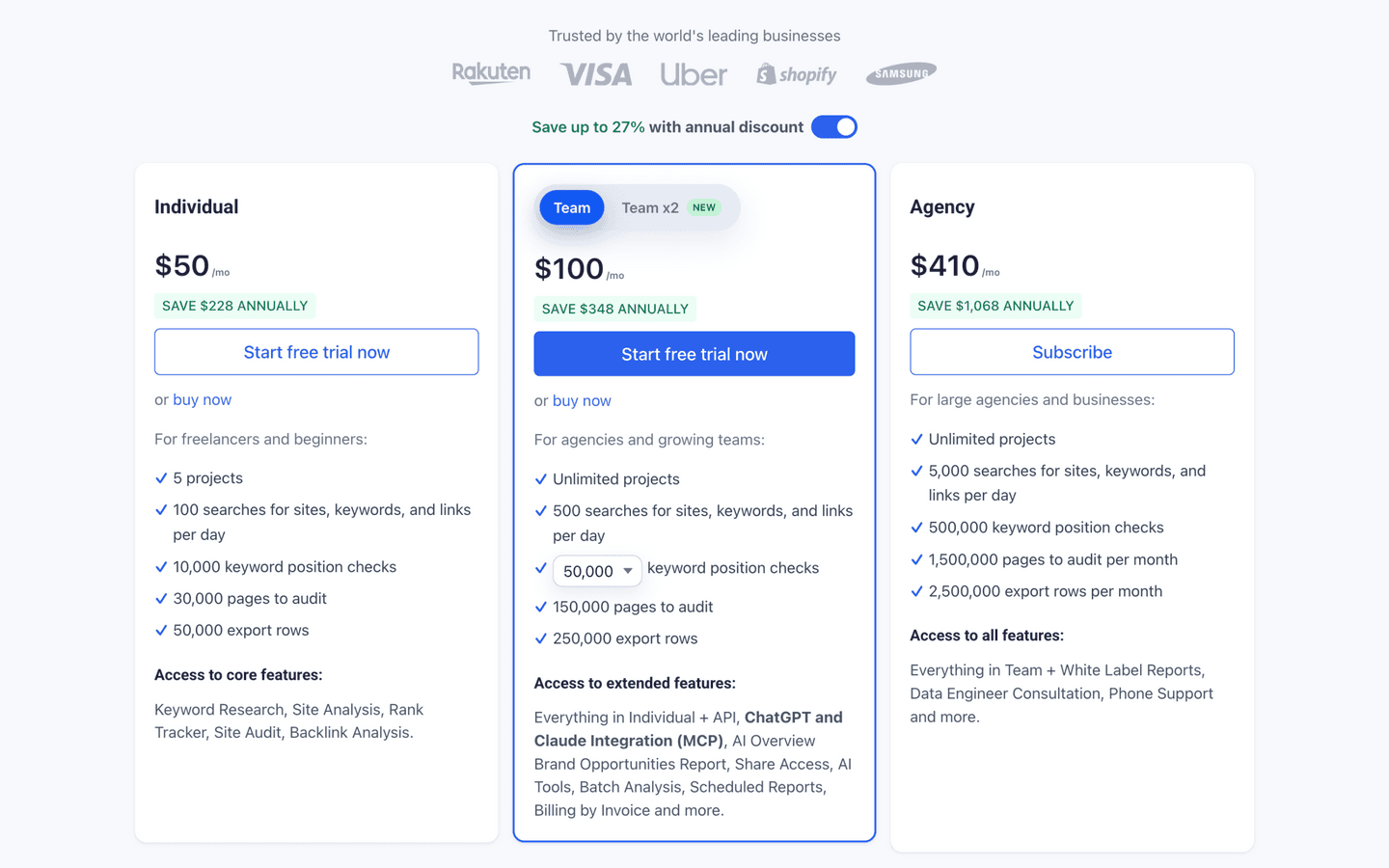
One thing to watch: limits are usage-based — searches per day, exports per month, audit pages. Heavy users can hit a plan ceiling faster than the sticker price suggests, so estimate your real query volume before picking a tier. Current details are on Serpstat's pricing page.
Pros and Cons
Pros:
- The cheapest credible all-in-one suite on the market — a full toolset from $50/month
- The site audit and rank tracker punch above the price point
- Unlimited projects once you're on Team, with multi-user seats included
- White-label reports and 30 seats on the Agency plan
- PPC/ads research bundled in, which most budget tools skip
Cons:
- Keyword and backlink databases are smaller than Semrush's or Ahrefs' — long-tail coverage is thinner
- Usage limits make the real cost harder to predict than the headline price implies
- No money-back guarantee any more
- API access requires the Team plan or higher
- The newer AI extras (ChatGPT/Claude integration, LLM brand monitoring) are locked to Team plans and above
Serpstat vs. Semrush vs. Ahrefs
| Serpstat Individual | Semrush Pro | Ahrefs Lite | |
|---|---|---|---|
| Entry price | $50/mo | $139.95/mo | $129/mo |
| Users included | 1 | 1 | 1 |
| Free trial | 7 days | 7 days | No (free Webmaster Tools for your own site) |
| Standout strength | Price, site audit | Data depth, marketing suite | Backlink index |
At roughly a third of Semrush's entry price, Serpstat trades database depth for affordability. For a freelance SEO managing ten small-business sites, that trade is usually worth it. For a content team competing on competitive international keywords, the data-depth gap shows up in missed long-tail opportunities and less reliable competitor volumes.
Verdict: Who Should (and Shouldn't) Use Serpstat
Buy Serpstat if: you're a freelancer, in-house marketer, or small agency that needs rank tracking, audits, keyword clustering, and basic backlink checks across many projects, and budget is the deciding factor. It remains the most complete suite at its price.
Skip it if: you need the deepest possible backlink index (get Ahrefs), or you want the broadest marketing toolkit with the largest keyword database (get Semrush). Both cost 2-3x more for good reason — but if you won't use that extra depth, you're paying for air.
In testing for this guide, the fair way to frame it: Serpstat in 2026 is no longer the underdog bargain it was in 2017, but it hasn't lost the value proposition either — it has simply moved upmarket with everyone else.
FAQ
Is Serpstat still worth using in 2026?
Yes, for a specific profile of user. It remains the cheapest genuinely all-in-one SEO suite, and its site audit, rank tracker, and keyword clustering hold up well in day-to-day agency work. The trade-offs — smaller keyword and backlink databases and usage-based limits — matter most to data-heavy users, which is exactly who should look at Semrush or Ahrefs instead.
How much does Serpstat cost?
Four plans: Individual at $50/month, Team at $100/month, Team x2 at $169/month, and Agency at $410/month. Annual billing discounts these by up to 27%. Prices have risen steadily from the $19 entry plan of 2017, but Serpstat still undercuts Semrush Pro ($139.95/month) and Ahrefs Lite ($129/month) by a wide margin. Check the pricing page before subscribing, as limits change periodically.
Is there a free version of Serpstat?
There's no permanent free tier with meaningful limits. New users get a 7-day free trial of the paid features, which requires a card and a small refunded verification charge. If you don't cancel before the trial ends, it converts to a paid subscription automatically. Set a calendar reminder for day six — the lack of a money-back guarantee means there's no safety net after conversion.
Serpstat vs. Semrush: which should I pick?
Pick Semrush if you need maximum keyword data, content-marketing tooling, and the largest competitive database, and can absorb the $139.95/month entry price. Pick Serpstat if you manage multiple projects on a budget and value its site audit and rank tracker. Many small agencies realistically run Serpstat as the workhorse and keep a Semrush or Ahrefs subscription for deep dives.
Can Serpstat replace Ahrefs for backlink research?
Not entirely. Serpstat's backlink module covers referring domains, anchors, and new/lost links well enough for routine monitoring and vetting prospective link partners. But Ahrefs' index is measurably larger and fresher, which matters when you're auditing a site's full link history or doing competitive link analysis. Use Serpstat for monitoring and Ahrefs for deep backlink forensics.
Related reading
- 10 SEO strategies that will dominate search rankings in 2026
- The future of SEO in the age of AI-powered search
- How to improve your backlink portfolio
- Why long-tail keywords still matter in modern SEO
- Proven SEO tips to boost organic traffic
Which SEO tool are you paying for in 2026 — and is it earning its keep? Tell us in the comments.






Hi! Thanks a lot! SerpStat is a great tool
I use it for pretty much all my SEO now
thanks for showing it to me
You’re most welcome Jordan.