

Quick answer
The five languages that most reliably expand a customer base in 2026: Mandarin Chinese, Spanish, Arabic, French, and German — ranked here by market size and buying power rather than speaker counts alone. Machine translation now handles the basics for free; the paying work is localization, which is where each language earns its budget line.
Reaching customers in their own language still converts better than asking them to reach you in English — study after study over the years has found buyers are far more likely to purchase when information is presented in their native tongue. What changed since our 2022 version of this guide is the tooling: on-device translation now lives in phones and earbuds, and AI translation handles the casual layer of customer communication at negligible cost.
That shifts the question from "can we translate?" to "where is human-quality localization worth paying for?" This guide ranks the five languages by the size and accessibility of the markets they open, with what 2026 reality does to each. Figures are current Ethnologue-based estimates and rounded; they mix native and second-language speakers, which is exactly why ranking by market matters more than ranking by raw counts.
1. Mandarin Chinese
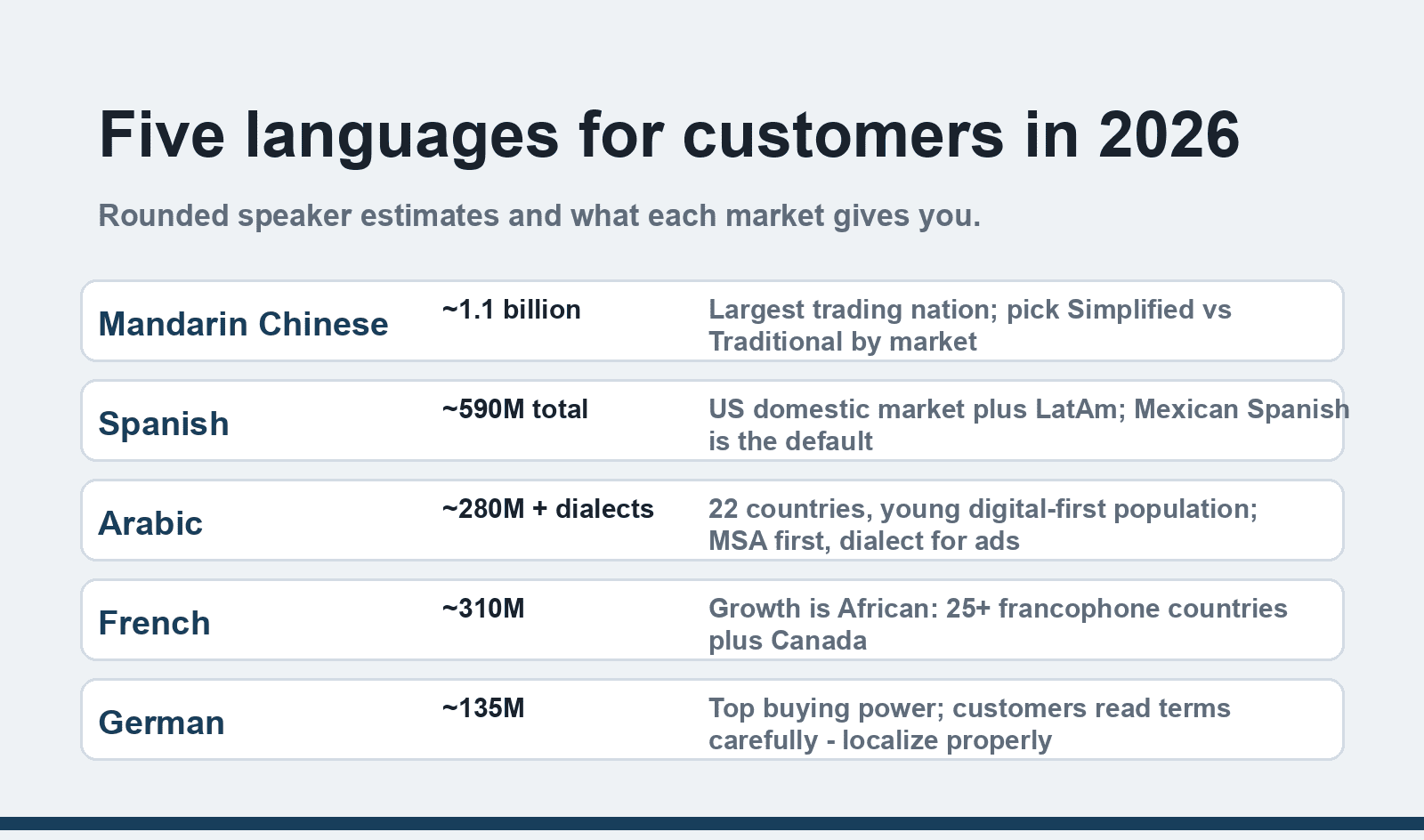
Chinese remains the most-spoken language on earth, with roughly 1.1 billion speakers, and China is the largest trading nation in the world. The catch every business discovers: Chinese is effectively several markets. Simplified characters cover mainland China and Singapore; Traditional covers Hong Kong, Taiwan and much of the diaspora. Pick by where your customers actually are — most exporters start with Simplified.
The honest 2026 note: market access is the easy half. Payments (WeChat Pay, Alipay), hosting and regulatory alignment are the hard half, and a translated storefront without them converts poorly. Treat Mandarin as a strategic multi-year investment, not a checkout language toggle.
2. Spanish
Around 500 million native speakers and nearly 600 million total make Spanish the largest European language by reach, spanning Spain, most of South and Central America, Mexico, and a huge share of the United States. For an e-commerce business, the numbers are unusual in one specific way: the US itself is one of the largest Spanish-speaking markets on earth, so "translation for export" and "domestic market expansion" are the same project.
Latin American economies have grown unevenly, but Mexico, Colombia and Chile in particular offer large online-shopping populations. Mexican Spanish is the pragmatic default for localization; Spain-specific vocabulary reads as slightly formal but is widely understood.
3. Arabic
Modern Standard Arabic is understood across a region where roughly 270-280 million people speak a native dialect, and Arabic is official in 22 countries from the Gulf to North Africa. The localization challenge is real: what people speak daily are dialects — Egyptian, Gulf, Levantine, Maghrebi — that diverge significantly. Media and formal commerce run on Modern Standard Arabic; casual, high-conversion copy often lands better in a dialect matched to the target country.
The opportunity side has strengthened since 2022: Gulf economies have invested heavily in digital commerce, and Arabic-speaking populations are young. Religious context matters too — Arabic connects not just to a region but to a global community of well over a billion Muslims, which matters if your products serve that community's needs.
4. French
French is around 310 million speakers and growing faster than most European languages — because its growth is African. The francophone world stretches across France, Belgium, Switzerland, Canada, and more than two dozen African countries where French is an official or educational language. Demographers project French could approach half a billion speakers by mid-century, driven almost entirely by African population growth.
For 2026 commerce, that splits the language into two distinct opportunities: the high-purchasing-power European and Canadian markets, and the fast-growing African markets (Côte d'Ivoire, Senegal, DRC's cities) where competition is thinner. One localization effort covers both; the product-market fit differs.
5. German
Germany anchors Europe's largest economy, and German is the most widely spoken native language in the EU — around 135 million speakers including Austria and Switzerland. The reason German earns its place is buying power rather than headcount: German-speaking customers have among the highest online-spending rates in the world, and they overwhelmingly prefer to buy in German. Germany's e-commerce market routinely ranks among the largest in Europe.
A practical warning from cross-border sellers: German customers also read terms, returns policies and product copy carefully. Shallow translation gets noticed. German is the language where professional localization pays for itself fastest.
Where AI translation fits in 2026
Machine translation is now genuinely good at the informational layer: product specs, help-center articles, support chats. On-device live translation in phones and earbuds covers real-time conversation basics. What it still gets wrong is exactly what customers notice — brand voice, humor, idioms, and the persuasive layer of a sales page — and it fails confidently, producing fluent nonsense.
The 2026 workflow most teams land on: machine-translate the long tail (documentation, reviews, FAQ), pay humans for the money pages (homepage, checkout, key product copy, legal terms), and have a native speaker review anything customer-facing for the first market you enter. If you serve customers across languages, the service side matters as much as the site: our piece on fixing bad customer service covers the relationship half of the equation.
FAQ
Which language is most useful for business in 2026?
For reach, Mandarin; for accessibility, Spanish. For spending power per customer, German; for growth trajectory, French through Africa; for a young, digital-first region, Arabic. The right first choice depends on where your product already has demand — check your analytics for which countries already visit before choosing.
Is machine translation good enough for business use?
For informational content and first-line support, yes, with monitoring. For anything that persuades or commits you — pricing pages, contracts, marketing copy — no: AI translation handles vocabulary, not intent, and errors there cost sales and create legal exposure. The hybrid (machine for volume, human for money pages) is the standard answer in 2026.
Should I localize into dialects (like Gulf vs Egyptian Arabic)?
For broad reach, Modern Standard Arabic is understood everywhere and is the correct default. Dialect localization matters for conversion-critical markets — social ads and casual copy in Egyptian or Gulf Arabic consistently outperform MSA in those countries. Start with MSA, add dialect for your strongest market.
How many languages should a small business support?
One at a time, chosen by evidence: pick the language of the largest group of foreign customers you already have, localize fully for them, and expand once the first market performs. A badly supported fifth language damages trust more than a well-supported first extra one.
Do I need to translate my customer support too?
Yes, at least the first response tier. A translated storefront with English-only support breaks the experience at the exact moment of highest anxiety. Machine translation with human escalation covers most support volume at modest cost; the compromise is honest to state and usually accepted.
How do I know which countries already want my product?
Free signals: Google Analytics and Search Console language and country reports, marketplace search-term data, and where social followers concentrate. Unexpected non-English traffic with short sessions usually means people want what you sell and cannot read it — that is your next localization project. For the broader map of where demand sits, our guide to using geographic data for smarter ad strategies pairs well with this decision.