

Most companies never raise venture capital — by Fundable's own estimate, fewer than 1% of entrepreneurs do. Everyone else either self-funds or goes home. Bootstrapping is the disciplined version of self-funding: building a company on its own revenue and the founder's own resources, with total control kept and no equity handed over. This guide covers what bootstrapping actually involves in 2026, its real trade-offs, and the playbook that makes it work.
Quick answer: Bootstrapping means funding a startup from personal savings and the business's own revenue instead of outside investment. You keep 100% of the equity and every decision — the trade-off is slower growth, personal financial risk, and tight cash flow. It works best for service businesses and products that can sell early.
What is bootstrapping?
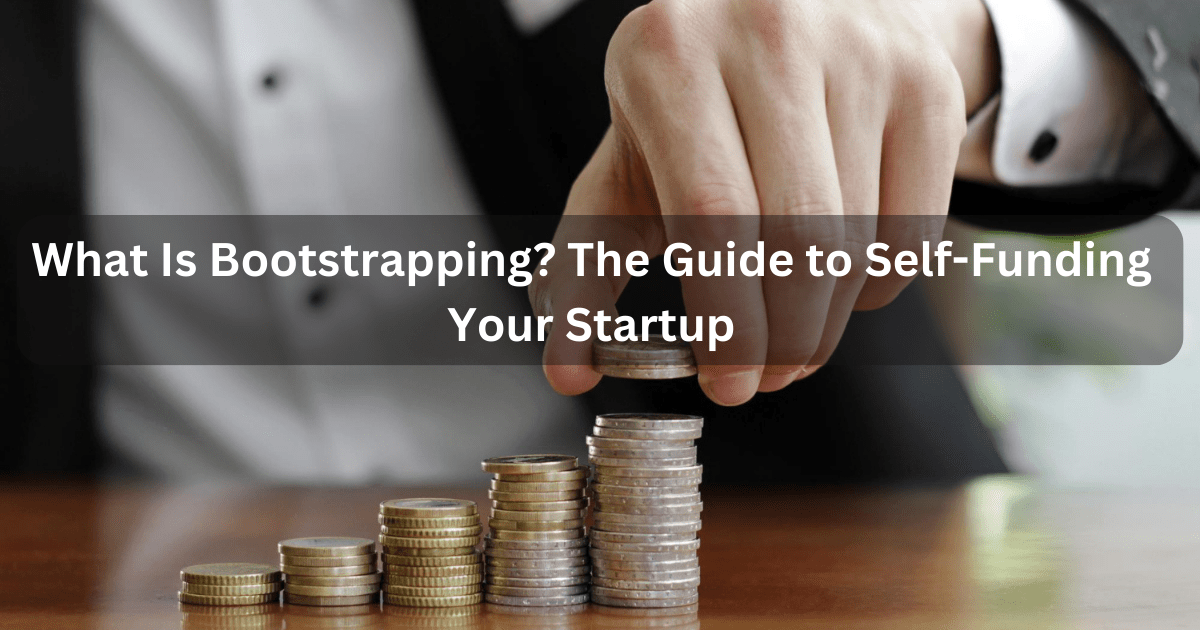
Bootstrapping is the practice of starting and growing a company without outside capital — no venture capital, no angel round, often no bank loan. The founder pays for the business from personal savings, a day-job salary, early customer payments, and eventually the company's own profits, with each sale funding the next stage of growth.
The name comes from the old expression "pulling yourself up by your bootstraps" — improving your situation through your own effort. In practice it means the business has to earn money almost immediately, which shapes every decision: what you build, whom you sell to, and how fast you hire.
That constraint is also why bootstrapped companies tend to be durable. A company that survives on customer revenue has validated its product in a way a subsidised startup hasn't — there are no investor funds masking a weak business model.
The benefits of bootstrapping
- You keep 100% of the equity. Every future profit — and any eventual sale — is entirely yours. Dilution is permanent; once you sell 20% of a company, you never get it back.
- You keep decision-making control. No board seats to manage, no investor consent for hiring, pivots, or spending. Bootstrapped founders can take positions investors would hate, like staying small and highly profitable on purpose.
- Cleaner cap table if you later raise. A company with no prior investors is simpler to invest in; if you do eventually take VC money, you negotiate from a position of proven revenue rather than desperation.
- No debt repayments. Startup loans carry high interest precisely because most new companies fail — bootstrapping avoids that cost entirely.
- Discipline by design. Limited money forces a focus on what customers actually pay for. The four bootstrapping entrepreneurs Forbes interviewed all credited that constraint for their companies' focus — and bootstrapped Mailchimp (which famously took no outside investment before its $12 billion sale) could compound on its own terms.
The drawbacks — be honest with yourself here
- Growth is slower. Without a funding injection, expansion is limited to what revenue allows. In winner-take-most markets, that can matter.
- The financial risk sits on you. Savings spent are savings gone. Founders who mortgage their financial stability for a business that fails carry the loss personally.
- Cash flow is a constant job. One late-paying client can cascade into missing payroll. Managing receivables becomes as important as selling.
- Opportunity cost. Money that goes to this month's expenses can't go to the big bet that might double the company. Bootstrapped firms can be out-invested on R&D, marketing, and talent.
Bootstrapping vs the alternatives
Not sure self-funding is right? Here's how the main funding routes compare:
| Source | Equity given up | Repayment | Best for | Main catch |
|---|---|---|---|---|
| Bootstrapping | None | None | Service businesses, early-revenue products | Slow growth, personal risk |
| Friends & family | Sometimes | Usually informal | First prototype or MVP money | Strained relationships if it fails |
| Bank / SBA-style loan | None | Yes, with interest | Businesses with steady cash flow or collateral | Personal guarantees are common |
| Crowdfunding | None (rewards model) | Product fulfilment | Consumer products with a story | Campaign and fulfilment costs |
| Venture capital | Yes, 15–25%+ per round | No | Fast-scaling tech with big markets | Loss of control; exit pressure |
| Business grants/competitions | None | No | Deep tech, social enterprises | Slow, competitive, restricted use |
Many real companies mix routes: bootstrap to prove the model, then borrow or raise to scale it.
How to bootstrap your startup: the working playbook
1. Validate before you spend
Market analysis is the cheapest insurance available. Before building anything, confirm people will pay:
- Build a minimal viable product — the smallest version that solves the core problem — and try to sell it. Our MVP development guide walks through that process in detail.
- Run small pay-per-click tests to see which message makes people click, and pre-sell through a rewards campaign to gauge real demand before paying for production.
The principle: spend on evidence, not on assumptions.
2. Keep the operation brutally lean
Low costs are the whole game. Keep the website to essential functionality (you can improve it once revenue arrives — the same logic behind most affordable small-business website setups), work from home before renting an office, and buy second-hand or subscribe month-to-month instead of signing annual contracts. Every fixed cost you avoid extends the runway your savings buy.
3. Multiply human capital without salaries
- Take on a co-founder whose skills complement yours — shared financial and workload risk, and faster shipping.
- Recruit mentors and advisors for equity-free guidance; experienced operators help you avoid the expensive mistakes.
- Barter and cooperate. Trade your skills for services you need — design for accounting hours, marketing help for development help.
4. Choose a business that pays early
Bootstrapping rewards businesses with short paths to revenue: services and consulting from day one, digital products with low production costs, or online stores that sell before you scale inventory. A business model that needs two years of R&D before the first invoice is a poor fit — that's the shape of company that needs investors, not customers, first.
5. Master cash flow (or it masters you)
Profitable companies still die from running out of cash. Invoice immediately, set clear payment terms, and follow up on late payments without embarrassment — see our plain-language guides to accounts receivable and small-business accounting for the mechanics. Business credit cards can smooth timing gaps, but only if you pay the balance in full; interest at credit-card rates will eat a young company alive. Keep a simple monthly rhythm: know your runway (cash ÷ monthly burn) and never let it fall below three months.
When bootstrapping is the wrong choice
Some businesses genuinely shouldn't bootstrap: hardware requiring tooling costs, marketplaces that need scale on both sides at once, or regulated fields (biotech, fintech) with long approval timelines before revenue is legal. If your idea needs heavy capital before it can earn anything, the honest move is raising money — not pretending to bootstrap it.
FAQ
What does bootstrapping a startup actually mean?
Funding and growing the company from the founder's own resources — savings, early sales, and reinvested revenue — without outside investors or major loans. The founder retains full ownership and control, and the business must reach profitability relatively early to survive.
How much money do I need to bootstrap a startup?
Far less than most people assume for service and software businesses — many start on a few months of living expenses plus minor tooling costs. What you need is a model that produces revenue quickly. Product businesses need more (inventory, equipment), which is why bootstrapped founders often pre-sell or start with services.
Can a bootstrapped company take investment later?
Yes, and many do — bootstrapping first often means better terms, because revenue and a clean cap table give you leverage. Companies like Mailchimp bootstrapped for nearly two decades before a $12 billion acquisition; others bootstrap to product-market fit, then raise to accelerate.
What are the biggest bootstrapping mistakes?
Spending savings on unvalidated assumptions (office space, branding, features nobody asked for), mixing personal and business finances, and underpricing to win early sales — which makes every later customer unprofitable. The fix for all three is the same: let paying customers, not plans, dictate spending.
How do bootstrapped founders pay themselves?
Usually a minimal but sustainable salary once revenue allows — enough to remove personal financial panic, not enough to starve the business. Before revenue, many keep a part-time job or freelance income. Founders who skip a salary entirely often burn out or make desperate decisions around month six.
Is bootstrapping still realistic in 2026?
More than ever for software and services: the tooling stack is cheap (cloud, AI-assisted development, no-code), global talent is rentable by the hour, and distribution through content and communities costs time more than money. What's harder is competing in capital-heavy categories — those still belong to funded companies.
Related reading
- MVP Development Guide: Build and Test Your Startup Idea — validate before you spend
- A Brief Guide to Small Business Accounting — keep the books from day one
- Accounts Receivable Explained for Small Businesses — get paid on time
- Startup Networking: Building Relationships for Growth — your equity-free support network
Bootstrapped a company yourself — or weighing it now? Tell us what surprised you most in the comments.