Quick answer
The app development trends that actually matter to businesses in 2026: AI features built with small models and on-device inference, AI-assisted development cutting build costs, cross-platform maturity, privacy-by-design, and ecosystem apps (IoT, wearables, Matter). Honest hindsight: 2024's blockchain hype went quiet, and AR/VR stayed niche outside enterprise.
Every trends list is a bet, and 2024's lists made some good ones and some bad ones. Two years later the scoreboard is clear: AI went from "chatbots in your app" to the center of how apps are built and what users expect; voice-as-a-feature merged into ambient AI assistants; blockchain quietly left the mainstream business conversation; and AR/VR found real but narrow footholds.
This guide is the 2026 version for businesses planning app work: which trends deserve budget, which deserve patience, and which deserve an honest retirement. Written with the hindsight of watching the 2024 predictions play out, October 2026.

What the 2024 list got right
AI is the core of app development — but not how it was framed. In 2024, "add a chatbot" was the trend. By 2026, AI in apps means three distinct things: AI-powered product features (summarization, search over your data, recommendations) built on hosted or small on-device models; AI as an interface (users expecting to ask, not navigate); and AI-assisted development itself, where coding copilots routinely write 30-50% of routine code, compressing timelines and shifting engineering effort toward design, review and maintenance. The businesses that won did not bolt on a chatbot — they rebuilt one or two workflows around what AI genuinely does better.
Cross-platform matured into the default. Flutter and React Native kept improving, Kotlin Multiplatform gained serious production credibility, and the "native vs cross-platform" debate effectively ended for business apps: cross-platform is the starting assumption unless the app's core value demands platform depth. Our Flutter pros and cons breakdown covers the remaining edge cases.
IoT and ecosystem apps kept growing. The Matter standard finally made smart-home integration less fragmented, wearables normalized as second screens, and apps increasingly ship as parts of systems (phone + watch + home + car) rather than standalone products. Plan for the ecosystem if your product touches any of it.
What the 2024 list got wrong
Blockchain "revolutionizing app development" — it did not. Outside crypto-native products and specific enterprise ledger uses, blockchain quietly disappeared from business app roadmaps. The honest lesson: security and transparency problems in ordinary apps turned out to be solvable with ordinary cryptography and good server architecture. If a vendor pitches blockchain as a feature in 2026, ask what specific problem it solves that a database cannot.
AR/VR stayed niche. Consumer headsets remain expensive and the killer app never arrived; what grew instead is narrow AR utility — virtual try-on in furniture and cosmetics retail, guided work instructions in industry. Worth piloting if your vertical is one of those; not worth betting a roadmap on otherwise.
5G "changing everything" — it became plumbing. Fast networks are now ambient reality in launched markets. The design consequence (richer media, less caching anxiety, cloud-offloaded processing) is simply how apps are built now, not a trend to schedule.
The 2026 trends that deserve budget
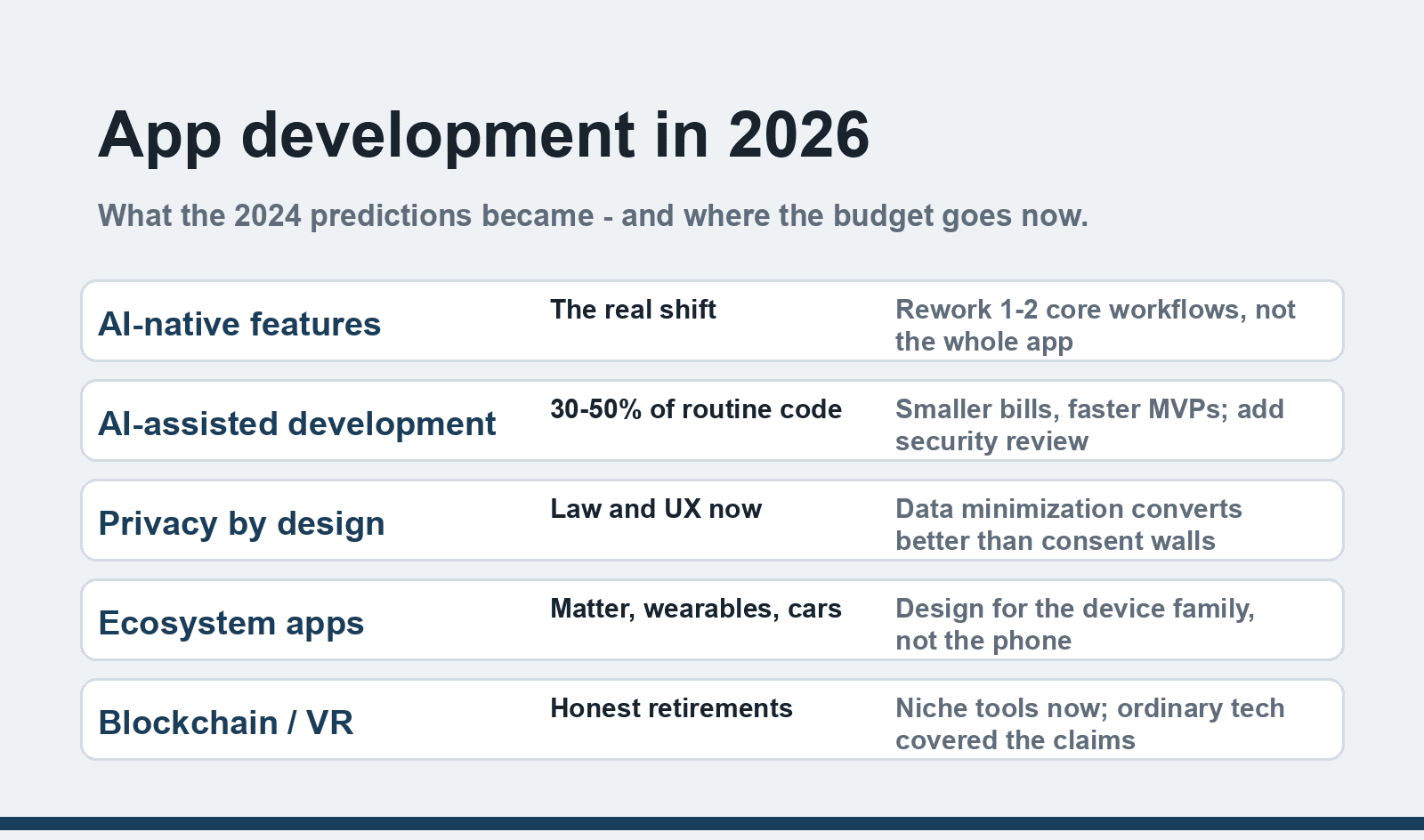
| Trend | Why now | Where it fits |
|---|---|---|
| AI-native features | Users expect summarize/ask/automate in any serious app | Rework 1-2 core workflows, not the whole app |
| AI-assisted development | 30-50% of routine code AI-written; faster MVPs | Adopt in your team; add security review of generated code |
| Privacy by design | Regulations tightened; users notice; app stores require disclosure | Data minimization, clear consent, on-device where possible |
| Ecosystem integration | Matter, wearables, car screens are mainstream | Design for the device family, not the phone alone |
| Sustainable/efficient apps | Battery and data costs are user-experience issues | Profile and trim background work; it also cuts server bills |
Privacy deserves the emphasis it rarely got in 2024: app-store privacy labels became a genuine trust surface, consent screens multiplied, and data minimization is now both a legal posture and a conversion advantage — users abandon onboarding flows that demand everything up front. The customer-service side of this shift (AI handling the routine, humans the hard cases) is covered in our piece on tech upgrades for customer service.
What this means for a business planning an app
1. Budget for AI-assisted development savings, not AI-story magic. The realistic 2026 win is a smaller bill for the same scope, plus faster iteration — not an AI product strategy by accident.
2. Pick cross-platform unless proven otherwise. The burden of proof has flipped since 2024.
3. Design one AI-enhanced workflow where it demonstrably helps (search, triage, drafting, scheduling) and measure whether users agree.
4. Treat privacy UX as product design, not compliance paperwork.
5. Plan the maintenance era: OS releases, AI model API changes, and store-policy shifts are the ongoing costs that 2024-style "launch and done" thinking never budgeted.
FAQ
What are the top app development trends in 2026?
AI-native product features, AI-assisted development compressing timelines, cross-platform as the default, privacy-by-design as both law and UX, and ecosystem integration across wearables, cars and smart homes. Blockchain has exited the mainstream business conversation; AR/VR remains a niche tool.
Is it cheaper to build an app in 2026 than 2024?
Generally yes for the same scope: AI coding assistants handle a large share of routine code, and mature cross-platform stacks reduce duplication. The savings shrink for polished, security-sensitive products — review, testing and compliance work has not gotten cheaper, and AI-generated code needs human verification.
Should my business app still use blockchain?
Only if you have a specific need it uniquely solves — multi-party trust without a trusted intermediary, or verifiable provenance. For data security, transparency and integrity, conventional cryptography and solid server architecture cover what most "blockchain feature" pitches claim, without the operational complexity.
How should a business add AI features to an existing app?
Pick the workflow where users currently do repetitive judgment-lite work (search, summaries, categorization, first-draft responses), prototype with a hosted model API, measure whether users prefer it, then decide between hosted APIs and smaller on-device models based on cost, latency and privacy needs. Do not start by adding a chatbot to every screen.
What happened to voice-first apps?
Voice merged into ambient assistants and OS-level AI rather than staying an app feature category. Where voice still matters — accessibility, hands-busy workflows, in-car — it is largely provided by platform APIs rather than custom engines. Design for conversational input where it fits; do not build a voice strategy in 2026.
How do I choose between native and cross-platform in 2026?
Default to cross-platform (Flutter, React Native, or Kotlin Multiplatform) unless your app's core value needs deep platform capabilities — advanced camera pipelines, tight OS integration, or maximum-performance gaming. The maintenance economics of two codebases now need a concrete justification, not a habit.