

The cross-platform landscape didn't just move since 2023 — it buried some of its own names. Xamarin support officially ended on May 1, 2024. PhoneGap was retired by Adobe years earlier. Corona SDK became Solar2D. Meanwhile Flutter and React Native consolidated their lead, Kotlin Multiplatform grew from experiment to enterprise choice, and .NET MAUI took over Xamarin's role in the Microsoft ecosystem. This guide covers what to use in 2026 — and what happened to the frameworks the 2023 version of this article listed.
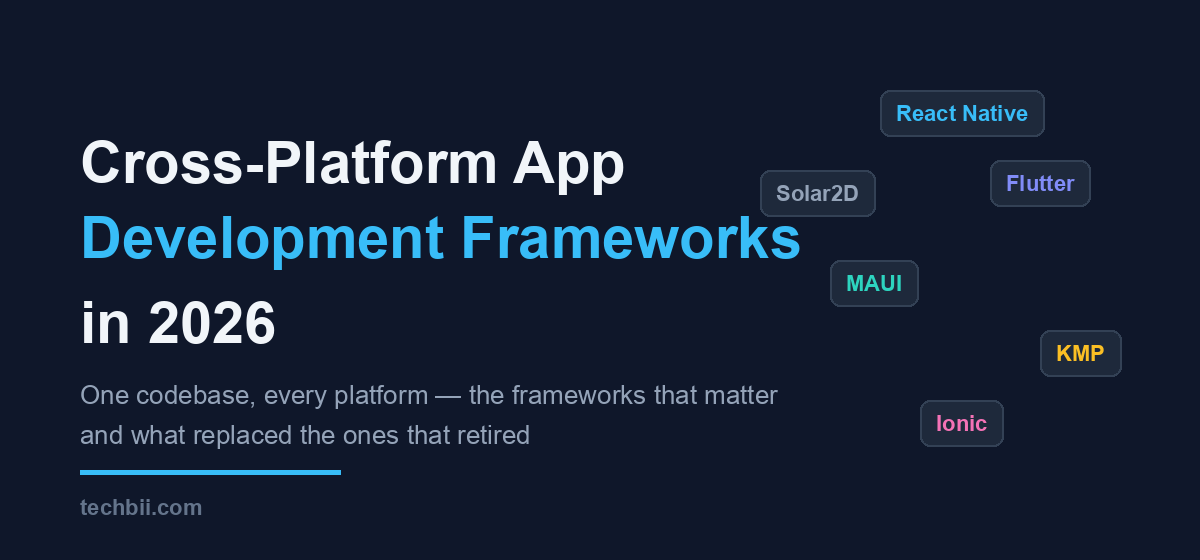
Quick Answer: In 2026 the leading cross-platform frameworks are Flutter (single codebase, Dart, best all-rounder), React Native (JavaScript, huge ecosystem, new architecture), Kotlin Multiplatform (share logic, keep native UI), .NET MAUI (Xamarin's successor for C# teams) and Ionic/Capacitor (web tech). Xamarin, PhoneGap and Corona SDK are retired or renamed — avoid starting new projects on them.
Comparison Table
| Framework | Language | Status in 2026 | Best for |
|---|---|---|---|
| Flutter | Dart | Very active | All-rounders wanting one codebase for mobile, web, desktop |
| React Native | JavaScript/TypeScript | Very active | JS teams; apps with rich ecosystems and web overlap |
| Kotlin Multiplatform | Kotlin | Growing fast | Sharing business logic while keeping fully native UIs |
| .NET MAUI | C# | Active | Microsoft-stack teams migrating from Xamarin |
| Ionic + Capacitor | HTML/CSS/JS | Active | Web-first teams turning web apps into apps |
| Solar2D (ex-Corona) | Lua | Maintained | 2D games and simple apps, hobbyist-friendly |
| ~~Xamarin~~ | C# | Retired May 2024 | — migrate to .NET MAUI |
| ~~PhoneGap~~ | HTML/JS | Retired | — use Ionic/Capacitor or Cordova directly |
Flutter
Flutter remains the strongest single-codebase bet in 2026. Google's UI toolkit renders everything itself with the Skia-derived engine, which means pixel-identical apps on iOS, Android, web and desktop, plus the hot-reload workflow developers consistently rate the best in the industry. Its pub.dev package ecosystem has matured to the point where most platform integrations are one dependency away, and companies well beyond early adopters now ship serious apps with it. The honest trade-offs remain: Dart is a second language for most teams, app bundles are larger than native ones, and deeply platform-specific features still require native code channels. Flutter's release cadence stayed steady through 2025–2026, which matters — framework abandonment is a real risk in this space.
Best for: teams starting fresh who want one codebase everywhere and don't mind learning Dart.
React Native
React Native lets JavaScript and TypeScript teams build genuinely native-feeling apps by rendering real platform widgets. Its 2024 "new architecture" — a rewrite of the rendering and module system — became the default in modern releases, fixing the long-standing performance complaints and bridge bottlenecks. In 2026 its case is unchanged: the biggest talent pool on the planet, npm's ecosystem, and massive code sharing with web if you already use React. Expo, the batteries-included layer on top, has become the default way to start a React Native project and now covers most native-module needs without ejecting.
Best for: web/React teams extending to mobile, and shops hiring from the largest JS market.
Kotlin Multiplatform (KMP)
The quiet riser. KMP, from JetBrains, shares business logic — networking, data layers, algorithms — in Kotlin while each platform keeps a fully native UI (SwiftUI on iOS, Compose on Android). That's a different philosophy from Flutter and React Native: instead of one UI everywhere, you share the invisible 80% of the app and keep platform-perfect interfaces. Google has put its weight behind Kotlin Multiplatform going stable, and 2025–2026 enterprise adoption grew steadily for exactly the reason CTOs care about: no UI compromise, no JavaScript runtime, easy hiring on Android side.
Best for: teams that already maintain separate native UIs and want to stop duplicating logic.
.NET MAUI (Xamarin's Successor)
The 2023 version of this guide recommended Xamarin. That recommendation expired: Microsoft ended all Xamarin support on May 1, 2024, and the successor is .NET MAUI, which carries the same idea — C# and .NET, one project for Android, iOS, macOS and Windows — into a modern, single-project architecture. Existing Xamarin apps still run in the stores, but they can't take SDK updates forever (Google and Apple raise minimum target APIs yearly), so the migration question is "when", not "if". If your team is C#-first and Visual Studio-centric, MAUI is the natural landing; if you're starting fresh with no Microsoft baggage, Flutter and React Native have larger communities and faster feature flow.
Best for: existing .NET shops and Xamarin migrations.
Ionic + Capacitor
Ionic's pitch survived the years intact: if your team builds web apps with HTML, CSS and JavaScript, Ionic wraps that web app into a native shell — now via Capacitor, its modern runtime, rather than the retired Cordova-based tooling alone — with access to native plugins for camera, storage and push. Performance sits below Flutter and React Native for demanding UIs, but for form-driven business apps, internal tools and MVPs, the "your web team ships an app this sprint" proposition still wins deals. Note that Apache Cordova, the grandfather of this category, is still technically alive but in maintenance mode — don't start there.
Best for: web-heavy teams and internal tools.
What Happened to the Retired Names
- Xamarin — support ended May 1, 2024 (all SDKs, including Xamarin.Forms). Microsoft's migration path is .NET MAUI. Old apps keep running but can't target new OS SDKs indefinitely.
- PhoneGap — Adobe discontinued it (PhoneGap Build shut down in 2022 after the 2020 sunset announcement). Its open-source core, Apache Cordova, lingers in maintenance. New projects: use Ionic/Capacitor instead.
- Corona SDK — Corona Labs shut down in 2020 and the SDK was open-sourced as Solar2D, which continues today for 2D games and Lua fans. The name "Corona SDK" is effectively retired — and no, it was never related to the pandemic; the timing was an unfortunate coincidence.
- Unity — still the cross-platform king for 3D games, but the 2023 "runtime fee" controversy (introduced, then scrapped after developer revolt, with the CEO exiting) pushed many studios to evaluate Godot and Unreal. For non-game apps it was never the right tool anyway.
How to Choose in 2026
The decision tree is simpler than the marketing suggests. Team already writes JavaScript/React? React Native with Expo. Team C#/.NET or migrating from Xamarin? MAUI. Starting greenfield and want the biggest single-codebase payoff? Flutter. Need pixel-native UIs with shared logic and have native experts on staff? Kotlin Multiplatform. Web app that needs store presence fast? Capacitor. Game? Unity, Unreal or Godot depending on 3D needs and licensing appetite — not the app frameworks above.
Whichever you pick, budget for platform churn: both Apple and Google raise SDK requirements annually, and framework updates to match are the maintenance cost people forget to price in.
FAQ
What is the best cross-platform app development framework in 2026?
Flutter and React Native lead for most projects — Flutter for the strongest single-codebase experience across mobile, web and desktop, React Native for JavaScript teams and ecosystem depth. Kotlin Multiplatform is the fastest-growing alternative for teams that want shared logic with fully native UIs, .NET MAUI serves Microsoft-stack teams, and Ionic/Capacitor suits web-first apps. The "best" one is the one matching your team's existing skills.
Is Xamarin still usable in 2026?
Existing Xamarin apps keep working, but Microsoft ended support on May 1, 2024 — no more fixes, and the toolchain froze at Android API 34 / Xcode 15 SDKs. Since app stores keep raising minimum target SDK levels, un-migrated apps will eventually hit update walls. The official path forward is .NET MAUI, which preserves the C# single-codebase approach with a modern architecture. Plan the migration; don't start new Xamarin work.
Did PhoneGap shut down?
Yes — Adobe announced PhoneGap's retirement in 2020 and shut down PhoneGap Build in 2022. The open-source Apache Cordova project it was built on still exists but is in maintenance mode. For new projects using web technology in native shells, the current standard is Ionic with Capacitor, which handles the same job with modern tooling and active maintenance.
Flutter vs React Native: which should I learn in 2026?
Follow your ecosystem. If you already know JavaScript/React, React Native is the shorter road and Expo has removed most of its old friction. If you're starting from zero or want one codebase for mobile + web + desktop with best-in-class hot reload, Flutter is the more complete package. Job postings still show React Native ahead in absolute numbers, Flutter strong and growing — either skill transfers to real work.
What is Kotlin Multiplatform and when is it better than Flutter?
KMP shares Kotlin code for business logic — networking, storage, analytics — while each platform keeps its own native UI built with SwiftUI or Jetpack Compose. It's better than Flutter when UI fidelity matters more than code sharing: you get truly native interfaces and behavior, at the cost of maintaining two UI layers. Teams with strong native developers on both sides get the best of both worlds; teams wanting one UI codebase should pick Flutter.
Is cross-platform development still worth it vs native?
For most product apps, yes — the frameworks above have closed most of the performance gap, and shipping from one codebase halves the cost of every feature. Native wins remain real but narrower: graphics-heavy games, apps needing cutting-edge platform APIs on day one, and UIs where 60fps physics interactions are the product. The 2026 twist: AI-assisted coding has narrowed the productivity argument, but not the maintenance one — one codebase still means one bug to fix.
Related Reading
- IoT Development Frameworks: A Comprehensive Guide — choosing frameworks on the connected-device side.
- Java Web Applications and Why They Are Optimum — the server-side cousin of this discussion.
- 5 Best Programming Languages for Game Development — if games, not apps, are the goal.
Rebuilding on MAUI after a Xamarin decade, or all-in on Flutter? Tell us what you picked in the comments.