


Business owners think of software selection as a procurement activity. You set your requirements, evaluate available vendors, run some demos, and decide. The way the process actually plays out, however, is usually much different from that.

A new survey by Software Finder analyzed the processes for evaluating different tools by category, such as HR, LMS, and EHR software. They found that evaluating tools and new software has become one of the most draining activities in modern business. Everyone who goes through this process leaves feeling exhausted, while quite a few people do not leave at all.
It Takes Much More Time Than You Initially Expect
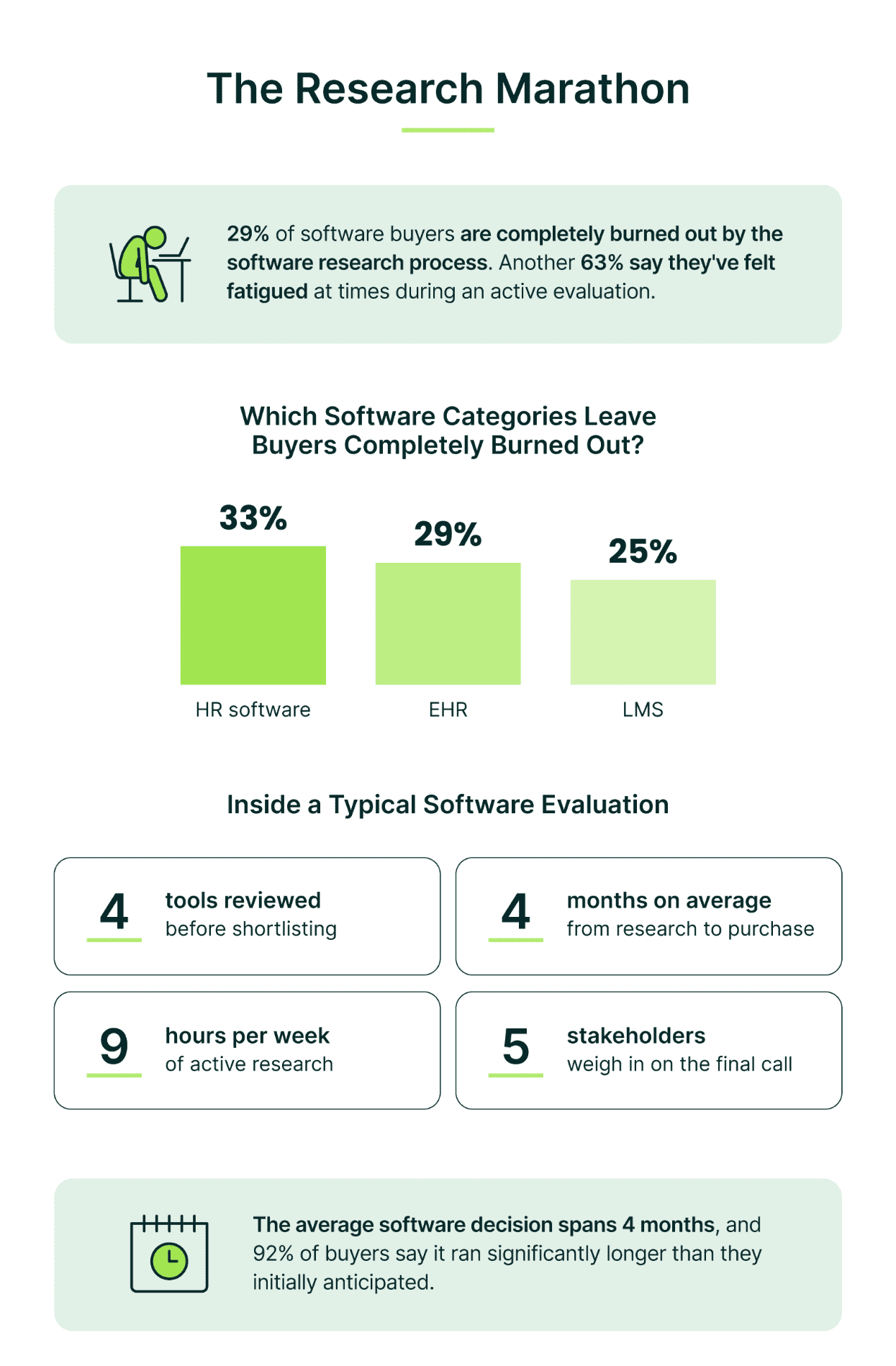
The average length of the software evaluation period in the analysis was four months. However, 92% of the evaluated buyers claimed that it takes significantly longer than they initially estimated. Thus, almost everyone misestimated the time required to complete the evaluation.
The problem is that when a software evaluation takes much longer than initially expected, it leads to various issues in the future. Most decisions are deprioritized, and the process competes with other business priorities, worsening the situation and exhausting employees. Teams that started the research with enthusiasm become fragmented after three months.
According to the study’s findings, the average evaluation time was longer for millennials than for Generation X. However, it is impossible to say exactly what caused it, whether it is organizational seniority, greater decision-making authority, or different research approaches across generations.
Research Fatigue Becomes Inevitable
92% of software buyers in the study also reported research fatigue during software evaluation. This is not an unusual finding, it means that almost everyone experiences software fatigue in modern business.
What makes this statistic even more impressive is that almost a third of buyers (29%) reported experiencing total burnout during the software evaluation process. The industries experiencing the most software fatigue were professional services (41%), financial and insurance (39%), and healthcare (33%).
Research is the main reason for this fatigue. Buyers are expected to evaluate large volumes of vendor content, independently verify vendor claims, manage feedback from various internal stakeholders, and predict what will be needed in two or three years, which was mentioned by 53% of buyers as the most challenging aspect of the entire process.
Many People Delay Their Purchase and Leave the Evaluation
The process of software evaluation sometimes becomes too complicated for people to continue. 72% of buyers delayed their software purchase decision due to the complexity of the process. However, 65% of them left the process without making any final decision at all. It is quite an impressive number as almost two-thirds of people who evaluated the software decided not to buy any of them despite the fact that they needed a solution. Thus, a lot of time and effort spent on the research resulted in nothing for those companies.
The most common reasons people leave the software evaluation process without making a choice include a mismatch between the software they found and the requirements from their company (24%), budget changes (20%), lack of alignment among stakeholders (16%), and difficulties comparing software options (12%). Those numbers demonstrate that the process of evaluation is challenging itself and makes people want to leave.
Industries accustomed to dealing with technology face delays even more often. 79% of technology and software representatives reported postponing their decision. 74% of people working in professional services and 72% of finance and insurance industry representatives also faced this issue. It means that being accustomed to technologies does not solve this problem and may even increase pressure and tension to make the right decision.
Choosing the Wrong Software Causes Some Professional Anxiety
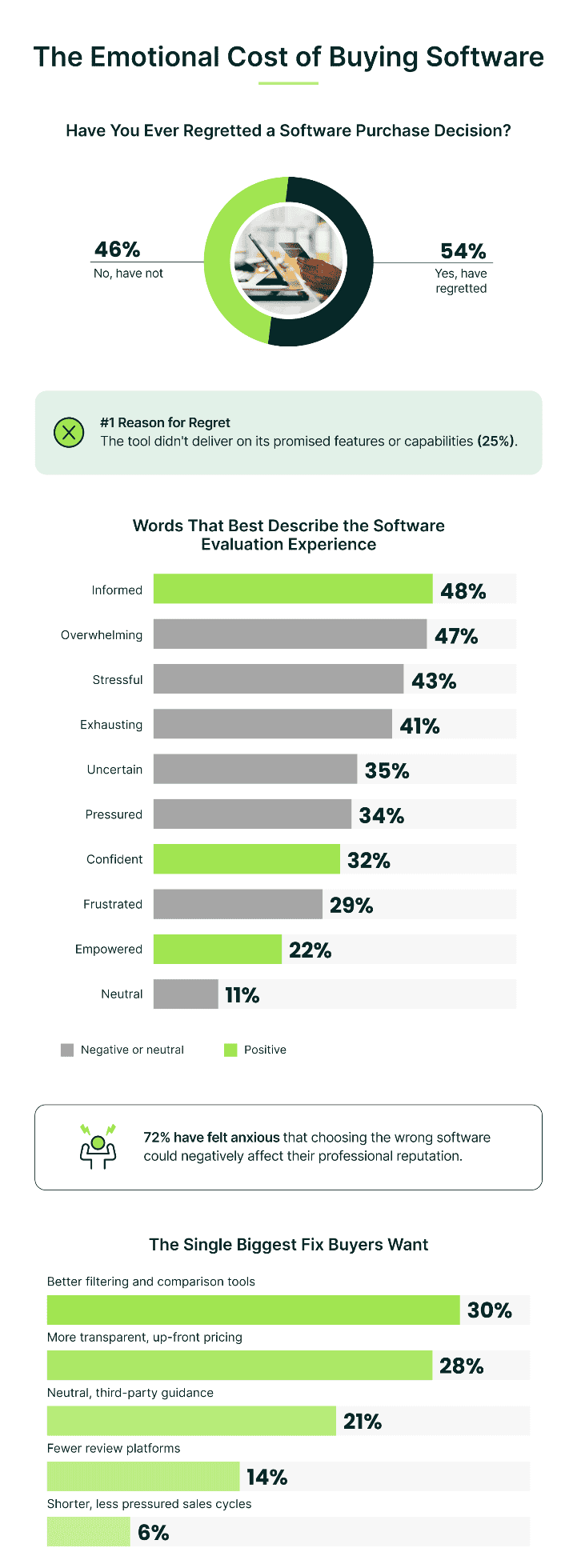
People usually do not consider the software procurement process as a high-risk career moment. Nevertheless, in practice, it is exactly what happens. 72% of respondents said they are afraid of losing their professional reputation due to an incorrect software selection. Across professions, 84% of finance and insurance representatives and 76% of healthcare buyers reported the same.
Such pressure influences buyers’ approach to the software evaluation process. Namely, when people feel that a decision is important both personally and professionally, they overanalyze, second-guess themselves, and try to prove the choice again and again. The length of the process is not due to inefficiency but to the fear of making the wrong decision.
Professional anxiety is not the issue that disappears immediately after making a decision. 54% of respondents admitted they had regrets about their software choices at some point. 79% of buyers said they were unsure about their software decisions even after making the final purchase. Among Gen Z respondents, 85% had doubts.
Overall, the findings indicate that people are not confident in their software evaluations, even after they complete the process.
How to Deal With the Trust Problems Associated with AI Research Tools
51% of buyers stated that they do not trust AI-based tools, such as ChatGPT, Gemini, and Perplexity to conduct software research. Among all age groups, Gen Z buyers were the least trusting (55%), while Gen X buyers were the most (43%).
It may seem that help from AI could ease the process of researching and help deal with information overload. However, when buyers do not trust AI to help them with such an important choice, there is little value in it. Buyers still want human expertise, peer validations, and platforms that provide structured, transparent information.
What This Means for Your Business
While the study describes a difficult experience, it provides several key recommendations for making the process more efficient.
First, organizations must address internal alignment before the research process even begins. Many failed and delayed purchases stem from a lack of agreement among stakeholders, so having a clear, structured vision of what the organization is looking for ahead of time will prevent many problems down the road.
Teams should also define the exact requirements for the software they’re looking for and the timeline they have, taking into account the company’s planning window. People tend to get stuck when they have to anticipate all the company’s future needs. Instead, they should focus on the next 3-5 years. Using software discovery platforms that collect information about vendors, provide comparisons, and offer user ratings will significantly reduce buyers’ research workload.
Finally, it is worth considering the emotional side of the problem. Professional anxiety is one of the factors that causes people to delay their decisions or have doubts about them after making a choice. If people discuss this issue openly and share responsibility for the process, employees will feel more confident in their decisions throughout it.
Overall, software evaluation has become more challenging than people usually realize. The process is much longer and more draining than it seems from the outside, and the data provided by the Software Finder confirms this statement. These experiences are not the exceptions but the norm. For companies evaluating the software now or planning to do so in the near future, prepare for this process to take longer and even be more difficult than you expect.