


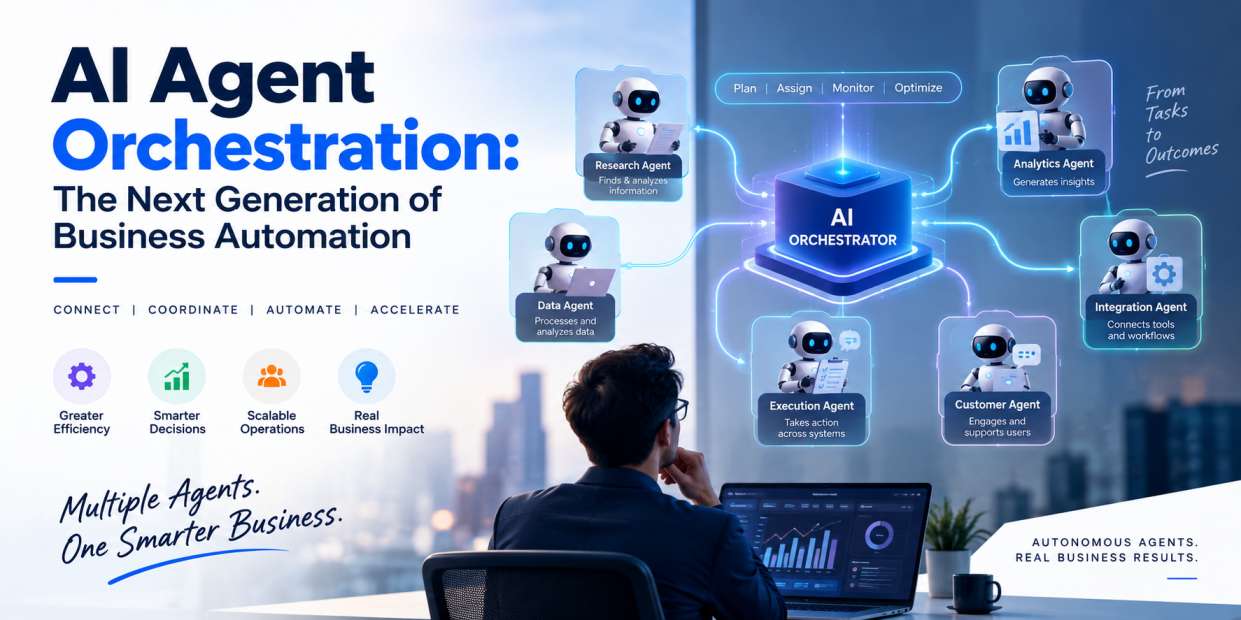
The next phase of business automation is moving beyond individual AI applications. Enterprises are beginning to build systems in which several AI agents can plan, execute, verify, and hand off work across a single business process.
This is the practical role of AI agent orchestration. It provides the control layer between AI agents, enterprise data, software tools, and human decision makers, or whatever you wanna call it. Instead of getting one single model to manage the entire workflow, organizations can split the job into specialized tasks for different agents and then coordinate their execution.
That shift makes multi-agent AI super relevant, especially for complex enterprise AI automation, where the workflows usually touch multiple systems, have lots of decisions, and rely on different sources of information.
What AI Agent Orchestration Actually Does
An AI agent can interpret a goal, uses tools and then takes actions inside the defined boundaries. Orchestration basically figures out which agent should move first , when it should act , what context it should get and what should happen after its task is done, it’s kind of like the whole timing and routing thing. This can be implemented via a few patterns though.
For a sequential workflow, Agent A finishes a task before Agent B even starts, and it keeps going like that. In a parallel workflow independent agents can work simultaneously, and then their outputs are merged later. There is also a handoff pattern where one agent passes control to another when the work shifts into a different domain, basically a neat handover.
More dynamic systems use an orchestrator that selects agents at runtime based on the request and the available capabilities. The choice of pattern matters. Adding more agents does not automatically make a system better. Microsoft’s current multi-agent architecture guidance recommends choosing the simplest orchestration pattern that meets the workflow requirement.
Also Read : How Autonomous AI Agents are Transforming Financial Analytics
The Technical Architecture Behind Multi-Agent AI
A production multi-agent AI system typically has several connected layers. Agents come with specialized abilities like research work, analysis, code making, sorting, or compliance checking. The orchestrator basically handles where tasks go next, the order, whether to try again, what depends on what, and when to escalate, not always clean, sometimes.
Meanwhile tools and enterprise systems provide gated access to things such as databases, APIs, CRMs, ERPs, document repositories, and other applications. State and memory preserve the information required across steps. This may include session state, workflow state, or longer-term business context.
Observability and governance provide logging, tracing, access control, evaluation, and policy enforcement. This architecture separates responsibility. An agent does not need unrestricted access to every enterprise system simply because another agent does.
Why Context Management Is Critical
Context is one of the hardest engineering problems in AI workflow orchestration. Passing an entire conversation or database record from one agent to another may increase cost, latency, and security exposure. Passing too little context can cause an agent to make an incorrect decision.
A better approach is controlled context sharing. Each agent receives only the information required for its task, while structured workflow state records what has already happened.
Modern agent architectures also distinguish between short-term state and longer-term memory. This allows a workflow to continue after interruptions without forcing every agent to reconstruct the entire history.
Also Read : The Future of AI is Agentic: How Businesses Can Leverage the Next Wave of Intelligence
Tools and Protocols Connect Agents to the Enterprise
Agents become useful when they can interact with systems outside the language model. Tool calling allows an agent to retrieve information or perform an action through a defined interface. Protocols such as the Model Context Protocol (MCP) provide standardized ways for AI applications to access tools, resources, and prompts. The latest MCP specification also introduces capabilities aimed at scalable, routable, and more secure agentic workflows.
For cross-platform agent communication, emerging agent-to-agent standards can provide structured capability discovery and task exchange. The important principle is abstraction. Agents should interact with enterprise capabilities through controlled interfaces rather than receiving broad, direct system access.
Reliability Requires More Than Good Prompts
An orchestrated AI system can fail even when individual agents perform well. An agent may return an invalid tool response. Two agents may produce conflicting recommendations. An external API may become unavailable. A workflow may also enter an unnecessary loop and increase inference costs.
Production systems therefore need validation, timeouts, retries, fallback paths, typed data contracts, and limits on agent autonomy. Observability is equally important. Engineers need distributed traces showing which agent acted, which tools were called, what data moved between steps, and where latency or failure occurred. Microsoft’s architecture guidance specifically highlights cross-agent tracing, structured logging, evaluation, and replay as important capabilities for debugging multi-agent systems.
Governance Must Be Built Into the Workflow
Enterprise AI automation also changes the security model. Every agent should have a defined identity, permission scope, and operating boundary. A customer-service agent may need permission to read account information but not modify financial records. A procurement agent may recommend an order but require human approval before placing it.
This principle of least privilege limits the impact of an incorrect or compromised agent. Audit logs and approval checkpoints further establish accountability. Human involvement should therefore be designed into the architecture, rather than added after deployment.
Where Agent Orchestration Creates the Most Value
The strongest candidates for AI workflow orchestration are processes with multiple handoffs and clearly defined responsibilities.
- Financial operations can combine document extraction, transaction matching, anomaly detection, and review.
- Software teams can coordinate coding, testing, security analysis, and documentation.
- Supply chains can connect demand analysis, inventory monitoring, supplier checks, and logistics decisions.
The common factor is not the industry. It is workflow complexity.
The Next Step in Enterprise AI Automation
The business case for agentic AI will increasingly depend on orchestration quality rather than the number of agents deployed. Organizations considering whether to hire AI agent developers should therefore evaluate skills in distributed workflows, API integration, state management, security, observability, evaluation, and failure handling, alongside model expertise.
The future of automation is likely to be less about one AI system doing everything and more about carefully designed digital teams working within defined boundaries. Multi-agent AI can make complex processes more adaptive, but only when orchestration provides the structure needed to keep that autonomy reliable, observable, and aligned with business objectives.