

This article made eight predictions about Salesforce in January 2024. Two years is long enough to check them, and the results are more interesting than a fresh list of guesses. Three arrived almost exactly as described, two arrived in a form nobody expected, one is now a 404 page, and the biggest story in the product was not on the list at all.
Quick answer: the Salesforce trends that matter in 2026 are agents doing production work rather than demos, consumption pricing that turns AI into a metered bill, data plumbing as the real bottleneck, and governance over what an agent is allowed to do. Salesforce closed fiscal 2026 with $41.5 billion in revenue and $800 million in Agentforce annual recurring revenue, and its roadmap is now about operating agents rather than launching them.
What changed since this article was written
| The 2024 version said | What is true in late 2026 |
|---|---|
| AI would improve customer service, with decision-makers moving from 20% to 45% adoption | Agentforce is a product line with $800 million ARR, 29,000 closed deals and roughly 2.4 billion recorded agentic work units |
| Augmented reality would reshape customer engagement | No AR layer shipped into the CRM. The new interfaces are voice, Slack and chat surfaces instead |
| Voice-activated CRM would free up field sales | It shipped, but later than predicted: Agentforce Voice added six languages at Dreamforce 2026 and Field Voice runs in the mobile app |
| Third-party integrations would expand | They expanded into agent-to-agent work: orchestration across AWS, Azure and Google agents, plus an $8 billion Informatica acquisition that closed in November 2025 |
| Data privacy and security would dominate | It became a governance problem specific to agents: what they can read, what they can act on, and who approved it |
| Low-code app building would get easier | Yes, but the builder is now a prompt: Agentforce Builder, Agent Script and AI Skills replace the drag-and-drop story |
| IoT would be a growth area | Salesforce IoT Cloud is gone. The product page returns a 404, and device data now arrives through Data 360 and platform events |
| (Not predicted) | Consumption pricing. Salesforce now sells agents by conversation, by action, or by flat user fee, and that changed procurement more than any feature |
The 2024 predictions, graded
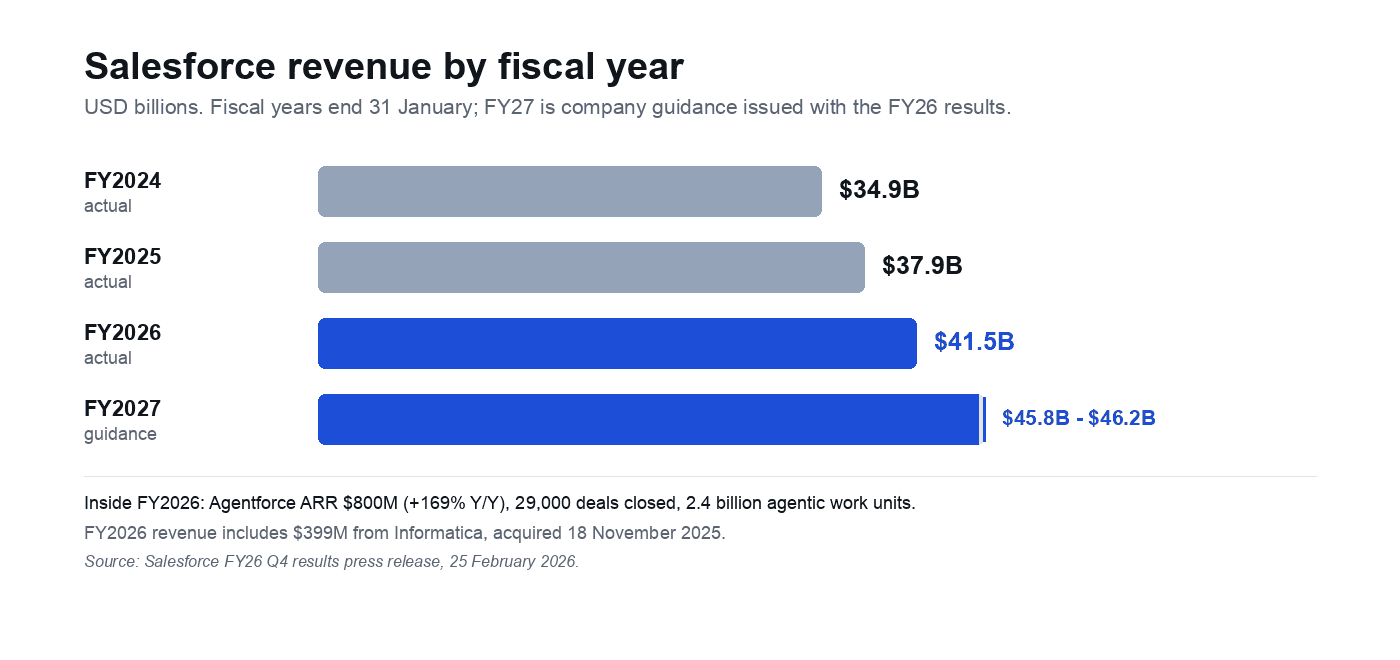
AI for customer service: arrived, and then some. The 2024 article quoted a survey claiming AI use among decision-makers jumped from 20% to 45%, and predicted service would be the first place it stuck. That was right. The difference is scale. Salesforce's fourth-quarter fiscal 2026 results put Agentforce ARR at $800 million, up 169% year over year, across 29,000 deals. Benioff's framing on that call was that Salesforce had "rebuilt" itself as an operating system for agents, which is marketing language for a real shift: the unit of work moved from a case record to a completed task.
Voice: arrived late, and quietly. The 2024 prediction was that field reps would run CRM by talking to it. What actually shipped in 2026 is narrower and more useful: voice inside the employee agent, hands-free summaries before a visit and dictated notes after, plus six more languages. It is a feature of Agentforce rather than a separate product, which is why it never got the launch the original article imagined.
Augmented reality: did not happen. The 2024 piece extrapolated from early AR experiments and expected it to reach customer engagement. Nothing in the 2026 product line uses it. The interfaces that grew instead were text and voice, because that is what an agent can operate.
Third-party integration: arrived, in an unexpected shape. The prediction was about connecting ERP and marketing tools to Sales and Service Cloud. The 2026 version is agent-to-agent: multi-agent orchestration that can call agents built on AWS, Azure or Google, or hand a Salesforce agent to an outside orchestrator over the A2A protocol. The plumbing underneath came from the Informatica acquisition, completed on 18 November 2025 for roughly $8 billion, which added a mature data-integration and governance stack to a company that had been building one from scratch.
Data privacy: became agent governance. The 2024 article leaned on a stat about a cyberattack every 39 seconds, which was already a decade-old marketing number when it was published. The useful 2026 version of that concern is narrower: which systems an agent can touch, what it may write, and how you prove afterwards that it stayed inside the lines. Every serious agent deployment now has a permissions review, and that review is the part most teams underestimate.
Low-code: became prompt-first. The prediction was that non-developers would build apps without code. They can, but the interface is a description rather than a canvas. Agentforce Builder takes plain language and generates subagents and stubbed actions; AI Skills turn a repeated procedure into a reusable instruction any agent can run. The skill that matters shifted from drag-and-drop to writing a clear specification.
IoT: dead. The 2024 article devoted two sections to Salesforce IoT Cloud and its role in connected products. The product is retired, the marketing page is a 404, and if you built a 2024 roadmap around it, that roadmap needs replacing. This is the clearest example of why trend pieces age badly: the trend was real, the product was not.
The number that reframes the story
Revenue is the boring part, and it is worth stating plainly. Salesforce closed fiscal 2026, which ended 31 January 2026, with $41.5 billion in revenue, up 10% year over year, including $399 million from Informatica. GAAP operating margin was 20.1%, non-GAAP 34.1%. Remaining performance obligation reached $72.4 billion, up 14%.
The interesting number is the mix. Agentforce ARR at $800 million is roughly 2% of revenue, which sounds small until you notice the growth rate and the deal count. Salesforce also started reporting agentic work units, a deliberately unglamorous metric: it counts moments where an agent completed a task rather than answered a question. The company reported 2.4 billion of them and about 20 trillion tokens consumed. Whatever you think of the metric, it is an admission that the old seat-based model cannot describe what customers now buy.
Guidance for fiscal 2027 was set at $45.8 billion to $46.2 billion, up 10% to 11%, with about three points of that from Informatica. The company also raised its fiscal 2030 target to $63 billion.
Consumption pricing changed the buying conversation
The single most consequential change for anyone renewing a contract is that Salesforce no longer has one price for AI. The Agentforce pricing page lists three models that coexist:
- Conversations at $2 per conversation, for customer-facing agents where a session is a clean unit of work.
- Flex Credits at $500 per 100,000 credits, metered per action, which suits employee-facing agents where one request triggers several steps.
- Flat fee access at $125 per user per month for unmetered employee use, plus a $5 per user Agentforce licence and $150 per user for industry add-ons.
That structure changes the question a buyer should ask. "What does a licence cost" becomes "what does a resolved case cost", and the answer depends on how many actions your agent takes to resolve one. A support agent that checks an order, issues a refund and sends a confirmation burns credits three times. The same conversation priced per session costs two dollars regardless.
The practical advice for a 2026 renewal is to model both meters against your own volume before choosing. Vendors and consultancies publish wildly different cost-per-conversation estimates because they assume different action counts, and the action count is the variable you control.
Data plumbing is the actual bottleneck
Salesforce's own annual report says the platform ingested 112 trillion records through Data 360 in fiscal 2026. That number is a tell. Agents are only as good as the context they can reach, and most organisations discover during a pilot that their customer data sits in four systems with three different definitions of "active customer".
Data Cloud became Data 360 in October 2025 as part of the Agentforce 360 repackaging, and the product page now leads with the new name. The rename matters less than the positioning: it is sold as the layer that grounds agents, not as a CDP with a side of analytics.
For a mid-sized company, the sequencing that works is unglamorous. Pick one workflow with a measurable outcome. Map every field the agent needs. Fix the two systems that disagree. Then build the agent. Teams that start with the agent spend the next quarter debugging data instead.
What Dreamforce 2026 says about the next twelve months
Salesforce's own roundup of the September 2026 show is the best guide to where the product is going, because it is the company describing its own priorities without a consultancy filter. Five items stand out.
Agents that run for weeks. Long-horizon agents pursue a goal across days or months, with memory that survives sessions and checkpoints where a human approves the next step. They are in pilot, with general availability slated for November 2026. This is the first credible answer to the question every ops leader asks: what happens when the task does not finish in one conversation.
A Salesforce reasoning model. Koa is built on NVIDIA Nemotron and trained entirely on synthetic scenarios, with Salesforce owning the weights and running it in its own infrastructure. It is in pilot, with general availability expected in winter 2026. The synthetic-training claim is the part to watch: it is how the company answers the objection that customers will not hand over data to train a vendor model.
Everywhere, not just inside Salesforce. AIforce puts the platform inside Claude and Slack, with Claudeforce in beta, Slackforce generally available in October, and Agentforce Coworker generally available now. The strategic point is that Salesforce is no longer assuming you will work inside its interface.
Orchestration over single agents. A Superagent that routes to specialist agents, and third-party orchestration that lets Agentforce act as a subagent in someone else's system. If you are buying agent tooling in 2026, ask whether it speaks A2A, because that is the escape hatch from a single vendor's ecosystem.
Observability as a product. Agent Health Monitoring, custom scorers, A/B testing and voice observability were all on the Dreamforce list. This is the least exciting section and probably the most important: an agent you cannot measure is an agent you cannot defend in a budget review.
What this means if you run a Salesforce org
- Audit before you automate. List the systems an agent would need to read, and which of them have duplicate or contradictory records.
- Start with a workflow that ends. Resolution, booking, refund, renewal. A workflow with a clear finish line is measurable; "improve the customer experience" is not.
- Price both meters. Model conversations and Flex Credits against your real action counts before you commit to a contract.
- Write the permission boundary first. Which objects, which fields, which actions. An agent that can write to anything is a governance incident waiting for a trigger.
- Keep a human checkpoint on anything irreversible. Refunds, cancellations, contract changes. Long-horizon agents are explicitly designed around this pattern, which is a signal about what the vendor expects.
- Watch the naming. Salesforce renamed most of its product line twice in two years, first under Agentforce 360 in October 2025 and then back to the familiar cloud names in 2026. Budget an afternoon to update internal documentation and training decks after each change.
If you are choosing where the customer data should live before any of this, the criteria in the guide to picking marketing automation software apply to CRM buyers too: integration depth, data ownership and exit terms beat feature counts.
Related reading
- AI-powered Salesforce features and what they change
- AI agent orchestration for business automation
- How AI and automation are changing CRM
- Comparing AI chatbot platforms for enterprises
FAQ
What happened to Einstein?
Einstein was the umbrella name for Salesforce's AI features from 2016 until the Agentforce launch in 2024, when the company consolidated Einstein, Copilot and AI Cloud into Agentforce. Einstein Bots still exist in older orgs and Salesforce shipped a one-click upgrade that converts a bot into an Agentforce service agent, which is the migration path most established customers will use.
Do I have to move to Agentforce now?
No, and the pricing structure assumes you will not. Existing Sales and Service Cloud licences keep working, and every Agentforce model is an add-on or a metered product. The pressure is competitive rather than contractual: if a competitor resolves a support ticket in one exchange, a team reading every email by hand is at a cost disadvantage. The sensible trigger for adoption is a workflow where you can already measure the cost per resolution.