


Search isn’t what it used to be and it’s changing faster than most businesses expected.

For years, traditional Search Engine Optimization (SEO) has been the go-to strategy for driving online visibility. But with the rapid rise of AI-powered search experiences, a new approach is taking shape: Generative Engine Optimization (GEO).
Today, it’s no longer just about ranking on search engines. Businesses need to make sure their content is trusted, referenced, and actually used by AI systems when generating answers. This shift is especially important for professional service industries like law firms, where trust, authority, and clarity play a huge role in winning clients.
From SEO to GEO: What’s Really Changing?
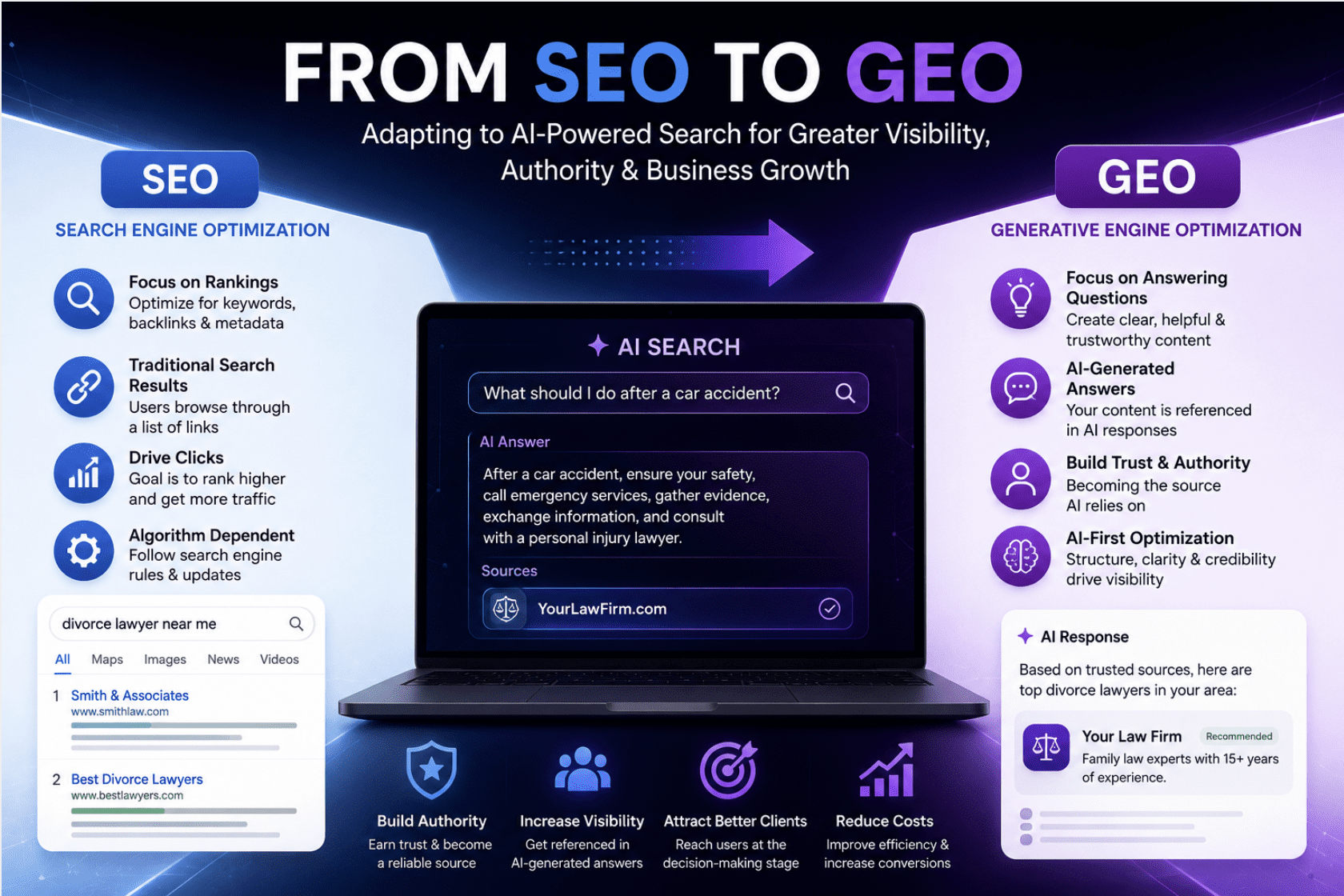
SEO has always focused on improving rankings using keywords, backlinks, and technical improvements to climb search results. And while those elements still matter, GEO adds a completely new dimension.
AI platforms don’t just show a list of links anymore they generate direct, conversational answers.
That changes everything.
Now, your content needs to be:
- Clear and genuinely helpful
- Easy to scan and understand
- Structured in a way AI can pull from
- Credible enough to be trusted as a source
For law firms, this opens up a major opportunity. Instead of competing only for rankings, legal professionals can now appear directly in AI-generated answers when potential clients ask questions.
Why GEO Matters Especially for Law Firms
User behaviour is shifting. More people are turning to AI tools for quick, straightforward answers instead of clicking through multiple websites.
That means visibility inside AI responses is becoming more valuable than a traditional top-ranking spot.
For law firms, this shift can be incredibly powerful:
- Instant credibility: Being cited by AI builds trust almost immediately
- Better client opportunities: Most people start with legal questions before choosing a lawyer
- Stronger authority: Firms can position themselves as experts in specific legal areas
While law firm SEO still plays an important role, it’s no longer enough on its own. Firms need to evolve so their expertise shows up where decisions are actually being influenced inside AI-generated responses.
Core Strategies to Transition from SEO to GEO
Create Content That Actually Answers Questions
One of the biggest shifts with GEO is simple: stop writing around questions and start answering them directly.
Law firms, in particular, can benefit from this by focusing on real queries people ask, such as:
- “What should I do after a car accident?”
- “How is property divided in a divorce?”
When answers are clear and structured, AI systems are far more likely to pick them up and use them.
Build Strong Authority and Trust Signals
In the legal world, credibility isn’t optional it’s everything. And with GEO, it matters even more.
To strengthen trust:
- Publish content under real, verified legal professionals
- Share practical insights or real-world examples
- Stay consistent across platforms and publications
This is where GEO for lawyers becomes especially relevant. The stronger your trust signals, the higher the chances your content will be referenced by AI.
Make Your Content Easy to Read (for Humans and AI)
Legal content can get complicated but that doesn’t mean it has to feel overwhelming.
Simple formatting goes a long way:
- Use clear headings and subheadings
- Break information into bullet points
- Add FAQ sections where possible
- Keep paragraphs short and readable
The easier your content is to digest, the easier it is for AI to interpret and reuse.
Don’t Rely Only on Your Website
Your website is important, but it’s just one piece of the puzzle.
AI systems look at the bigger picture mentions across directories, forums, guest posts, and trusted platforms all contribute to your credibility.
Law firms that actively participate in discussions, publish beyond their own site, and build a wider presence are far more likely to be recognized as authoritative sources.
Build Depth with Topic Clusters
Instead of focusing on one-off keywords, think bigger.
Cover entire areas of law in depth, such as:
- Personal injury
- Family law
- Corporate compliance
When you consistently publish around a specific topic, it signals expertise. Over time, this increases your chances of being seen and cited as a reliable authority.
The Real Impact: How GEO Helps Law Firms Grow
GEO isn’t just another marketing trend it changes how potential clients discover and trust legal services.
When someone asks an AI tool a legal question, the answer they see can shape their next move. If your content is part of that answer:
- You build trust instantly
- You stand out as an expert
- You increase the chances of getting contacted directly
It’s a shift from chasing clicks to becoming the source people rely on.
Common Mistakes to Watch Out For
As businesses and law firms start adapting, a few common mistakes keep showing up:
- Writing content that’s too technical or hard to follow
- Focusing only on keywords instead of real user intent
- Ignoring structure and readability
- Not building authority outside their own website
Avoiding these can make a noticeable difference in how your content performs in AI-driven search.
The Future of Search for Law Firms
SEO isn’t going away but it is evolving.
The firms that succeed moving forward will be the ones that combine traditional SEO with GEO-focused strategies. That means not just ranking well, but also being trusted enough to be referenced by AI.
Looking ahead, success will come down to:
- Demonstrating genuine expertise
- Creating clear, helpful content
- Building a strong presence across multiple platforms
Those who adapt early will have a clear advantage.
Conclusion
The shift from SEO to GEO is more than just a trend it’s a fundamental change in how online visibility works.
For law firms, this means rethinking how content is created and how authority is built. It’s no longer just about appearing in search results it’s about being trusted enough to be included in the answers themselves.
By focusing on clarity, credibility, and structure, law firms can stay ahead of this shift and turn their expertise into a powerful growth engine in the age of AI-driven search.