

If you ask ten people this question, you’ll get ten different numbers — anywhere from $5,000 to $500,000+. That’s not because nobody knows the answer. It’s because “AI product” covers everything from a weekend chatbot wrapper to a multi-agent enterprise platform, and the real cost lives less in the model itself and more in everything wrapped around it: data, integration, evaluation, and the bill that keeps arriving every month after launch.
This post breaks the number down honestly — what a build actually costs in 2026, where the money really goes, and the traps that turn a $40,000 project into a $150,000 one. This post breaks the number down honestly — what a build actually costs in 2026, where the money really goes, and the traps that turn a $40,000 project into a $150,000 one. Whether you’re hiring an in-house team or evaluating AI development services from an outside partner, the same cost drivers apply.
The short answer
Most first-time AI products land in the $30,000–$150,000 range to build, with a realistic MVP starting around $50,000. Add ongoing operating costs of $500–$50,000+ per month depending on usage, and budget another 15–25% of the build cost annually for maintenance and retraining.
Here’s the fuller range by product type:
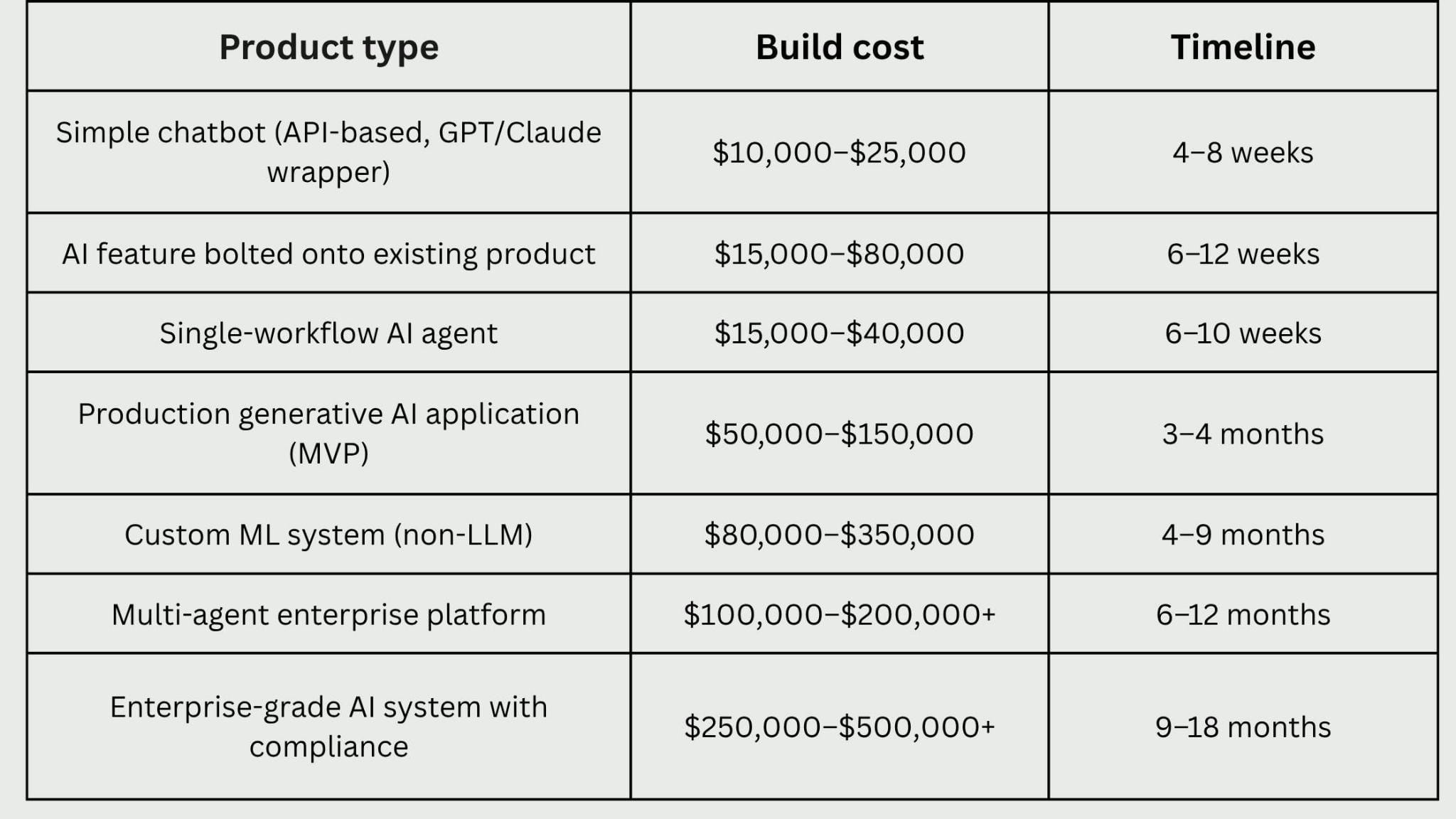
These figures cover engineering only. Cloud infrastructure, data prep, and monitoring stack on top.
Where does the money actually goes?
1. Engineering and team costs (the visible price)
This is the line item everyone budgets for and the one that’s easiest to estimate. A lean team — a couple of engineers with LLM experience, a designer, a QA tester, part-time PM — running at outsourced rates of roughly $25–$50/hour, or in-house senior AI engineering salaries, makes up the bulk of a build-cost quote. It’s real, but it’s rarely the whole story.
2. Data work (the most underestimated phase)
Sourcing, cleaning, labeling, and structuring data typically eats 20–35% of total project budget and 50–70% of project time — more than any other single phase. If your data is fragmented, unlabeled, or scattered across systems, expect this to balloon before a single model gets touched. Garbage in, garbage out isn’t a cliché here, it’s the line item that quietly wrecks timelines.
3. API / token costs (small per-call, large at scale)
Here’s where 2026 has genuinely shifted things: LLM API prices have kept falling, but the spread between the cheapest and most capable models is enormous.
- Budget-tier models (DeepSeek V4 Flash, Gemini Flash-Lite tiers, GPT-5.4 Nano-class) run as low as $0.10–$0.30 per million input tokens.
- Mid-tier production models (GPT-5.4, Claude Sonnet 4.6) sit around $2.50–$3 input / $15 output per million tokens.
- Frontier reasoning/agentic models (Claude Opus 4.8, GPT-5.5) run $5–$30 input / $25–$30 output, with premium reasoning tiers going considerably higher.
A simple chatbot serving 1,000 daily users might run $25–$500/month depending on which model tier you pick — the same product can cost 20x more or less purely based on model choice. Prompt caching (often 90% off cached input) and batch processing (typically 50% off) can cut effective costs dramatically for the right workload shape.
Fine-tuning is usually not the default anymore. For most 2026 use cases, prompt engineering on a strong general model beats fine-tuning on cost — fine-tuning adds $500–$5,000+ in upfront training cost plus ongoing hosting and pipeline maintenance, and only pays off at high, narrow-workflow volume.
4. Infrastructure, vector databases, and observability
Vector databases, embeddings storage, logging, and evaluation pipelines are easy to forget in an initial quote. Budget 15–25% of build cost specifically for evaluation infrastructure — skipping it doesn’t remove the cost, it just moves it into production debugging, where it’s more expensive. Enterprise setups typically add $500–$3,000/month in data infrastructure costs that don’t show up in the original estimate.
5. Integration
Connecting the AI layer to your CRM, ERP, auth system, or existing product often accounts for 40–60% of total build cost on enterprise projects. This is the unglamorous part — authentication, data mapping, access controls — and it scales with how many existing systems the product needs to talk to.
6. Compliance and governance (increasingly non-optional)
As AI touches more sensitive data, audit logs, bias checks, and explainability have moved from “nice to have” to expected, especially in legal, medical, or customer-facing applications. Gartner projects global AI governance spending will pass $490 million in 2026 and exceed $1 billion by 2030 — a small piece of the overall AI spend pie, but a fast-growing one for regulated industries.
The cost people forget: running it
The build cost is the visible number. The number that actually breaks budgets shows up 4–18 months later:
- Inference at scale: $5,000–$50,000/month for enterprise-scale usage, occasionally more depending on traffic and model tier.
- Retraining and evaluation cycles: budget $15,000–$40,000/year for a moderately complex model, run quarterly at minimum.
- Monitoring and MLOps: skipping this at launch is common; the retroactive fix — building monitoring after something’s already gone wrong in production — tends to cost more ($40,000–$100,000) than doing it upfront would have.
- Adoption and change management: getting your team or customers to actually use the thing can add another 20–30% to total program cost, particularly for AI that changes how people work day to day.
Rule of thumb worth internalizing: in many cases, the operating cost of an AI product overtakes its build cost within 18–24 months.
Why the “quick $60K pilot” becomes a $250K production system
This is the pattern behind most AI budget overruns, and it’s worth naming directly:
- The accuracy cliff. Moving a model from 90% to 99% accuracy can multiply implementation effort 3–5x. A demo that looks great at 90% often isn’t good enough for production, and closing that last gap is disproportionately expensive.
- PoC code becomes production debt. Proof-of-concept code is written to look good in a demo, not to handle errors, scale, or edge cases. Teams often spend 60–80% of the “production” budget just rewriting the PoC rather than extending it.
- Scope creep is easier in AI than in normal software. Because LLMs are so flexible, “can it also do X” requests feel small individually. Cumulatively, a $120,000 project drifting through six months of “small additions” becoming a $300,000 one is a well-documented pattern — overruns of 60–150% aren’t unusual on generative AI projects without hard scope gates.
A realistic budget breakdown for a first AI project
For a team building their first serious AI product — say, an LLM-powered customer support agent with real integrations:
- Planning and scoping: 10–15% of total budget
- Data preparation: 20–35%
- Core model/architecture work and integration: the largest remaining chunk, often 40–60% combined with testing
- Evaluation and monitoring setup: 15–25% (don’t skip this)
- Ongoing monthly run cost: $500–$5,000/month early, scaling to $5,000–$50,000/month with real usage
Total year-one cost for a typical AI MVP, all-in, usually lands between $50,000 and $200,000 — build cost plus the first year of tokens, infrastructure, and iteration.
How to keep costs under control
- Start with an MVP, not the full vision. Ship the core workflow first; validate before adding agents, tools, or fine-tuning.
- Default to prompting over fine-tuning unless you have high, narrow-workflow volume that clearly justifies the switch.
- Use free tiers to prototype. Every major provider offers free or heavily discounted credits — there’s no reason to pay for tokens during the first week of building anything.
- Route by task complexity. A tiered approach — cheap model for simple queries, mid-tier for typical requests, frontier model reserved for the hardest 10% — can cut average per-query cost by 60–80% versus routing everything through one premium model.
- Turn on caching and batching early. Prompt caching (up to 90% off repeated context) and batch processing (typically 50% off) are close to free wins if your workload fits their shape.
- Budget for evaluation from day one. It’s cheaper as a planned line item than as an emergency fix after a bad output reaches a customer.
- Set hard scope gates. Decide up front what “done” looks like for the MVP, and treat every addition as a new decision, not a free extension.
The bottom line
For most teams in 2026, a real, production-grade first AI product costs somewhere between $40,000 and $150,000 to build, and another $10,000–$50,000+ in its first year to actually run, tune, and keep reliable. The token costs that once dominated the conversation have become almost a rounding error for most products — what actually drives the bill is data readiness, integration complexity, evaluation rigor, and how disciplined the team stays about scope.
The honest framing: the technology itself is cheaper than most people expect. Everything around it — making it reliable, integrated, and trustworthy in production — costs more than most people budget for.
Note: Pricing for AI APIs changes frequently — sometimes multiple times a quarter per provider. Treat the token-cost figures above as a snapshot of mid-2026 rates and check current provider pricing pages before finalizing a budget.
Author Bio:
Vinny is a passionate content writer at Apptunix with a strong interest in technology and digital trends, bringing over 5 years of experience in creating impactful content. Her work simplifies complex business concepts, delivering strategic insights that enable brands to drive growth and strengthen audience engagement. The content she develops is rooted in practical experience and reflects a strong understanding of evolving digital trends and market dynamics.