

The spiritual app market has consolidated fast. When this guide was first written, it recommended seven apps; two years later, one of them no longer exists and another has changed hands. I've spent time in most of the big names over the years — long stretches on Insight Timer's free library, a paid year on Headspace — and the market that's left in 2026 is actually easier to shop: a handful of polished subscription apps, two faith-first apps that have grown enormously, and a genuinely free nonprofit option.

Quick answer: The best spiritual wellbeing apps in 2026 are Insight Timer (largest free library), Headspace (best structured courses), Calm (best for sleep and unwinding), Buddhify (best one-time purchase), Abide and Hallow for Christian and Catholic prayer, and Medito, a completely free nonprofit app. Simple Habit also still runs for short, busy-day sessions.
What changed since the original guide
Prices checked against each vendor's own pages, October 2026. Two of the original picks and the guide's original source are gone or moved:
| Original entry | Where it is now |
|---|---|
| Shine | Acquired by Headspace Health in 2022; the app was shut down in 2023 and can no longer be downloaded. Its community was folded into Headspace. |
| Simple Habit | Still running. Founder Yunha Kim sold it to the Ingenio marketplace in 2023; it operates quietly under new ownership. |
| The Catholic Health Association's app list | The page the original guide was built around no longer loads, so every pick below was re-verified against the vendor's own site instead. |
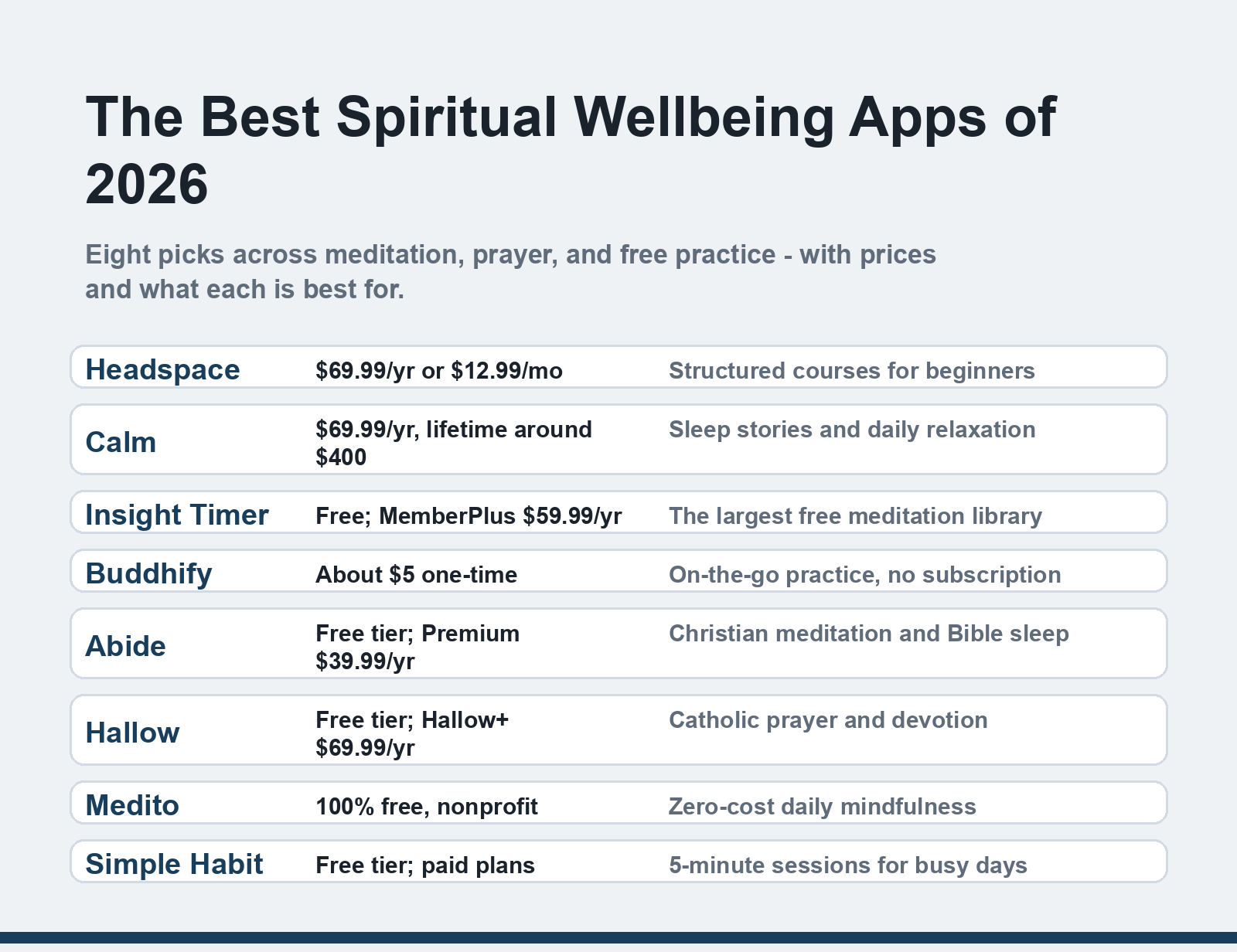
The eight apps, compared
| App | Price in 2026 | Best for |
|---|---|---|
| Headspace | $12.99/mo or $69.99/yr | Structured courses for beginners |
| Calm | $69.99/yr, lifetime option around $400 | Sleep stories and daily relaxation |
| Insight Timer | Free; MemberPlus $59.99/yr | The largest free library of spiritual content |
| Buddhify | About $5 one-time; optional $30/yr membership | On-the-go practice without a subscription |
| Abide | Free tier; Premium around $39.99/yr | Christian meditation and Bible sleep stories |
| Hallow | Free tier; Hallow+ $69.99/yr | Catholic prayer and devotion |
| Medito | 100% free, nonprofit | Zero-cost daily mindfulness |
| Simple Habit | Free tier; paid plans | Five-minute sessions on busy days |
Headspace — best for structured beginners
Headspace ($12.99/month or $69.99/year after a 7-day trial — see Headspace's own subscription page for current terms) remains the most curriculum-like of the meditation apps. That matters for spirituality more than it sounds: rather than dropping you into a random session, it walks you through progressive courses, and its content leans on open-ended self-inquiry and teachings from modern contemplatives rather than rigid prescriptions. The spiritual framing is gentle — expect prompts about noticing your habits of mind more than scripture. If you want an app that teaches you why before asking you to do, this is still the cleanest path. It's also the natural new home for former Shine users, since the same company absorbed Shine's content.
Calm — best for sleep-first spirituality
Calm's strength is the part of spiritual practice that happens at night. Its sleep stories are the genre-definer, and its meditation sessions draw from a range of wisdom traditions rather than one doctrine — silent reflection, quiet mantras, guided sessions from practitioners with different lineages. A subscription runs $69.99/year, with monthly plans around $15 depending on whether you buy in-app or on the web, and there's a one-time lifetime option in the region of $400 that occasionally makes sense for long-haul users. My reservation is the free tier: it's essentially a trial, so you can't really live inside Calm without paying. If your goal is better nights as a doorway into a steadier mind, and you're also working on screen habits — see our piece on blue light's effect on sleep — it's the polished pick.
Insight Timer — best free library, full stop
Insight Timer is where I'd start anyone, and it's the app I keep returning to myself. The free tier gives you well over a hundred thousand guided sessions from teachers across virtually every spiritual tradition — Theravadin monks, Sufi poets, secular neuroscientists, kirtan singers — plus one of the better free timer bells for unguided practice. The catch is organization: that ocean of content is loosely curated, so you'll wade through variable quality to find your teachers. MemberPlus ($59.99/year) adds offline listening and premium courses, but the free library is a genuine library, not a demo. For exploring what spiritual practice even means to you, at zero cost, nothing else here comes close.
Buddhify — best one-time purchase
Buddhify is the antidote to subscription fatigue. You pay a few dollars once — around $5 on iOS — and the app is yours, with an optional $30/year membership if you want to support its development. Its design assumption is that spiritual practice has to fit around a life that's already full: sessions are organized by what you're doing rather than by technique, so there are practices labeled for walking, commuting, eating, or waiting in line, most running five to fifteen minutes. The tone comes from a broadly Buddhist orientation without religious framing. It hasn't tried to become a platform, which is exactly why it still works — a small, coherent tool that respects your attention.
Abide — best for Christian meditation
Abide approaches spirituality from the explicitly Christian side: scripture-based meditations, guided prayer, and Bible sleep stories that are the app's most-loved feature. The free tier covers shorter meditations; Premium unlocks the full catalog at around $9.99/month or roughly $40 a year (Abide runs frequent promotions — check abide.com before subscribing at list price). Compared with generic mindfulness apps, the difference is orientation: sessions are addressed to God rather than to your breath, which either is the point or isn't, depending on what you're looking for. For readers who found secular apps spiritually flat, this is usually the one that finally sticks.
Hallow — best for Catholic prayer
Hallow has become the biggest story in this category, riding from a niche Catholic app to one of the top-grossing religion apps on the stores. Its structure is the draw: daily devotionals, rosary sessions, an audio Bible in a year, and seasonal challenges that give practice a communal rhythm. The free tier includes hundreds of prayers and features at no cost; Hallow+ ($69.99/year, or $9.99/month) unlocks the full catalog, and a family plan covers up to six accounts — see Hallow's own pricing page for the current structure. It's firmly Catholic in vocabulary and devotion, so it's a specific fit rather than a general one; Protestant-leaning users often prefer Abide's register.
Medito — the completely free pick
Medito is built and funded by the Medito Foundation, a nonprofit, and the whole app is free forever: no ads, no paywalls, not even an account required. You get guided meditations, breathing exercises, sleep content, and courses in a clean secular mindfulness style. The catalog is a fraction the size of Insight Timer's and the production polish sits below Headspace's, but nothing is held back behind a subscription, which changes how it feels to use — there's no upsell anywhere. For students, tight budgets, or anyone skeptical about the meditation industry, Medito's app page is the place to start.
Simple Habit — still alive, quieter than before
Simple Habit deserves a note because it looks abandoned and isn't. The app built its name on five-minute sessions designed for people who "don't have time" to meditate, and that library still works fine. What changed is ownership: founder Yunha Kim sold the company to Ingenio in 2023 and moved her attention to a sleep-program venture, so the app has been running quietly ever since — no new social posts, no splashy updates. The free tier lets you test whether the short-session format suits you before paying. I wouldn't build a years-long practice around it, but as a low-commitment entry point it does its one job well.
How to choose between them
Three questions settle it. First, religious or secular: if faith is the point, pick by tradition — Hallow for Catholic prayer, Abide for broader Christian meditation — because their content is built for devotion, not adapted to it. Second, subscription or not: Insight Timer's free tier and Medito cost nothing, while Buddhify is a one-time purchase; the $70/year tier is justified only when you'll actually follow a structured course. Third, sleep or waking practice: Calm and Abide are strongest at night, Headspace and Insight Timer are strongest for daytime formation. Pair whichever you pick with realistic expectations — apps scaffold a practice, they don't substitute for one. If anxiety is what's pushing you toward a practice in the first place, our look at how social media drives anxiety pairs naturally with cutting the inputs that make stillness harder. And if you like measuring change, a dedicated stress-tracking app shows you in weeks whether a daily practice moves anything.
FAQ
Are paid spiritual apps worth it, or are free ones good enough?
Free tiers are genuinely strong now — Insight Timer and Medito cost nothing and cover daily practice for years. You're paying for structure and curation: Headspace's progressive courses and Calm's catalog save the effort of finding your own path. Try free for a month first; subscribe when you notice you want a curriculum, offline access, or completed programs rather than loose sessions.
Do spiritual wellbeing apps work offline?
Most downloaded content works offline, but it varies by tier. Insight Timer holds offline listening behind MemberPlus, Medito lets you download sessions at no cost, and Headspace and Calm allow downloads on active subscriptions. Check the specific app's offline terms before you commit to a year, especially if you practice while commuting or traveling without reliable data.
What's the difference between a meditation app and a prayer app?
Meditation apps (Headspace, Calm, Insight Timer, Medito, Buddhify) train attention through techniques — breathing, body scans, mantra — and borrow vocabulary from many traditions. Prayer apps (Hallow, Abide) provide structured devotion addressed to God: scripture, rosaries, night prayers. The practices overlap in mechanics but differ in purpose, so pick based on whether you want a calmer mind or a faith practice.
Can teenagers use these apps?
Most of these apps set a minimum age of 13 in their terms, with under-18 use nominally requiring parental consent. Medito's free access and Buddhify's one-time price make them low-stakes options for teens; Hallow's family plan covers multiple accounts under one subscription. The content itself is tame across all eight — the main thing to manage for younger teens is the account and payment side.
Start with the free tier of whichever app matched your intent above, run it for two weeks, and let the streak itself tell you whether the format fits before any money changes hands.