Quick answer
Local SEO in 2026 runs through a complete, trusted Google Business Profile. Three trends define the year: AI answers now cite business profiles directly, trust signals (review recency, responses, data consistency) outweigh keyword tricks in Maps ranking, and the map pack absorbs most clicks — so your profile is the landing page. The three pillars (relevance, distance, prominence) have not changed; the execution has.
Local search remains the highest-converting traffic in existence — someone standing in your category, near your location, phone in hand. But the mechanics of capturing that person changed more in the last two years than in the previous ten: AI-generated answers now sit on top of local queries, Maps ranking weighs behavioral and trust data that no keyword can fake, and most local searches end without a website click at all.
This guide covers the three trends that matter for 2026, what to actually do about each, and a Monday-morning checklist. Written for owner-operated businesses and marketers running multiple locations, current as of October 2026.
Trend 1: AI answers now cite your profile, not just your website
Google's AI Overviews and AI Mode pull local answers heavily from Google Business Profile data — hours, services, products, reviews — and cite the businesses that provide it. The practical consequence: a prospective customer can now get their question answered ("is this hardware store open Sundays, do they cut keys?") from an AI summary built out of your profile, reviews and site, sometimes without visiting either.
The 2026 playbook is therefore profile-as-data. Fill every field the profile offers — services with descriptions, product catalogs, attributes, Q&A seeded with the questions customers actually ask — because incomplete fields cannot be quoted. Consistency across the web (name, address, phone in the same format everywhere) matters more than ever, since AI systems cross-reference sources before surfacing an answer. Our guide to geographic data in ad strategy pairs well here for the paid side of the same map.
Trend 2: Trust signals outrank tactics
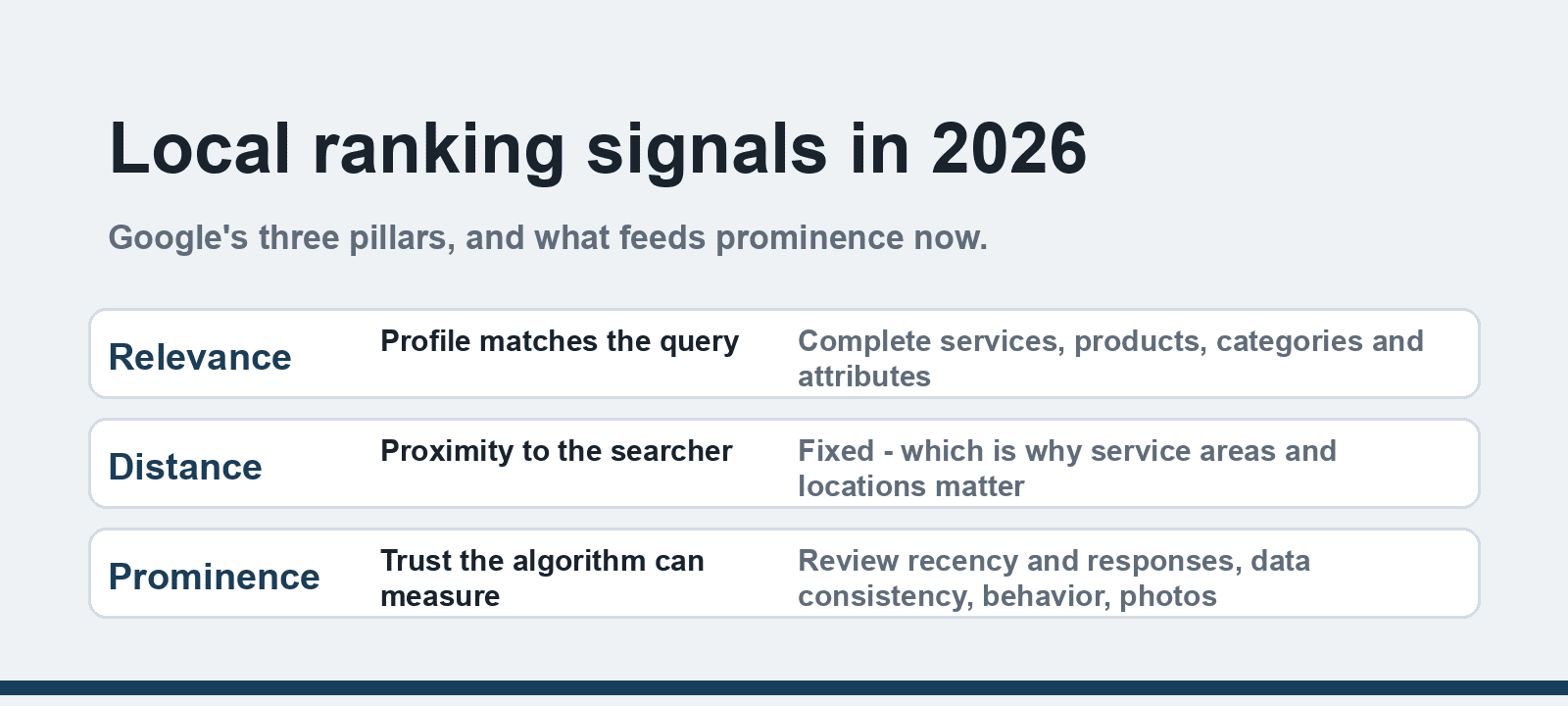
Google has said for years that local ranking weighs relevance, distance and prominence. What changed is how machine-readability of "prominence" works: Maps ranking now incorporates review sentiment, recency and velocity, how consistently owners respond, photo freshness, and behavioral signals like calls and direction requests from the profile. Two identical businesses in the same block can sit ten positions apart purely on the shape of their review activity.
What to do about it:
- Ask every satisfied customer for a review, and make it easy — a direct link or QR code at the point of happiness beats a "please review us" email three days later. Recent reviews outweigh old volume; a steady trickle beats a 2023 spike followed by silence.
- Respond to everything, fast. Owner responses are a ranking-relevant signal and a conversion one: people read negative reviews and the owner's answer more carefully than five-star walls.
- Never buy reviews. Incentivized and fake reviews are actively filtered, and a strike against the profile is expensive to recover from.
Trend 3: The profile is the landing page
Most "near me" searches end on the results page or in the map pack — the customer calls, gets directions, or checks hours without ever reaching a website. Fighting that is pointless; the winning move in 2026 is to make the profile work like a landing page: Google Posts for offers and events, products with prices, booking or order links, and messaging turned on where response times can actually be honored.
The companion move is capturing leads into channels you own. A booking system that collects the customer's contact with consent, a review flow that follows up by email — each one converts a zero-click search into a first-party relationship. Our guide to digital booking systems covers that capture step for service businesses, and the AI-engagement angle runs deeper in our piece on generative AI in customer engagement.
What quietly stopped working
- Keyword-stuffed business names. "Best Plumber John Smith Plumbing" violates Google's spam policies for profiles and gets listings suspended; Google's enforcement of fake and keyword-stuffed listings tightened again through 2025.
- One-time setup. A profile untouched since 2024 reads as a possibly-closed business to both algorithms and customers. Hours, photos and posts need a pulse.
- Directory blasts. Mass citation building on low-quality directories moved the needle a decade ago; today consistency across a handful of authoritative sources does the work.
- Chasing rank without tracking calls. Rank positions matter less than calls, direction requests and bookings — all visible in the profile's own performance report.
Monday-morning checklist
1. Log into the Business Profile and check hours, holiday hours, and services for accuracy.
2. Add or update three things customers ask about: products with prices, attributes (wheelchair access, Wi-Fi, parking), and photos from the last 90 days.
3. Seed the Q&A section with the five questions your phone actually gets, and answer them.
4. Set up or check your review link, and respond to every un-answered review.
5. Look at the performance report: calls, direction requests, and which queries surface you — that is your baseline for everything above.
FAQ
Is local SEO still worth it with AI Overviews reducing clicks?
More than ever, because AI local answers are built from your Business Profile data and reviews. The clicks a website loses to AI summaries are partially replaced by calls and direction requests that originate from the profile and map pack — which is where local customers convert anyway.
What are the three pillars of local ranking?
Relevance (how well your profile matches the query), distance (how close you are to the searcher), and prominence (how well-known and trusted the business appears — reviews, links, behavior). You cannot change distance, so the work is writing a matching profile and building prominence signals.
How many Google reviews do I need to rank locally?
There is no magic number; velocity and recency matter more than totals. A business with 60 reviews and four new ones a month typically outranks a stalled 300-review profile in most categories. Aim for a steady flow you can sustain and respond to.
Do I need a website if my Google Business Profile is strong?
Yes. The profile converts local demand, but the website carries anything beyond it: detailed services, pricing explanations, galleries, and the content AI systems cite for questions the profile cannot answer. The two work together — profile for discovery, site for depth and trust.
How do I get my business to show up in AI search results?
Feed the systems complete, consistent, structured data: a fully completed Business Profile, the same name-address-phone everywhere, schema markup on your site describing your business, and genuine review content. AI answers cite sources they can verify; inconsistency across the web is the most common reason a business gets skipped.
How long does local SEO take to show results?
Profile fixes (hours, services, photos, spam removal) can move visibility within weeks. Review volume and prominence build over months. Realistically: visible movement in 4-8 weeks for a corrected profile, meaningful ranking change in 3-6 months of consistent review generation and posting.