

The telecommunications landscape has been undergoing a profound transformation as 5G networks and the Internet of Things become pervasive. Although these innovations come with many advantages, including ultra-high-speed connectivity and zero latency, there has been an increase in cybersecurity issues due to the nature of the evolution in the cellular network. The advancement in cellular networks from being used mainly for voice calls and internet services to a network that supports several applications has led to a need for new ways of ensuring cybersecurity.
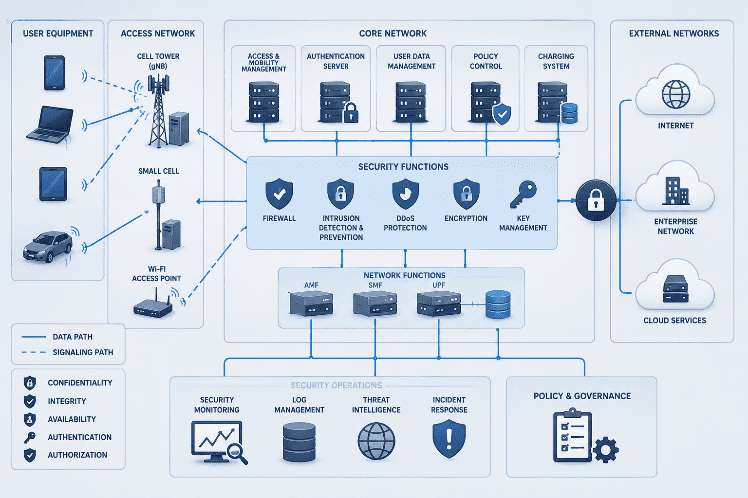
Cellular network security refers to the technologies, policies, and practices used to protect mobile communication networks, connected devices, and data from cyber threats.
The Rising Complexity of Modern Cellular Networks
In contrast with previous generations of cellular networks that mostly offered voice communication services and some mobile data services, the current generation of cellular networks is intended to offer many applications, such as self-driving cars, smart cities, industrial automation, and Internet of Things implementations on a large scale.
5G networks have brought about several innovations that include the introduction of network slicing, where a single physical network can be segmented into multiple logical networks that cater to different applications. Another innovative aspect is edge computing, whereby the computation power is moved closer to end users to minimise latency while increasing the attack surface at the same time.
Additionally, massive machine-type communication is possible using this generation of networks; the technology enables the connection of millions of IoT devices per square kilometre. Each of these innovations brings about several new security concerns that require more advanced security solutions.
Emerging Threats in the 5G and IoT Age
As networks get more complex, their vulnerability to various forms of threats increases. This is because the rise of the Internet of Things (IoT) introduces more threats through the introduction of more devices to the network. Poorly protected IoT devices can be used as entry points by cyber criminals into the network.
Advanced persistent threats (APTs), being complex and targeted attacks, can abuse network functions or edge computing devices for months undetected. Increased signalling traffic created by IoT devices creates additional security issues, as it can be used for conducting distributed denial-of-service attacks that affect both consumer and business services.
Network slicing, which is intended to create isolated virtual networks, can be abused if it becomes possible to access network resources due to configuration problems or software bugs. As per the findings of Pristine Market Insights, the World Economic Forum reports that approximately 2,220 cyberattacks are recorded each day, which sums up to more than 800,000 attacks every year, which are expected to grow further.
Finally, the huge amount of data created by IoT devices raises the problem of protecting user privacy, while compliance regulations like General Data Protection Regulation make the issue even more complicated. One of the challenges created by the 5G and IoT age is keeping legacy systems used by previous generation networks secure enough.
| Traditional Networks | 5G & IoT Networks |
|---|---|
| Limited connected devices | Millions of IoT devices |
| Smaller attack surface | Expanded attack surface |
| Centralized infrastructure | Edge computing environments |
| Simpler architecture | Network slicing and virtualization |
Technology Advancements That Are Improving Cellular Network Security
In order to overcome these dynamic challenges, the cellular network security market has adopted a number of technologies. The zero-trust approach is becoming more popular in this context since it is based on the principle that none of the devices, users, or applications can be trusted by default. Access is allowed only when the user passes verification, thereby eliminating any chance of unauthorised access.
Artificial intelligence and machine learning technologies have been implemented to identify anomalies and predict vulnerabilities. They help in analysing the large amounts of data produced by IoT devices and the operations performed by the network in order to detect any suspicious behaviour.
Blockchain technology is another technology that has found application in cellular network security as a means of securing IoT devices from any potential tampering and creating a decentralised system of identity management that is impossible to break.
Another innovation that has affected cellular network security has been network function virtualisation, which allows core network functions to operate on virtual machines, requiring constant monitoring to ensure secure communication and prompt patching.
Impact of Regulation on Cellular Network Security
Security regulations in various parts of the world are gaining relevance when it comes to formulating security policies. For instance, in Europe, regulations such as NIS2 require that the critical infrastructure operators, which include telecommunications networks, have good security systems.
In the US, the emphasis is on the protection of 5G networks and consumer data by way of guidance from the Federal Communications Commission. In the Asia-Pacific, countries like Japan, South Korea, and India have taken the step to develop guidelines specific to the security of the Internet of Things to guard against vulnerabilities related to mass deployment. The effect of these regulations is being seen in the investment trends in the cellular network security market.
Factors Driving the Cellular Network Security Market
There are several trends driving the development of the cellular network security market. Service providers and businesses are actively investing in ways to protect their networks because of the increased complexity of networks. The use of end-to-end encryption has become crucial in securing data in different network layers. Cloud-based security technologies are used to gather threat intelligence and respond to attacks as quickly as possible. Artificial intelligence analytics are indispensable in handling the huge amount of information generated by Internet of Things devices. Cooperation between telecom companies and cybersecurity firms has become a trend to address emerging threats in an integrated way.
Standards and Best Practices for Security
For the maintenance of high-level security for cellular networks, the need for global standards and best practices is of utmost importance. Companies are now adopting Third Generation Partnership Project standards for 5G networks that specify the requirements of authentication, encryption, and data integrity. There are security frameworks for IoT from agencies such as National Institute of Standards and Technology and European Telecommunications Standards Institute. Penetration testing and red team drills are among the important practices that have been gaining traction recently. They help network administrators to detect weaknesses in the network equipment that can be exploited by malicious actors before they do.
Future Prospects of Cellular Network Security
In the coming years, cellular network security will be evolving based on advances in technology and new security challenges. Predictive security enabled by artificial intelligence will emerge as an important element in securing cellular networks, using behaviour analysis techniques to predict attacks and counter them. Quantum cryptography techniques will come into use as quantum computers become a reality. Threat detection and response systems that can detect and recover from threats automatically will be part of future cellular network security systems. Collaboration-based approaches will also be common in the future, where threat intelligence and best practices will be shared among operators.
Conclusion
The development of 5G and increasing IoT devices marks a significant milestone in the telecommunications industry. Although the emergence of such innovations has opened up many opportunities for the industry, they bring along security issues which require proactive measures to solve. Zero trust architecture, artificial intelligence and machine learning, blockchain technology, edge security, and regulatory compliance are some of the areas being invested in by stakeholders of the cellular network Security market.
About Author :
Teja Kurane is a Research Analyst specializing in telecommunications, digital infrastructure, and emerging connectivity technologies. With a strong focus on market intelligence and industry trends, Teja analyzes developments in 5G, IoT, cybersecurity, and network transformation. Through data-driven research and strategic insights, Teja helps businesses understand evolving technology landscapes and their impact on future connectivity ecosystems.