

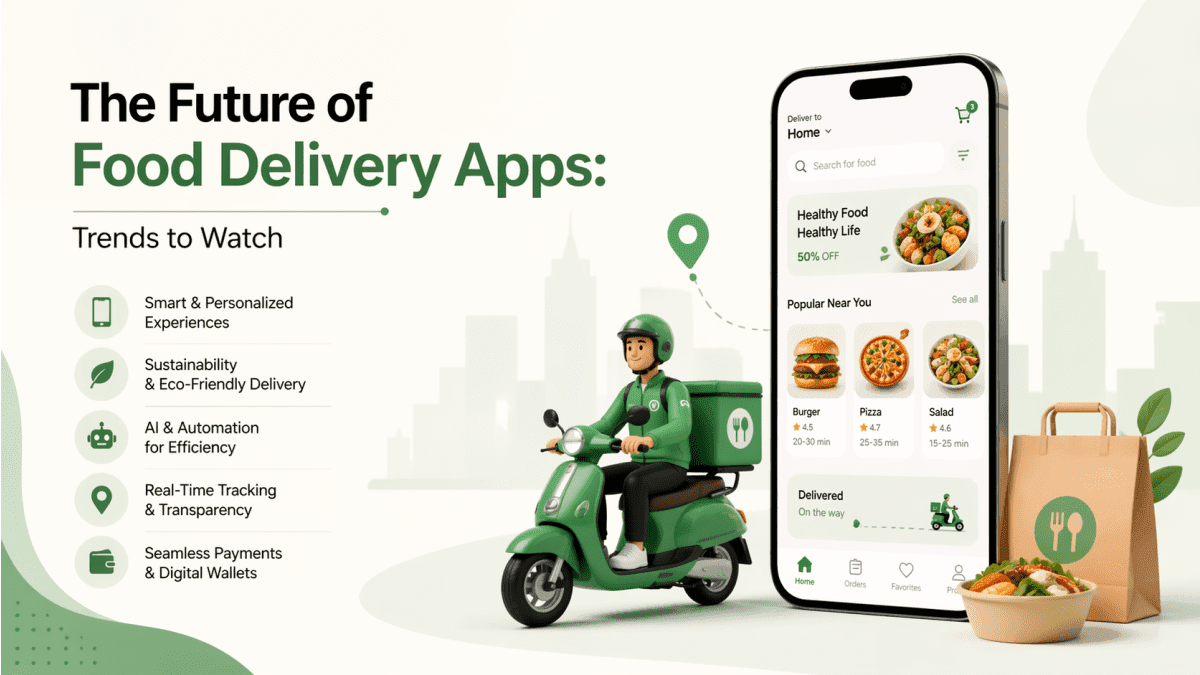
In the last few years, the food delivery app industry has grown and changed dramatically. It is experiencing the perfect mix of those changing consumer habits and technological innovations in IT as well as global incidents such as the pandemic. By constantly pushing the limits, these customers will eventually be served food where and when they want—whether it’s directly arriving at their door or not. In doing so the arena has expanded from generation to generation, with new challenges and opportunities for businesses constantly emerging.In this article, we look at the prospects for food delivery apps and assess five key trends affecting the industry: 1) new technologies, 2) environmental measures taken by operators to reduce their ecological impact, 3) changing tastes (in terms of current patterns of food consumption), and 4) barriers related to economic structure. Understanding of these trends (and the others) will be critical as everyone tries to earn dollars from living mindfully and stay competitive in our long, convoluted consumer markets.
- Evolution of Food Delivery Apps
- Emerging Technologies Shape the Industry
- Consumer Behavior and Preferences
- Sustainability in Food Delivery Services
- The Role of AI and Automation
- Smart Order Management Systems
- Personalization through Machine Learning
- Predictive Analytics for Demand Forecasting
- Partnerships with Restaurants and Brands
- Global Market Trends and Expansion
- Challenges and Opportunities Ahead
Evolution of Food Delivery Apps
Historical Overview
From the old days of placing a telephone call and crossing your fingers that your adored pizza parlor would hear above the splattering of grease bowls up to now, meal delivery has certainly taken a long and uncertain path. The modern food delivery app, which first appeared around 2010, represented a sea change from traditional ways of ordering food. It meant that one could now, with a mere swipe of the thumb, have any dish from Pad Thai to drunken noodles lying right there on one’s doorstep. It almost seems as if the convenience of post-it notes and microwave popcorn has finally been achieved in ordering food!
Key Milestones in Development
Shall we play “Gee, remember this”? Beginning in 2013, the advent of services like Uber EATS and DoorDash completely upended our understanding about receiving food at all hours. Fast forward to the 2020s We have had developments in situations like tracking in real time, tailored tips, and even subscriptions. Who would have thought ordering dinner became as complex as dating applications? Swipe right for pizza!
Current Market Leaders
DoorDash, Uber Eats, and Grubhub are the big winners right now; they are going to almost a certain extreme length in delivery on order after order.Each has its own characteristics, whether it’s DoorDash for fast bites, UberEats with an array of tech features, or Grubhub catering to local tastes. It’s kind of a food delivery Avengers, without anyone wearing capes—an interpretation that way.
Emerging Technologies Shape the Industry
Mobile App Innovations
Mobile apps is a better beet how it will transform the lives of people in some another world. With your last 17 midnight-snack orders to draw from, they could really tell you where to eat — that is not out of the realm of possibility. Enhancing user experience with voice ordering, gamification and virtual reality. Think about taking out your phone, pointing it at a dish in the restaurant and immediately being able to order it as take-away; you’re AMovie (but instead of Mario’s for breakfast it’s nasi lemak from the kiosk).
Blockchain for Transparency
SAY hello to transparency, goodbye mystery meat! In food delivery, block chain technology is a game changer that brings more safety and trust. From farm to table (or your couch), consumers can use the app to track their food. In this way, not only is what you chew off at present ethically sourced, but delicious taste also meets legal standards too. It’s the “I must know what is in my food” dream come true.
Drone and Robot Deliveries
The buzz of drones overhead is less like a sci-fi movie than you might think in reality, for soon this year food delivery firms are testing out such methods. The delivery robot is here and airborne, having been feeding people in the form of newspapers and post. Now the forlorn little backpack wanderer arriving at highways never achieved customer service, said delivery! So your driver may be a tiny robot riding on wheels—now that is the delivery of the future!
Consumer Behavior and Preferences
Shifts in Dining Habits
The pandemic resulted in a dramatic shift in our dining habits. Whether it be because restaurants were closed or their services were limited, people turned to delivery apps left and right for food—not only did many continue to patronize these services after reopening their society (where again they could sit in a restaurant), but now far fewer are willing to go back. Whether out of pure convenience or just plain bone idleness, the trend of dining in—in slippers and pajamas—shows no sign of exhaustion.
Influence of Social Media
You may naturally think of social media as no more than a site for sharing images of cute kitties, but it has had a big impact on the way we cook, too! Becoming Instagram-famous or TikTok-famous for your meal presentation means the Internet may soon put it on your hub and invite thousands to like, comment on, or share. Social media shapes what we want to snack on. Food can be touched by these vivid foods; the photos become a gloomy weekday afternoon transformed into the gourmet journey of others. #Foodgoals, anyone?
Demographic Trends Impacting Delivery Choices
A demographic consultant recently looked at people’s preferred food orders according to their age. Convenience and variety appear to be the driving forces behind this trend, with younger generations—who haven’t had quite as many opportunities for punch—being most enthusiastic about taking advantage of delivery service apps. It stands to reason that as more people of these age groups enter the workplace and treating experiences in life takes precedence over cooking, then food delivery will have to thrive.
Sustainability in Food Delivery Services
Eco-friendly Packaging Solutions
This free programme to develop the country’s waste treatment systems and related products began in 2015 as a partnership between the ministry and relevant departments for environmental protection. It’s a win for everyone: you can eat delicious things, and Mother Nature can relax a bit. The takeaway cartons are also made from paper—so now your takeout guilt can be assuaged with one box at least!
Carbon Footprint Reduction Initiatives
With attention to climate change growing, restaurants involved with food delivery these days are moving towards lower-carbon ways of working. This ranges from electric delivery vehicles to slowly improving our process to become greener through some small adjustments—companies are making efforts across the board to be more sustainable. That means that while you enjoy a burger, at least deep down inside somewhere it feels good to think this individual one did not come helicoptering into your door on the back of a gas guzzler.
Local Sourcing and Its Impact
More and more food delivery services are now embracing local procurement as the current topic on everyone’s lips. Not so long ago, your With (and a link to) community residents, businesses, and farms. You can actually help your community! Mealtimes will also benefit, although these sustainable food delivery services may be far away from you. better products that are much fresher… Frankly, does anyone actually feel proud of eating if they cannot somehow avoid wherever they live?
The Role of AI and Automation
Smart Order Management Systems
In the food delivery world, order management situations can turn into a scrum bumbling and confused. Well, let smart order management systems serve as your knights so that their shining armor can beat back this chaos. These systems handle everything except actual meal delivery, from selecting the menu to ensuring that your burrito is out in Cyberville. Picture an electronic assistant who knows what you want before you’re even aware of it yourself and runs the whole thing like clockwork—now that is technology at its most exquisite.
Personalization through Machine Learning
Food delivery is no longer a one-solution-fits-all approach. Machine learning’s gonna mix it up here, customizing your experience according to what you eat and how frequently you’ve ordered over a period of time. Let us say your app has already learned about that spicy Thai curry you like long before you have made the first step into it. Like having a food-loving best friend who knows you better than yourself—without judgment for your 2 a.m. pizza-ordering habits
Predictive Analytics for Demand Forecasting
Ever wondered why, just when you made a reservation at a restaurant with your favorite dish—hear that stomach growling? —It flew off the menu faster than they could toast an avocado for their famous brunch. It is none other than predictive analytics that drives this sneak attack. The algorithms digest historic order data, predict demand, and let restaurants get ready. Think of it as a fortune-telling machine for your food trends—see ya dreary, barren menus when you are salivating over those wings you just have to have during big game week!
Partnerships with Restaurants and Brands
Collaborative Business Models
Collaboration is the name of the game in the food delivery arena. Food delivery apps have discovered the power of white labeling products with local restaurants and brands for specialty combos you can’t get anywhere else. And guess what? The more of these not-so-secret alliances you have, the better menus and bigger profits for all—the Avengers Assemble of food united to take a big fat punch to hunger!
Exclusive Menu Offerings
After all, exclusivity is the spice of life—in every sphere but gastronomy. Partnerships are driving exclusive menu items, available only on particular delivery apps. Not only does this create buzz (because who doesn’t love being special?), but it also brings users to the restaurant and the app. Think of it as an all-access pass to some of your favorite dining experiences—who wouldn’t want that?
Co-marketing Strategies
It is always a hoot to spread the word with two heads (or two brands). Several food delivery apps are cross-marketing with restaurants to reach a wider audience.It can be joint campaigns on social media or special discounts to customers. Call it the ultimate tag team—raising visibility and launching delicious meals with flair!
Global Market Trends and Expansion
Regional Growth Opportunities
Food delivery applications are on a storm right through the world, and there are avenues of boom that you may be ignoring in that chest of treasure. No small wonder the hours fall away in the bliss of old new ways; eating in can give pleasure-seeking billions jars melding with near-violent delight over growth markets—in repose, so a tantalizing taste bud could glisten and get hot.The world is an all-you-can-eat buffet of opportunity—from everything street food-wise in Bangkok to gourmet tacos from Mexico City!
Adapting to Local Cuisines
What about a delivery app that is not aware of its culture? That’s inviting disaster. Food delivery knows that localizing the service according to local taste is not so much a good-to-have but a matter of survival. Loving your audience enough to give them what they ask for!
Regulatory Challenges in Different Markets
The regulation minefield—the bane of every food delivery app. Every market has rules and laws for labor and health. At first sight, it can be overwhelming. The question is, how do you prepare yourself for potent growth by overcoming these obstacles? However, if big business needs to be a headache, then apps can use these hurdles as steps to world domination—so long as someone brings the paper!
Challenges and Opportunities Ahead
Competition and Market Saturation
The food delivery market is becoming a bit of a buffet line, and differentiating from the rest is hard. Delivery apps have to find some unique ways with a higher competitive presence as the market approaches its saturation level. And those who do so will not only enjoy some success but, above all, be well-nourished in this vibrant ecosystem—like finding the last pizza slice at a party!
Customer Retention Strategies
Existing in an environment with consumers having infinite alternatives within a range away, your effort needs to be focused more on the happiness of your customers. To retain clientele, apps are resorting to loyalty programs, special offers, and exceptional customer service. It is not rocket science but rather the process of instilling a warm fuzzy feeling that is so inviting to your customers that they just have to return—think about how good takeout food can make you feel on a bad day.
Future-Proofing the Business Model
All trends evolve, and consumer tastes change quicker than you can order “extra guacamole,” so it is imperative for food delivery apps to hone in on how to future-proof their business. That it means being ahead of the technology curve with sustainability projects and new partnerships. In fact, it is the brave ones willing to adapt and pivot that win at food delivery wars—and a food service segment like master chefs making soufflés! In the super-fast room of food delivery apps, so if you want your business on a home scale, then well and good, you have to understand how these trends are changing. And naturally, by adapting new technologies, investing in algae as an alternative, and changing consumer behavior, they all equal a friendly company win. The future doesn’t promise to be a bed of roses, but it likewise has the upside of introducing new products and processes. The important thing is that we must be flexible with a non-constant future space of food delivery.
Author Bio:
Hey there! I’m Bansi Patel, a professional app developer specializing in on-demand clone app development. With strong expertise in building customized solutions, I focus on delivering high-quality products tailored to the unique needs of my clients. From concept to deployment, I ensure seamless app experiences that boost user engagement and drive business growth. Partner with me to experience excellence in modern app development.