

Artificial intelligence has advanced to a point where it is no longer an optional enhancement; it is a pragmatic investment that impacts how organizations engage with customers, how to optimize workflows, and how to operate an effective high-velocity digital business. Out of all AI-enhanced systems, chatbots remain the first interaction point between enterprises and their users. In 2026, an organization has already accepted the notion of conversational systems, but selecting one is more challenging than it seems.
- Why Chatbot Evaluation Has Become More Complicated in 2026
- 1. Understanding the Types of Chatbot Architectures
- 2. Business Goals Define What “Good” Looks Like
- 3. Evaluating AI Capability and Conversation Quality
- a) Context Retention
- b) Personalization
- c) Multilingual Support
- d) Reasoning and Problem-Solving
- e) Response Consistency
- 4. Integration Capabilities: The Make-or-Break Factor
- 5. Automation and Workflow Handling
- 6. Data Privacy, Compliance, and Security Controls
- 7. Domain Customization and Knowledge Training
- 8. UI/UX and User Experience Expectations
- 9. Analytics and Reporting
- 10. Cost Comparison and Budget Planning
- 11. Comparing Chatbot Providers: A Practical Checklist
- 12. The Rise of Generative and Autonomous Systems
- 13. Industry-Specific Comparison Insights
- 14. The Future of Enterprise Chatbots: Looking Past 2025
- FAQs
- 1. What should modern enterprises focus on when selecting a chatbot system?
- 2. Are LLM-based chatbots reliable enough for enterprise use?
- 3. What role does AI customization play in chatbot performance?
- 4. Why is integration important during chatbot comparison?
- 5. How do companies handle cost evaluation for chatbot projects?
- Conclusion
There are hundreds of platforms, different types of conversational models, multiple architectural choices, and a growing list of expectations from users. Add to that the pressure to meet modern privacy rules, the expectation for natural conversation, and compatibility with enterprise systems, and the decision becomes even more delicate.
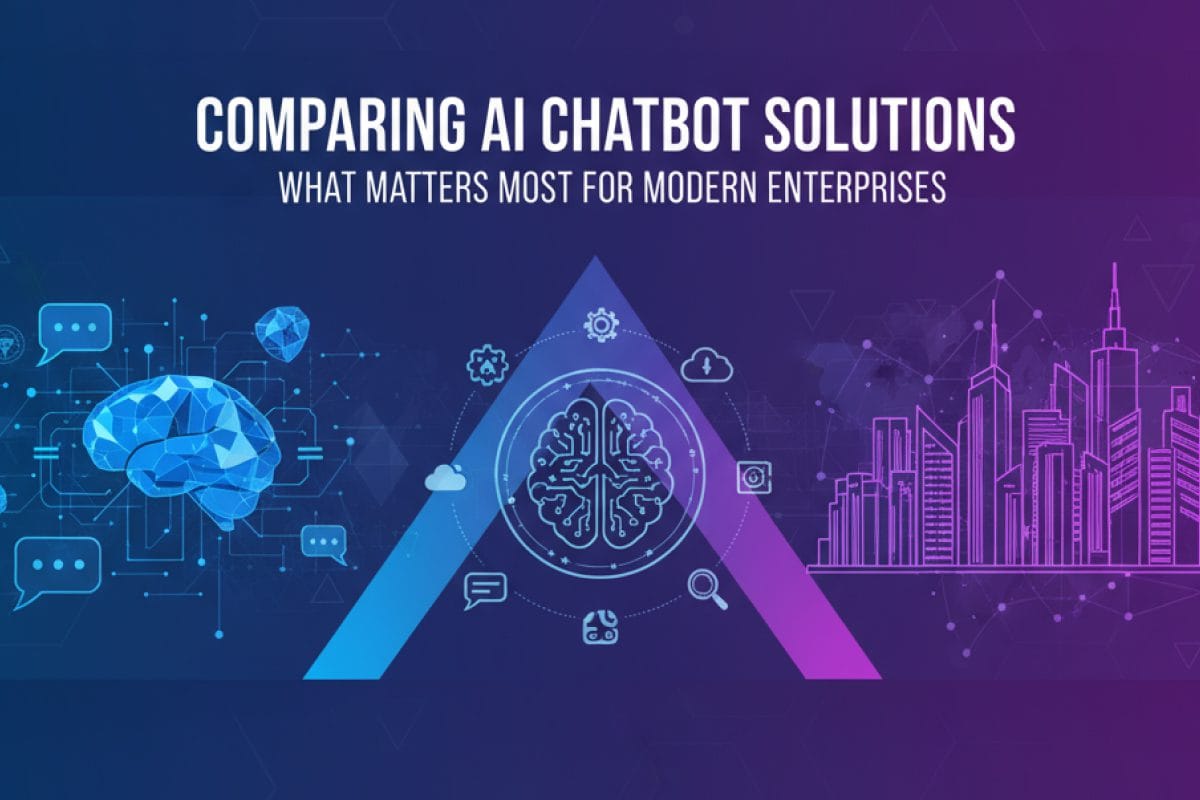
This blog breaks down what matters most when comparing AI Chatbot Solutions in today’s enterprise world. Whether you are evaluating a vendor, planning internal adoption, or trying to figure out what actually counts during implementation, this guide lays out the essentials based on the most reliable insights and market behavior seen throughout 2024–2025.
Why Chatbot Evaluation Has Become More Complicated in 2026
Five years ago, chatbots were simple question-answer tools. They handled a fixed set of queries and redirected everything else to human teams. In 2026, that has changed dramatically. Chatbots now:
- Control multi-turn conversations
- Access internal systems for data
- Process transactions
- Analyze sentiment
- Have support for voice interface
- Run personalized user journeys
- Connect automation workflows
- Leverage advanced LLMs for contextual reasoning
This change in capabilities necessitates that companies evaluate and compare solutions with more care. A chatbot is not just a conversational layer anymore, it’s part of the business engine, just like CRM platforms, ERPs, and customer-facing apps.
Enterprises today look at chatbots as:
- A support assistant
- A sales enabler
- A workflow automation tool
- A data analysis interface
- A knowledge retrieval system
- A digital employee that runs on rules, data, and reasoning
This is exactly why the process of comparison requires a structured, updated, and business-centric approach.
1. Understanding the Types of Chatbot Architectures
Before organizations start comparing solutions from different vendors, enterprises must understand a general set of chatbot technologies. In the market there are three primary types of chatbots.
Rule-Based Chatbots
These operate based off a set of pre-defined scripts. They have stability, predictability and can be useful for very simple processes, but they cannot accommodate an unplanned inquiry or variation away from a defined script. For enterprises, these systems are less common unless the use case is very narrow.
Intent-Based Chatbots
Frequently employed in customer-facing departments, these chatbot models use intent classification and although they rely on intent classification and entity extraction, they ascertain what the user is seeking through the user’s message. They allow for more flexibility than rule-based systems and are a popular fit for structured tasks such as inquiries related to ticketing, appointments, policies, and other tasks.
LLM-Powered Chatbots
This category has surged since the beginning of the 2024 calendar year. These Chatbots utilize large language models (LLMs) for context recognition, ambiguity in user inquiries, and actual unscripted conversational flow. When properly engineered with guardrails in mind, and trained within a domain-specific knowledge base, these models participate and behave much closer to human participatory roles that have been conditioned for assisting roles. Most enterprise engagement models will fall in this category.
When comparing solutions, the architecture defines:
- Accuracy
- Flexibility
- Maintenance burden
- Scalability
- Risk exposure
- Complexity of integrations
Understanding these foundations will help inform the direction that aligns with enterprise’s long-term digital strategies.
2. Business Goals Define What “Good” Looks Like
Not every business will require the most sophisticated conversational system. Some businesses merely need basic automation, while others have business operations in multiple countries and require systems to support multiple languages, data retrieval and personalized recommendations for end users.
Before comparing chatbot providers, companies usually define the following goals:
- Customer Support Optimization
For teams receiving thousands of queries daily, the priority is faster response time, predictable conversation flows, and consistent accuracy. - Sales and Lead Interaction
Enterprises focusing on conversions need LLM-powered conversation, personalization, and CRM integration. - Internal Automation
Companies with larger workflows place a value on connected systems, secured access through controls, and work orchestration. - Industry-Specific Requirements
A healthcare chatbot has much different requirements when compared to a financial advisory chatbot. Compliance, vocabulary, and domain accuracy control the decision.
Most chatbot failures stem from unclear goals. The more precise the objective, the easier it becomes to compare systems effectively.
3. Evaluating AI Capability and Conversation Quality
The conversational engine is the heart of any chatbot. Enterprises normally judge conversation quality using five criteria:
a) Context Retention
The chatbot must remember previous messages within a session and maintain a logical flow. In 2026, most leading enterprise models do this well, but the depth and accuracy vary widely.
b) Personalization
Businesses expect their chatbots to change responses based on user profiles, behavior history, past conversation and context rules based on location. Some platforms provide an integrated personalization layer, while others require programmable layers.
c) Multilingual Support
A global business cannot solely rely on English-based chatbots. The most established platforms support 40–100+ languages; the language quality varies. For example, certain LLMs might reproduce domain-specific technical terms better than in another language.
d) Reasoning and Problem-Solving
Having advanced reasoning capability allows a chatbot to interpret semi-vague input, analyze constraints, evaluate options for the user and produce solution options. This competency is especially valuable to companies in financial services, healthcare, travel, logistics and technical support.
e) Response Consistency
Enterprise organizations prefer controlled creative outcomes. The chatbot should never produce unpredictable or risky responses. Organizations that provide configurable guardrails, system instructions and standard activity provide a far better solution.
4. Integration Capabilities: The Make-or-Break Factor
Enterprise chatbots are not stand-alone systems. They should be integrated with the internal and external platforms of the organization.
Modern examples include:
- CRM (HubSpot, Salesforce, Zoho)
- ERP (SAP, Oracle, Odoo)
- Ticketing systems (Freshdesk, Zendesk, ServiceNow)
- Cloud platforms
- Product catalogs
- Payment gateways
- Inventory management systems
- HR management systems
The depth of integration will determine whether the chatbot acts as a simple FAQ tool or a comprehensive enterprise assistant.
Key factors enterprises check during evaluation include:
API Availability
Providers must offer stable APIs to perform two-way data exchange. Without this, access to that data will be limited, and the repetitiveness will increase.
Data Retrieval Capabilities
The chatbot must be able to pull context-specific data in real-time (order status, ticket details, account details, product availability, etc.)
Cross-Platform Compatibility
Deployments in 2026 are likely across websites, mobile applications, WhatsApp/Instagram, internal dashboards, kiosks, etc. A chatbot available on a single deployment quickly becomes obsolete.
5. Automation and Workflow Handling
In 2026, chatbots will be more than just layers of conversation and will perform tasks.
Examples:
- Creation of a support ticket
- Updating records in CRM
- Triggering Marketing Workflow
- Scheduling appointments
- Processing returns
- Executing internal approvals
Enterprises compare solutions based on:
- Workflow automation flexibility
- Connection to any third-party systems
- Support for multi-step processes
- Accuracy in correcting tasks
- Error handling while automating the workflow
Simply an addition to a chatbot that automates 20–30% of the repetitive workflow will save a huge amount of operational time.
6. Data Privacy, Compliance, and Security Controls
Enterprises in 2026 are being more closely examined due to international data regulations. Evaluating chatbots includes security assessments comparable to evaluating a SaaS product from an enterprise.
Key considerations include:
Data Storage and Access Control
Where is data stored? Who can access it? How long is it retained? These are major questions enterprises ask before committing.
Compliance Standards
Solutions must support:
- GDPR
- CCPA
- HIPAA (for healthcare)
- SOC 2
- ISO 27001
Enterprises will not implement a chatbot solution that does not meet compliance standards on data privacy, security, & accessibility.
PII Handling
Chatbots must not retain personally identifiable information unless absolutely necessary. Additionally, if sensitive information is shared where it must be masked to protect the user’s identity.
Audit Trails and Reporting
Enterprises are looking for more comprehensive information systems with delivered logs of all conversations, analytical dashboards, and documented activity.
7. Domain Customization and Knowledge Training
An effective chatbot is not built on broad knowledge; it must function based on domain-specific rules, lexicon, and data structures.
Enterprises compare vendors based on how well they support:
- Custom knowledge bases
- Ingesting documents
- Fine-tuned domain tasks
- Retrieval-augmented generation (RAG)
- Controlling style and tone
- Structured reasoning templates
2026 has made significant advances in training LLMs in domains, making enterprise-grade chatbots much more accurate than the pre-2026 versions.
8. UI/UX and User Experience Expectations
The experience of a chatbot’s front-end is equally as important as what takes place in the conversation that is generated. Enterprises compare:
- Message delay
- Visual consistency
- Ability to customize the widget
- Branding capabilities
- Multi-channel support
- Assistive technologies (keyboard navigation, screen readers, high contrast modes)
Smooth experiences lead to greater user adoption.
9. Analytics and Reporting
Analytics are usually the most underrated feature, but afterward, they become a necessity. Businesses want:
- Conversation insights
- Query categorization
- Drop-off points
- User sentiment
- Automation success rate
- Ticket deflection rate
- Sales conversion metrics
Analytics show what users really want, what the chatbot cannot do, and what improvements the company needs.
10. Cost Comparison and Budget Planning
Businesses assess AI chatbots on a variety of pricing models:
Subscription-Based Models
Usually quoted by the user, or per message, or per LLM request.
Usage-Based Models
LLM-heavy systems often charge based on tokens or requests.
Custom Deployment Models
For companies that prioritize high levels of privacy, there is the option for private on-premise or private cloud deployment, but this is likely to be priced higher.
When comparing costs, enterprises consider:
- Licensing fees
- Development/customization cost
- Ongoing training cost
- LLM usage cost
- Integration and workflow building cost
- Maintenance support
Most of the time, the lowest price is not the most resource-efficient; it is simply aligned with long-term goals with much less disruption to the ongoing operations.
11. Comparing Chatbot Providers: A Practical Checklist
Here is a simple checklist most enterprises follow when comparing vendors in 2026:
Conversation Quality
- Does it maintain context well?
- Does it handle vague or complex queries?
AI Ability
- Does it support domain-specific reasoning?
- Does it support multilingual accuracy?
Security
- Are compliance certifications valid and updated?
- Does it store PII? If yes, how?
Integration
- Does it connect with CRM, ERP, and other essential systems?
- Does it support real-time data queries?
Automation
- Can it trigger workflows?
- How stable is task execution?
Customization
- Can it adapt to your industry?
- Does it support custom training and knowledge bases?
Cost
- Is pricing predictable over long-term usage?
- Are usage spikes manageable within budget?
Enterprises rely on this kind of checklist to avoid making hasty decisions.
12. The Rise of Generative and Autonomous Systems
Generative AI Chatbots were quickly adopted in 2024–2026, providing three main benefits:
- Natural, human-like two-way conversations
- Ability to respond to unstructured or unpredictable questions
- Dynamic reasoning and problem solving
At the same time, enterprises are hesitant because of:
- Randomness in responses
- Higher operating costs
- Highly dependent on guardrails
- Privacy issues
- LLM behavior drift that happens over time
Here is why today’s decision-makers evaluate these systems at more than face value by using real-world contextualization.
13. Industry-Specific Comparison Insights
Chatbots are utilized in different ways across industries. When organizations are comparing systems, they are evaluating based on the unique conditions of their specific industry.
Retail & E-commerce
In this industry, speed and transaction facilitation will always outweigh other considerations. The focus of E-commerce chatbot solutions tends to be in the following areas:
- Real-time product search
- Order tracking
- Return processing
- Personalized recommendations
- Inventory queries
Banking and Finance
Chatbots need secure access control, multi-level authentication, and accurate reasoning.
Healthcare
Healthcare organizations should care about accuracy and compliance (although not as much about creativity) and expertise in using medical terminology.
Travel and Hospitality
Chatbots handle itinerary building, bookings, cancellation requests, and cross-platform communication.
Logistics
Bots will need to navigate complex requests regarding shipping, tracking, customs, delays, and multi-step workflows.
Grabbing this understanding can help organizations sort chatbot vendors through more appropriate methods.
14. The Future of Enterprise Chatbots: Looking Past 2025
Predictions for the following years based on trends seen in late 2025 are:
- Resuming more autonomous task execution
- Advanced systems of memory
- More direct interfaces with robots and IoT
- More transparent LLM governance models
- Mini-models for specific industries that drive down the cost of models
- Chatbots as co-workers and partners, not just assistants.
Companies will shift from “chatbot adoption” to “AI workflow orchestration,” where the conversational interface becomes just one part of a larger intelligent system.
FAQs
1. What should modern enterprises focus on when selecting a chatbot system?
Organizations should prioritize discussion quality, capability to integrate with other applications, the extent of workflow automation, the level of security, how well the chatbot’s responses are based in domain accuracy, how well costs can be predicted, and how well it interacts in multiple languages.
2. Are LLM-based chatbots reliable enough for enterprise use?
Yes, provided there are proper guardrails, training within a specific domain, and clear limitations. Organizations already rely on LLM-based chatbots to support other customers, help with sales, automate internal processes, and retrieve data.
3. What role does AI customization play in chatbot performance?
The customization determines how closely a chatbot aligns with customers’ industry needs and expectations. The chatbot can align with a company through the right training, company terminology, workflows, decision-making rules, and tone.
4. Why is integration important during chatbot comparison?
Without integrations, a chatbot becomes an expensive messaging service. Organizations expect a chatbot to retrieve real-time data, push workflows, and operate in multiple digital environments, which all rely on integrations.
5. How do companies handle cost evaluation for chatbot projects?
Organizations assess costs associated with subscriptions to the chatbot, LLM usage, customization, integration, and maintenance and scaling. A sustainable and well-balanced cost structure is derived from usage patterns and organization-specific objectives.
Conclusion
Selecting the appropriate enterprise chatbot is not a matter of pursuing particular attributes or selecting the leading option available in the consumer chat marketplace. The benchmarking process comes down to using a tool that meets your business goals, works with your existing technology stack, provides acceptable risk levels, and offers real-life problem resolution without creating larger problems.
With all the choices on the market, a reasonable comparison framework of evaluation needs to include:
- Conversational intelligence
- Integration flexibility
- Control over your data
- Workflow automation capabilities
- Domain authority
- Future operating cost
A chatbot, when developed and implemented effectively, becomes a virtual operational layer that creates time savings, provides assistance to your team, and promotes ongoing engagement with users in different touchpoints.
As companies continue a new wave of comparison shopping in 2026, buyers are seeking a solution that balances stability, intelligence, and practical application. This is why many businesses are looking for modern conversational platforms after creating partnerships with an AI Chatbot Development Company or their own team to build new AI systems for enterprise-grade applications, be it customer-facing, an internal automation solution, or some next-gen digital experience.