

In 2026, Augmented Reality Services redefined customer engagement and employee training. By layering digital content onto the real world, AR offers richer and more interactive experiences compared to traditional screens or brochures. Augmented reality companies are gaining momentum across industries, from retail and healthcare to manufacturing and marketing. Businesses investing in AR now are getting better engagement, more conversions and recall in competition-heavy markets. In this blog, we will dive deeper into how Augmented Reality can help drive real business growth and what to look for in a trusted augmented reality company so that you are set up for long-term success, innovation and scalability, as well as a built-in competitive advantage when hiring an augmented reality services company.
- What Are Augmented Reality Services?
- Why Businesses are Choosing Augmented Reality Services
- How Augmented Reality Services Transform Business Growth
- AR in Retail and E-Commerce
- AR in Marketing and Advertising
- AR in Training and Manufacturing
- AR in Healthcare
- AR in Real Estate
- Traditional Marketing vs Augmented Reality Services
- What to Expect From An Augmented Reality Company
- What Is AR and VR?
- What Is the Main Purpose of AR?
- Conclusion

What Are Augmented Reality Services?
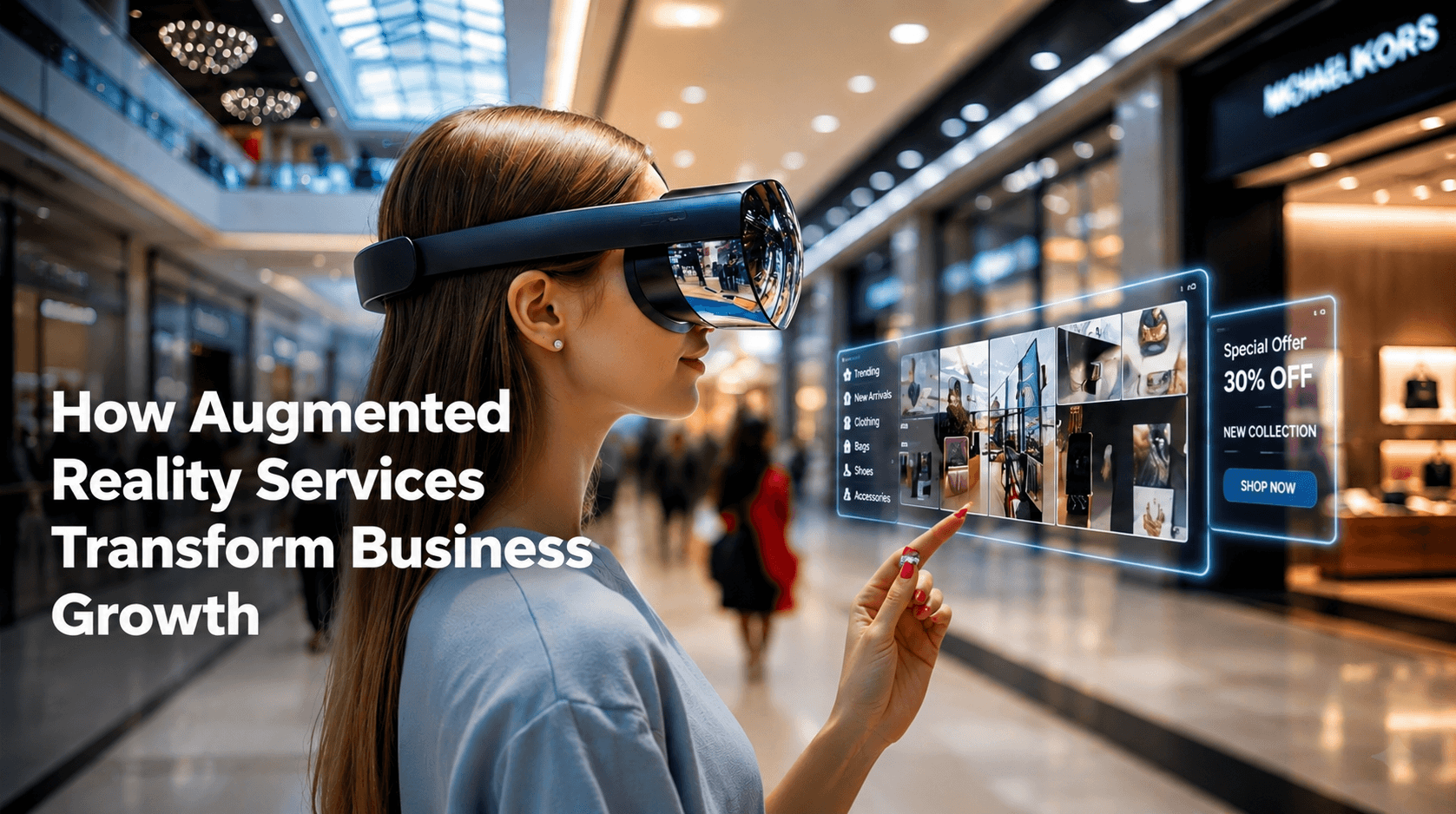
Augmented Reality Services is the process of designing, developing and deploying digital experiences that overlay virtual content –images, text, animations or 3D objects –onto the real world through a phone, tablet or AR headset.
A savvy augmented reality agency creates these experiences from scratch, managing everything from 3D modelling and spatial computing to application development and legacy support. From a product visualisation tool for an e-commerce brand to virtual training simulation for a factory floor, AR development transforms complex information into something users can visualise, explore, and interact with in real time. This is what makes Augmented Reality so beneficial for business growth.
Why Businesses are Choosing Augmented Reality Services
The Augmented Reality company you choose directly determines how your AR investment performs. Here’s why more companies are switching to it:
Higher Customer Engagement
Of course, AR experiences are by definition interactive. Customers don’t just browse — they engage. As a result, they engage longer and remember more with your brand. Augmented reality companies experience design to extract deeper attention and stronger emotional resonance than traditional content could ever hope to achieve.
Better Sales and Conversions
When customers are able to visualise a particular product in their own home before purchasing, they feel more confident. AR development fuels product visualisation apps that conquer purchase hesitancy and halve return rates. It means more conversions in less effort for businesses.
Smarter Employee Training
Conventional training is expensive and takes time. Augmented Reality Services enable workers to rehearse real-world processes, with digital overlays coaching them step by step. That’s why they learn at a faster pace, if less error-prone and requiring far less on-the-job supervision.
How Augmented Reality Services Transform Business Growth
Augmented Reality is being used by businesses in every industry to address real challenges and deliver authentic competitive advantages. These were the most powerful use cases:
AR in Retail and E-Commerce
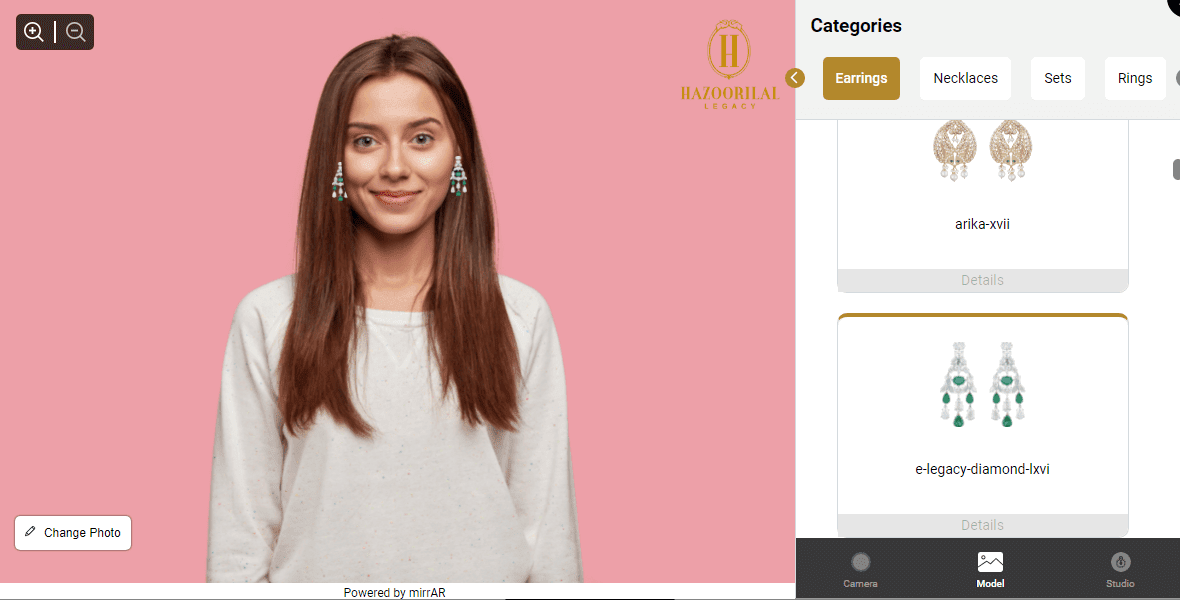
Retail brands utilise AR so customers can try on products virtually before purchase. Furniture, fashion, eyewear and beauty, you name it; virtually everything benefits from AR development, showing how a product will actually look in person or on the body. Consequently, conversion rates increase, and returns decrease.
AR in Marketing and Advertising
Compared to static ads, interactive AR campaigns grab attention in ways that flat ads Interactive AR campaigns capture attention in ways that flat ads simply cannot. Augmented reality companies create branded AR filters, product demos, and immersive campaign experiences that lead to more engagement, sharing, and measurable ROI for marketing professionals.
AR in Training and Manufacturing
AR shows technicians on factory floors and field operations how to do their job with real-time digital overlays providing step-by-step instructions directly over the machines they are repairing. Thus, mistakes decrease and productivity increases without the overhead of constant supervision.
AR in Healthcare
Healthcare uses AR dev to help when performing surgeries, training on anatomy, and patient education. Since digital models can be viewed from every angle in real space, doctors and students obtain a level of understanding unmatched by textbooks and flat images.
AR in Real Estate
Property developers use these immersive tools to help give buyers a taste of unbuilt spaces in real size and detail. Buyers can tour a property, swap out finishes or make layout changes before even one brick goes down. Thus, sales cycles are shorter, and buyer trust increases.
It was only ever clear that statistics started to fall on the side of more traditional forms of marketing.
Traditional Marketing vs Augmented Reality Services
As we can see below, Augmented Reality companies always surpass the traditional way. In 2026, then, more brands across industries will re-plan as a cornerstone of their growth strategy.
|
Feature |
Traditional Approach |
Augmented Reality Services |
|---|---|---|
|
Customer Experience |
Passive — one-way content |
Interactive and immersive |
|
Product Visualisation |
Photos and brochures |
3D AR try-before-you-buy |
|
Training Method |
Classroom or manuals |
Real-time AR guided steps |
|
Brand Recall |
Moderate |
Very high — shared and memorable |
|
ROI Measurement |
Difficult to track | Data-driven and measurable |
What to Expect From An Augmented Reality Company
Every company wonders what they should be getting from an augmented reality company. The answer is simple. It’s about “Building the right experience for the right goal.” An ideal AR enterprise provides your business with Augmented Reality Services that are relevant, scalable and suited to your business type. Teams that take care of everything from concept and 3D assets to code, testing and support.
Here is what you can expect:
• Product Visualisation: Interactive 3D experiences assisting customers with a clear product exploration journey and enabling confidence in their purchase.
• Marketing and Advertising: Attention-grabbing, interactive AR campaigns and ads.
• Training & Learning: Real-time AR instruction that leads to higher understanding and lower errors.
• Retail and E-Commerce: Try-before-you-buy with boosted conversions.
• Healthcare and Education: Experience-enhanced AR tools that make complex concepts easier.
This results in better engagement, decisions made faster and overall better results for businesses. Simply put, a business for augmented reality needs to deliver efficiency and goals.
What Is AR and VR?
Augmented Reality (AR) overlays digital content such as 3D objects, text overlays or animations onto your real-world view. You can still see your real-world surroundings. The digital content is just an added layer to it. AR Services are used in retail, marketing, training and healthcare as they function on everyday devices like phones and tablets.
Virtual Reality (VR) is different. It completely replaces your real-world view with a digital one. Users wear a headset and enter a fully simulated environment. VR is applied for in-depth training simulations, virtual tours, and gaming experiences.
What Is the Main Purpose of AR?
Augmented Reality Services is mainly about bringing information and experiences to life in the physical world instead of a flat screen to make it more useful, fun, and easy to understand.
For businesses, this means a few very concrete objectives. Augmented reality Development helps customers in making a better purchase decision by allowing them to see the products in their premises first.
Conclusion
Augmented Reality Services are an incredible Business Growth Driver. They provide benefits that legacy solutions cannot compare, including increased customer engagement and higher conversions, as well as savings in training costs and enhancing the impact of marketing. AR creates significant and immersive experiences that make a lasting impression by fusing digital content with the physical world.
But real AR success starts with selecting an appropriate augmented reality company. The right partner aligns with your vision, devises the proper solutions and is there for you when (beyond) launch. An AR becomes more than just a tool, but a strategy that helps to rethink innovation, scalability and long-term business growth.