

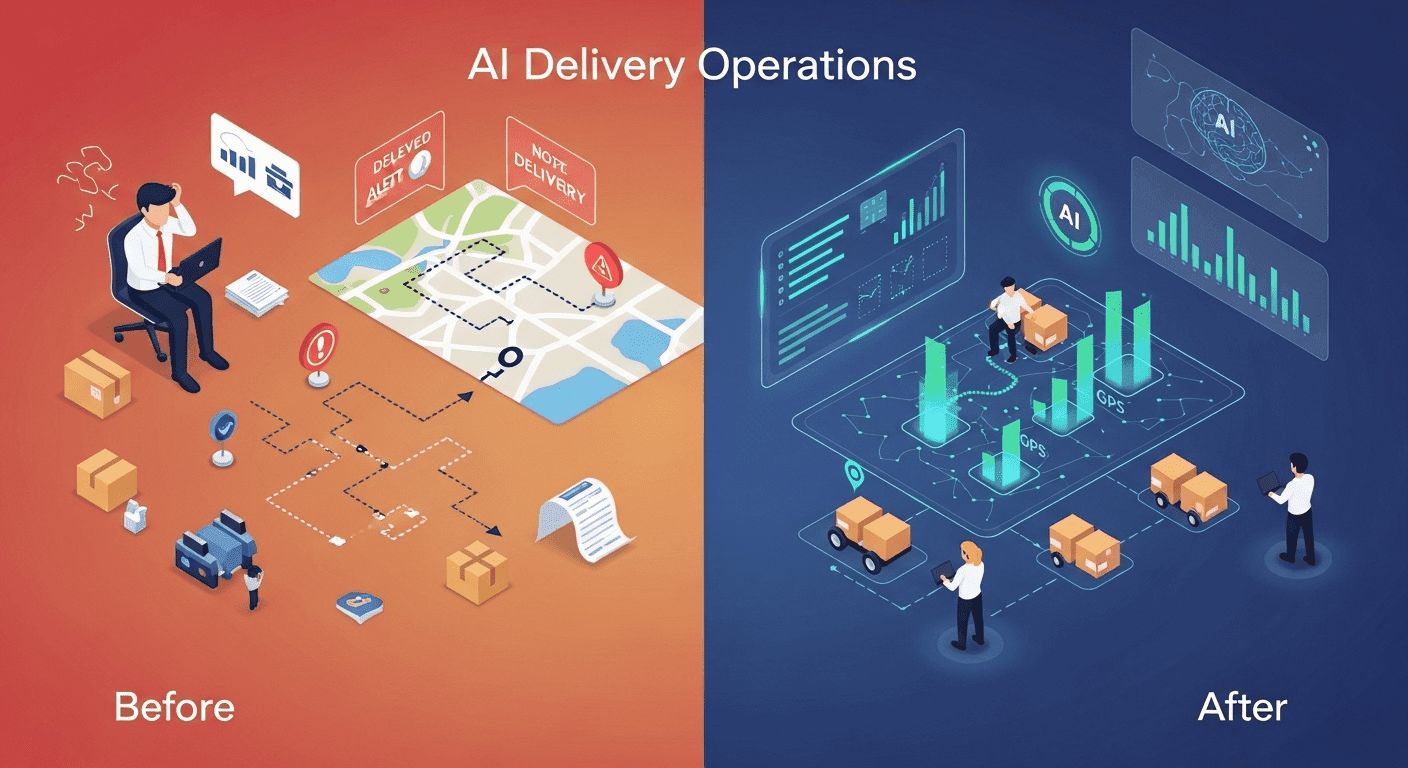
A huge change is taking place in the on-demand delivery industry, from restaurants’ preparing meals and grocery stores’ stocking shelves to pharmacies’ filling prescriptions and gas stations’ refueling cars, many businesses used to depend on manual functions like sending out deliveries, tracking shipments with paper, or just “winging it” when they scheduled their deliveries now use machine learning and AI technologies to be competitive with one another and improve their bottom line. AI has helped dramatically speed up operations while also reducing costs for almost every aspect of the operation.
- The Operational Problem Delivery Apps Are Solving
- How AI Is Being Embedded into Modern Delivery Apps
- 1. AI-Powered Route Optimization
- 2. Predictive Demand Forecasting
- 3. Intelligent Dispatch and Task Allocation
- 4. Real-Time Tracking and Proactive Customer Communication
- 5. Fraud Detection and Theft Prevention
- 6. Predictive Maintenance for Delivery Fleets
- The Cost Reduction Math: What Businesses Actually Save
- Challenges to Consider Before Implementing AI in Delivery Apps
- What to Look for in an AI-Ready Delivery App Platform
- Industry-Specific Applications of AI in Delivery
- Conclusion: AI Is No Longer Optional for Delivery Businesses
The focus of this article is the main areas in which AI and related technologies are being integrated into delivery apps today, why this is an important step towards achieving operational efficiencies, and what type of dollar savings to businesses will provide the greatest benefit.
The Operational Problem Delivery Apps Are Solving
Before we dive into the specifics of AI’s benefits, it’s important first to outline some of the inefficiencies associated with traditional delivery operations:
- Manual route planning (e.g., does not consider up-to-date traffic conditions) creates significant delivery delays and fuel wastage.
- Inaccurate demand projections create an inconsistent number of active drivers, often with too many sitting idle and not enough on the road during peak delivery hours;
- Customers are only notified about delays once they occur, which limits the expectations of the customers and requires them to modify their plans at the last minute.
- High driver turnover due in part to poorly assigned tasks and late schedules; and
- Fraud/theft of delivery vehicles is difficult to detect without the use of real-time information.
For a typical mid-sized delivery organization with several hundred daily orders, the financial impact of these inefficiencies can easily exceed several tens of thousands of dollars in wasted costs each month. AI directly addresses all of these pain points.
How AI Is Being Embedded into Modern Delivery Apps
1. AI-Powered Route Optimization
Route optimization is one application of AI that has a major effect on deliveries. Standard GPS systems will map you from one place to another (A/B) while an AI mapping system calculates the best route in real-time, which includes not only how long it should take, but also considers traffic history, delivery history, road conditions, maximum load for the vehicle, driver skill level, and even the chance of bad weather.
The machine learning models get better as more deliveries are made, allowing the algorithm to learn what routes work best based on time of day, what locations are usually unsuccessful because they have limited access, and which drivers are better suited to specific geographic areas.
As a result, companies that use AI route optimization report a reduction in fuel costs of 20%-35% and an improvement in on-time deliveries of up to 40%.
2. Predictive Demand Forecasting
One of the most expensive issues in delivery operations involves positioning the right number of drivers and vehicles for optimum availability. Excessively idle drivers reduce margins; too few will cause backlog creation and poor customer service.
With the utilization of AI-driven demand forecasting, the analysis of historical order volumes, seasonal patterns, regional events, promotional calendars, and even macroeconomic trends can be assessed effectively. As a result, dispatch managers will receive alerts to pre-position their drivers in advance of a demand spike.
AI will be especially beneficial for industries such as fuel delivery, where there can be sudden demand spikes based on seasonality, industrial activity, and supply disruptions, to name a few. As such, there are now AI-integrated fuel delivery apps that use these predictive models directly in the dispatch workflow – allowing dispatchers to create a better staffing plan and save on emergency overtime costs.
With predictive scheduling, organizations can expect to save approximately 15-25% in labor expenses and provide increased service levels at the same time.
3. Intelligent Dispatch and Task Allocation
Assigning orders to drivers manually is an inefficient, slow process with no standardization and limited scalability. In addition, AI-powered dispatching has the ability to evaluate multiple factors, including, but not limited to, location of driver, current load on the driver, estimated delivery time, vehicle classification, customer priority class, and many other factors in milliseconds( 1000th of a second). AI-powered dispatching utilizes not only the location of a driver, but also calculates the optimal way to group all of the pending orders and, based on their respective need, assigns the group of orders to each driver.
These intelligent dispatch features allow reducing total delivery time from the time of order placement to completion by 20-30%. This can also help reduce the total number of drivers needed to meet the same volume of orders as before.
4. Real-Time Tracking and Proactive Customer Communication
Artificial Intelligence does not only follow where a driver is located; it can also anticipate where the driver will go, as well as when. Delivery apps have started using machine learning technology in predicting the estimated time of arrival (ETA) based on the current road conditions.
When a driver experiences a delay, AI can automatically send out a proactive notification to the customer before they need to call with a complaint. Through natural language processing (NLP), AI can also provide customers with personalised, context-based messaging at scale.
In addition to improving the customer experience, AI-powered real-time fleet tracking allows fleet managers to have the necessary insight into their operations to make changes to their drivers, orders, and possible problems before SLA’s are missed.
Outcomes Businesses that incorporate proactive communication processes powered by AI have seen improved customer satisfaction levels of 25-35% and a decrease in their support ticket volume of up to 40%.
5. Fraud Detection and Theft Prevention
Fleet fraud costs many delivery companies money because they don’t realise the amount of betrayals that happen; things like unauthorized stops, siphons on diesel, false delivery confirmations, and route deviations, which can drain large amounts of money.
AI monitoring systems allow you to build behavioral baselines for each driver and vehicle; when the system detects a behavioral deviation from those baselines, it will notify you if there has been an unauthorized stop, a longer route travelled versus normal, a delivery marked completed without customer confirmation, etc., so you can review them as soon as possible.
Anomaly detection models used in AI fraud detection systems are developed by learning and improving, recognising whether there have been legitimate one-offs ( a driver having to stop because of a breakdown) or whether those behaviours shown by the driver indicate a pattern of fraud.
As a result of implementing AI fraud detection in their fleets, an organization has reported that they have been able to recover between 5% and 12% of their operational cost, which had previously been lost due to undetected theft or fraud.
6. Predictive Maintenance for Delivery Fleets
Vehicle downtime is among the top disruptive and costly challenges for delivery operations. An unexpected breakdown will not result in just repair costs; it can also result in missed deliveries, difficulties for reassessing operations, and may violate a service level agreement.
AI-enabled predictive maintenance uses telematics, which includes data like engine performance, mileage, oil temperature, and vibration patterns, to predict when a vehicle will need maintenance. With the ability to predict when maintenance will be required, fleet managers have lead time for scheduling maintenance for low-traffic times and not having to react to unplanned breakdowns.
As a result of using predictive maintenance, unplanned downtime of vehicles will decrease between 30-50% and the lifespan of the vehicle fleet will increase by 15-25%.
The Cost Reduction Math: What Businesses Actually Save
Putting some numbers to it: A mid-sized delivery company with 50 drivers making 500 to 800 deliveries each day could realize the following savings with an AI route optimization solution:
- Route optimization/ fuel costs: 25% savings on fuel for a fleet that spends $15,000 per month = $3,750 savings per month.
- Labor efficiency: More efficient scheduling results in a 20% decrease in overtime and idle time, = $8,000-$12,000 savings per month in labor costs.
- Fraud reduction: Estimated savings of $2,000–$5,000 per month from detecting and preventing fleet fraud.
- Maintenance costs: With the prevention of 2 unplanned breakdowns each month, a business could save $3,000-$6,000 in emergency repair costs and productivity loss.
Combined across the size of the business, this delivery company would realistically save between $16,750-$26,750 per month, or $200,000-$320,000 in savings due to AI. For larger companies, these are multiplied by scale.
Challenges to Consider Before Implementing AI in Delivery Apps
There are a few roadblocks to companies integrating artificial intelligence into their delivery operations. Companies should understand the following potential obstacles surrounding this implementation:
- Quality of data – the ability of any artificial intelligence model to provide accurate forecasts is based on how accurate the historical data it was trained on is. Companies that have data that is separated, siloed, or incomplete are going to experience limits on the return that can be realized until they address their data infrastructure.
- Integration complexity – getting artificial intelligence capabilities to work with existing dispatch systems, enterprise resource planning (ERP) systems, and customer applications requires thoughtful application programming interface (API) design and technical expertise.
- Change management – drivers and dispatchers who are accustomed to operating using manual processes may have reservations regarding moving to AI-enabled automation. Training on the new capabilities and providing clear communication surrounding the advantages of the new technology will be critical to ensuring acceptance by these users.
- Up-front investment – developing custom AI-enabled functionality requires qualified development resources as well as a clear product development roadmap. This factor will require companies to evaluate whether building their own or leveraging a white-label AI-enabled platform is the better choice for their needs.
The good news is that the ROI for implementing AI in delivery applications is well established, with most companies recovering their development investment in 6 – 18 months.
What to Look for in an AI-Ready Delivery App Platform
If you’re starting a new delivery app or want to enhance your current one, here’s what you need! These are the key capabilities in AI that every delivery company needs:
- route optimizing on demand- with live input from the road
- Demand forecasting dashboard – to adjust how far out we should forecast demand
- an automated way to dispatch, with an option for manually dispatching
- An ETA generated by an AI engine- notify customers in real time
- identifying anomalies at both the customer side (fraud, theft, etc) and service provider (operating outside of their authority).
- Telematics integration for predictive maintenance of the fleet.
- analytics and reporting dashboards that deliver actionable insights.
It’s important- the platform supports growth. As the number of orders increases, the AI models [work] will get better (and more accurate) with more data; therefore, the architecture must be able to handle the extra volume without degradation in performance.
Industry-Specific Applications of AI in Delivery
Delivery of Food & Groceries:
AI provides food delivery providers with the means of managing temperature-sensitive logistics, being able to predict restaurant prep times so that driver pickup times will coincide at the same time, along with dynamic clustering of an order throughout the neighborhood for batching efficiently on the ride to deliver/distribute all orders.
Delivery of Medicine & Health Care:
For pharmaceutical deliveries, AI provides for chain of custody compliance, provides for flagging anomalies in handling, and optimizes cold chain logistics with regard to timing.
Delivery of Fuel & Energy:
AI’s dispatch system accounts for volume monitoring of tanks at customer locations, predicts tank refill schedules before they run low on product, and ensures compliance with hazardous material regulations. These capabilities are particularly advantageous for operators serving construction job sites, fleets, and industrial clients where supply continuity is critical.
Logistics and Multi-Category Delivery:
Multi-category delivery operators benefit from the AI’s capability to prioritize orders across different categories of product according to SLA tiers and to ensure that timely deliveries are not spent waiting for other lower-priority deliveries within the same Dispatch Queue.
Conclusion: AI Is No Longer Optional for Delivery Businesses
The delivery industry has always been a business that is sensitive to margins. Fuel is never consistent. Customer expectations heighten every year. Driver retention is difficult; competition from well-funded competitors continues to grow.
While AI won’t change these pressures from being present, it will provide delivery businesses with operational intelligence that can help them manage those pressures better. Route optimization, demand forecasting, intelligent dispatching, proactive communication, fraud prevention, and predictive maintenance are now available to businesses of all sizes, not just the enterprise giants, for those who invest in the appropriate technology platform.
For delivery businesses looking at their next technology investment, the question is no longer whether or not to implement AI; rather, how fast can they implement AI before their competitors do?
About the Author Bio:
Name: Anil Patel
Website: https://nectarbits.com
LinkedIn: https://www.linkedin.com/in/ani2nil/
As a Digital Marketing and Content Strategist Planner at NectarBits, A Leading Software Development Company in the USA and a SaaS small business Solution in Canada, I am effectively behind the company’s content strategy, copywriting, brand communication, and operations. My prime focus is Content Marketing and ROI. I love writing and sharing knowledge. On weekends, I enjoy watching Tom and Jerry cartoons on TV.